You budgeted for six meeting rooms when planning your 120-person Gurgaon office. Standard guidance said 1 room per 20 employees, so six rooms felt adequate.
Three months in, half your team is scheduling fake “meetings” just to reserve space for phone calls. Your actual meetings get delayed 15-20 minutes daily while people hunt for available rooms. You’re spending ₹35,000 monthly on external coworking space bookings because internal rooms are always occupied.
The problem isn’t that your team suddenly got more collaborative. The problem is hybrid work fundamentally changed why people come to office—and meeting room requirements shifted accordingly.
Why Hybrid Work Changed Meeting Room Math
Pre-COVID, offices were for individual work and occasional collaboration. People came to office because that’s where their desk was. Meetings happened, but most work was individual.
Hybrid flipped this. Now people work from home for focused individual tasks. They come to office specifically for collaboration—team meetings, client presentations, brainstorming sessions, onboarding, reviews.
This concentrates meeting demand into fewer days. Instead of spreading 100 weekly meetings across 5 days with 100 people in office, you have 70 meetings concentrated in 2-3 high-attendance days with 60-75 people present.
The math changes dramatically:
Pre-COVID pattern:
100 employees × 5 days = 500 person-days weekly
25 meetings per week spread across 500 person-days
Meeting density: 5% (25 meetings ÷ 500 person-days)
1 room per 20 employees adequate
Hybrid pattern (2026):
75 employees × 3 peak days = 225 person-days weekly
22 meetings per week concentrated in 225 person-days
Meeting density: 9.8% (22 meetings ÷ 225 person-days)
Need nearly 2× meeting room density
Companies planning space using pre-COVID ratios end up with half the meeting rooms they actually need.
The Actual Cost of Undersized Meeting Room Inventory
When you don’t have enough meeting rooms, costs show up in three places:
External space rental costs:
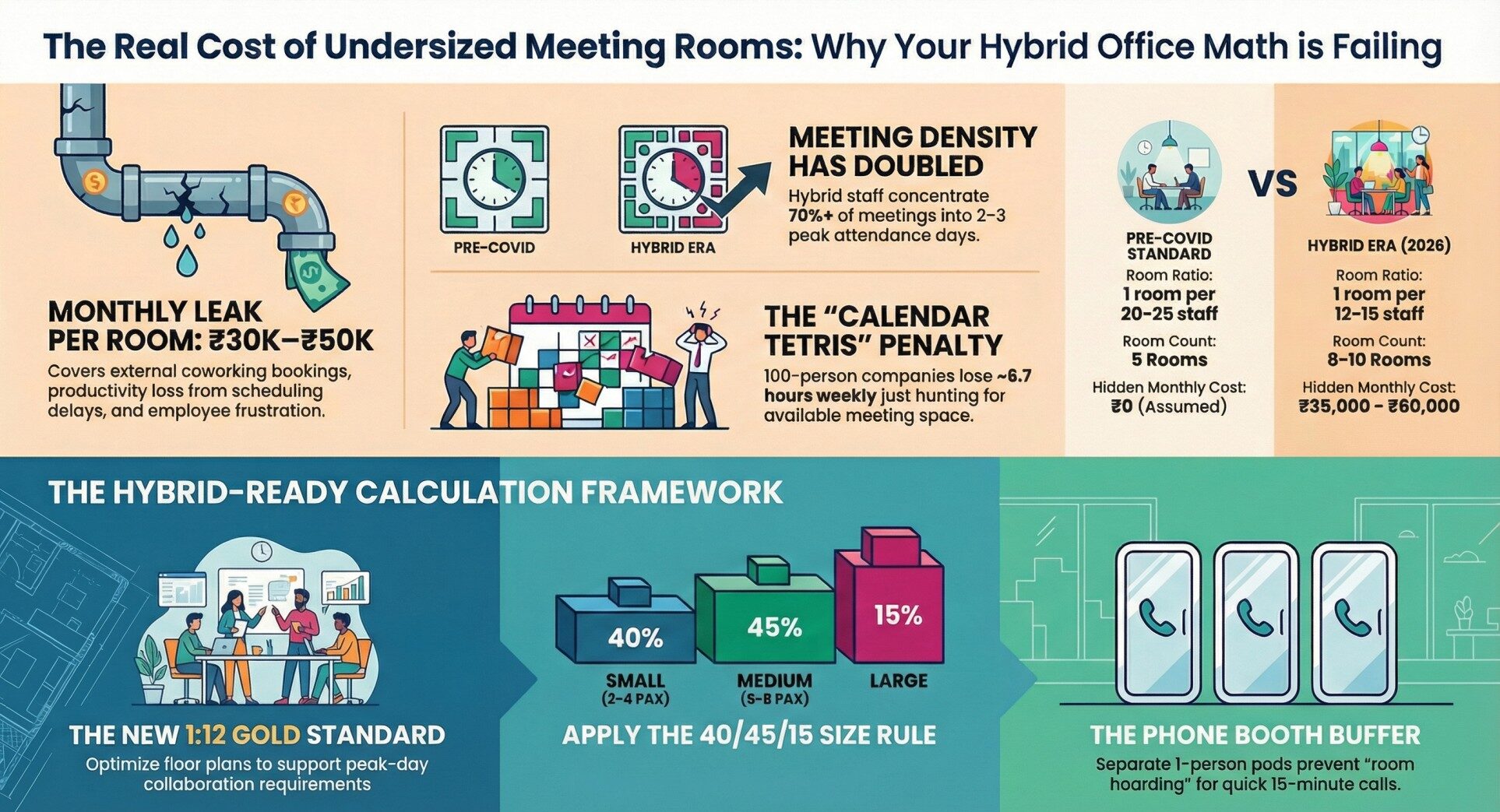
Teams book coworking space, hotel conference rooms, or café meeting spaces to get work done. In Gurgaon, basic coworking meeting rooms cost ₹500-800 per hour. If you’re short 2 meeting rooms and teams external book 40 hours monthly, that’s ₹20,000-32,000 monthly.
This shows up in team expense reports, not real estate budget, so it’s invisible when planning office space. But it’s real cost directly caused by inadequate internal inventory.
Productivity loss from scheduling conflicts:
When meeting rooms are always booked, scheduling meetings takes longer. You’re playing calendar Tetris trying to find a room when all stakeholders are available. Meetings get delayed 15-30 minutes while people hunt for space or set up makeshift meeting areas.
For a 100-person company averaging 20 meetings weekly, if each loses 20 minutes to scheduling conflicts, that’s 400 minutes (6.7 hours) weekly. At average ₹500 hourly salary cost, that’s ₹3,350 weekly or ₹14,500 monthly in pure productivity cost.
Meeting quality degradation:
When proper rooms aren’t available, meetings happen in noisy open areas, reception zones, or corner desks. Audio quality suffers (bad for remote participants). Privacy is compromised (problem for sensitive discussions). Focus is harder (ambient noise and visual distractions).
This is harder to quantify but affects decision quality, remote team inclusion, and client perception. A pitch meeting held in a noisy corner versus proper conference room changes outcomes.
Combined, being short 2-3 meeting rooms costs ₹35,000-60,000 monthly through external bookings and productivity loss. That’s ₹4.2-7.2 lakhs annually—enough to justify better upfront space planning.
The Meeting Room Calculation Framework
Here’s how to actually calculate meeting room requirements for your Gurgaon office in 2026:
Step 1: Determine meeting frequency and types
Track current meeting patterns (if existing office) or estimate based on team structure:
Weekly team standups and syncs
Client/prospect meetings
1-on-1s between managers and reports
All-hands and department meetings
Interview panels and candidate meetings
Training and onboarding sessions
For a typical 100-person company:
15-20 recurring team meetings weekly
8-12 client/prospect meetings weekly
20-25 1-on-1s weekly
2-3 larger gatherings monthly
4-6 interview panels weekly
Total: ~50-60 meetings weekly requiring dedicated space
Step 2: Calculate concurrent meeting demand
Not all meetings happen simultaneously. Calculate peak concurrent demand:
For 100-person company with 50 weekly meetings:
Peak attendance days (Tue/Wed/Thu): 70-80% of team present
Meetings concentrated in core hours (10am-5pm): 7 hours
Average meeting duration: 45-60 minutes
Average: 8-10 meetings happening concurrently during peak hours
Concurrent demand: 8-10 meeting rooms needed during peak periods
Step 3: Factor in room sizes needed
Different meetings need different room sizes:
2-4 person (1-on-1s, small team check-ins): 40% of meetings
5-8 person (team meetings, client calls): 45% of meetings
9-12 person (department meetings, panels): 12% of meetings
12+ person (all-hands, training): 3% of meetings
For 8 concurrent meetings:
3 small rooms (2-4 person)
4 medium rooms (5-8 person)
1 large room (9-12 person)
Total: 8 rooms across size distribution
Step 4: Add buffer for flexibility
15-20% buffer prevents constant 100% utilization:
8 rooms × 1.2 = 9.6 → round to 10 rooms
Step 5: Hybrid-adjusted formula
For companies with hybrid policies:
Meeting rooms needed = (Peak office attendance ÷ 12) × 1.2
For 100-person company with 75 peak attendance:
75 ÷ 12 = 6.25 → round to 6
6 × 1.2 buffer = 7.2 → round to 7-8 rooms
Compare to pre-COVID formula (headcount ÷ 20):
100 ÷ 20 = 5 rooms
Hybrid model needs 40-60% more meeting room density than pre-COVID.
Industry-Specific Variations
Meeting room requirements vary by business type:
Tech/Product companies:
Heavy collaboration culture (agile standups, sprint planning, design reviews)
Formula: Peak attendance ÷ 10
100-person company: ~8-10 rooms
Consulting firms:
Constant client meetings, internal strategy sessions
Formula: Peak attendance ÷ 12
100-person company: ~7-8 rooms
Finance/Professional services:
Compliance, confidentiality requirements drive meeting room use
Formula: Peak attendance ÷ 14
100-person company: ~6-7 rooms
Sales-heavy organizations:
Pitch meetings, prospect calls, deal reviews
Formula: Peak attendance ÷ 11
100-person company: ~7-8 rooms
GCC operations often need the highest meeting room density (1 per 8-10 employees) because they coordinate across time zones and run intensive collaboration.
Meeting Room Types and Size Distribution
Don’t just count total rooms—plan the right mix:
Small rooms (2-4 person) – 30-40% of inventory:
1-on-1s, manager check-ins, phone booths
~50-80 sq ft each
Most heavily utilized, need sound isolation
Medium rooms (5-8 person) – 45-50% of inventory:
Team meetings, client calls, small project sessions
~100-150 sq ft each
Workhorse rooms, need good AV
Large rooms (9-12 person) – 10-15% of inventory:
Department meetings, panels, workshops
~180-250 sq ft each
Less frequent use but critical for key activities
Extra-large rooms (12+ person) – 5% of inventory:
All-hands, training, presentations
~300+ sq ft
Often double as event/social space
For 8 total meeting rooms:
3 small (2-4 person)
4 medium (5-8 person)
1 large (9-12 person)
This distribution matches actual usage patterns better than uniform-sized rooms.
Common Meeting Room Planning Mistakes
Mistake 1: Using pre-COVID ratios
“1 room per 20 employees” is outdated for hybrid workplaces. That guidance assumed people came to office for individual work. In 2026, they come for collaboration. Use 1 per 12-15 employees as baseline, adjusted for industry.
Mistake 2: Not accounting for peak vs average attendance
Planning for average daily attendance (50% of team) underestimates peak days. Tuesday-Thursday often see 70-80% attendance. Size meeting room inventory for peak, not average, or accept constant shortages on busy days.
Mistake 3: Making all rooms the same size
Eight 8-person rooms sounds efficient. But 40% of your meetings only need 2-4 people—they’ll still book the 8-person rooms because that’s what’s available. You effectively have fewer usable rooms because small teams waste large rooms. Size distribution matters.
Mistake 4: Ignoring phone booth needs
Quick calls don’t need full meeting rooms, but they need quiet private space. Without phone booths (1-person rooms), people book meeting rooms for 15-minute calls, reducing availability. Budget 1 phone booth per 15-20 employees separate from meeting room count.
Mistake 5: Skimping on AV infrastructure
Meeting rooms without good AV get avoided. Teams external book coworking space with better tech rather than use your room with bad screen sharing or awful audio. Every room needs: large display, camera, quality speakerphone, wireless screen sharing. Budget ₹40,000-80,000 per room for proper AV.
How Meeting Room Requirements Fit Into Space Planning
Meeting rooms affect total space and space per employee calculations:
For 100-person office:
Individual workstations: 100 seats × 50 sq ft = 5,000 sq ft
Meeting rooms: 8 rooms × average 130 sq ft = 1,040 sq ft
Support spaces: 800 sq ft
Circulation (25%): 1,700 sq ft
Total: ~8,500 sq ft
Meeting rooms are 12% of total space but create disproportionate operational issues when undersized.
If you’re in a build-to-suit situation, meeting room count and size distribution should be specified upfront based on your actual patterns, not generic building standards.
In managed office space, verify meeting room inventory matches your needs. Some providers offer 1 room per 20 employees (pre-COVID ratio). Others properly provision for hybrid usage. Ask specifically how many rooms of each size are available to your team.
The Total Cost of Occupation Impact
Undersized meeting room inventory increases TCO through:
Direct costs:
External coworking space bookings: ₹20-40K monthly
Lost productivity from scheduling conflicts: ₹15-25K monthly
Employee frustration affecting retention: Harder to quantify but real
Indirect costs:
Client perception (meetings in noisy corners vs proper rooms)
Remote team inclusion (bad AV reduces remote participation)
Decision quality (lack of private space for sensitive discussions)
Spending an extra ₹5-8 lakhs upfront to fit 2-3 additional meeting rooms in your layout saves ₹35-60K monthly in operating costs—payback in 10-14 months.
This is precisely the kind of operational planning failure that shows up months after move-in: the space looks great but doesn’t support how the business actually operates.
📥 RESOURCE: Access AIHP’s Seat & Space Planning Calculator to model meeting room requirements based on your team size, hybrid policy, and industry. The calculator includes meeting room sizing formulas, phone booth ratios, and total space recommendations.
Conclusion: Meeting Rooms Are Infrastructure, Not Amenities
Meeting rooms aren’t nice-to-have amenities. They’re critical infrastructure for hybrid work models where people come to office specifically for collaboration.
Under-provisioning meeting rooms is like under-provisioning internet bandwidth. You’ll manage—with workarounds, frustration, and hidden costs—but you’ll never operate efficiently.
The cost of getting this wrong shows up in monthly expense reports (external bookings), lost productivity (scheduling conflicts), and employee experience (constant friction finding space). These costs often exceed ₹50,000 monthly for a 100-person company, or ₹6 lakhs annually.
The fix is straightforward: use hybrid-appropriate ratios (1 room per 12-15 employees), plan proper size distribution (40% small, 45% medium, 15% large), and factor in peak attendance rather than average.
Companies planning office space in Gurgaon should calculate meeting room requirements early in space planning, not as an afterthought once layout is locked in.
For guidance on meeting room planning and space requirements for your team, get in touch with AIHP.