Most companies don’t struggle because they chose the wrong building.
They struggle because the building was never designed for how their teams actually work. The floor plate can’t accommodate the layout they need. The power infrastructure can’t handle their equipment load. The meeting room ratio doesn’t match their collaboration patterns. The HVAC zones don’t align with how teams cluster.
You end up fighting the space instead of using it.
Build-to-suit offices solve this by flipping the model. Instead of finding a building and adapting your needs to fit it, you start with how your business operates and design space around that reality.
This isn’t about custom paint colors or branded reception desks. It’s about fundamental infrastructure decisions that determine whether your office supports productivity or creates friction for the next five years.
What “Build-to-Suit” Actually Means (Not Just Custom Interiors)
The term gets misused. Companies think build-to-suit means picking finishes and furniture layouts. That’s just customization within an existing shell.
Real build-to-suit starts earlier—during core and shell design, before walls go up.
You’re specifying:
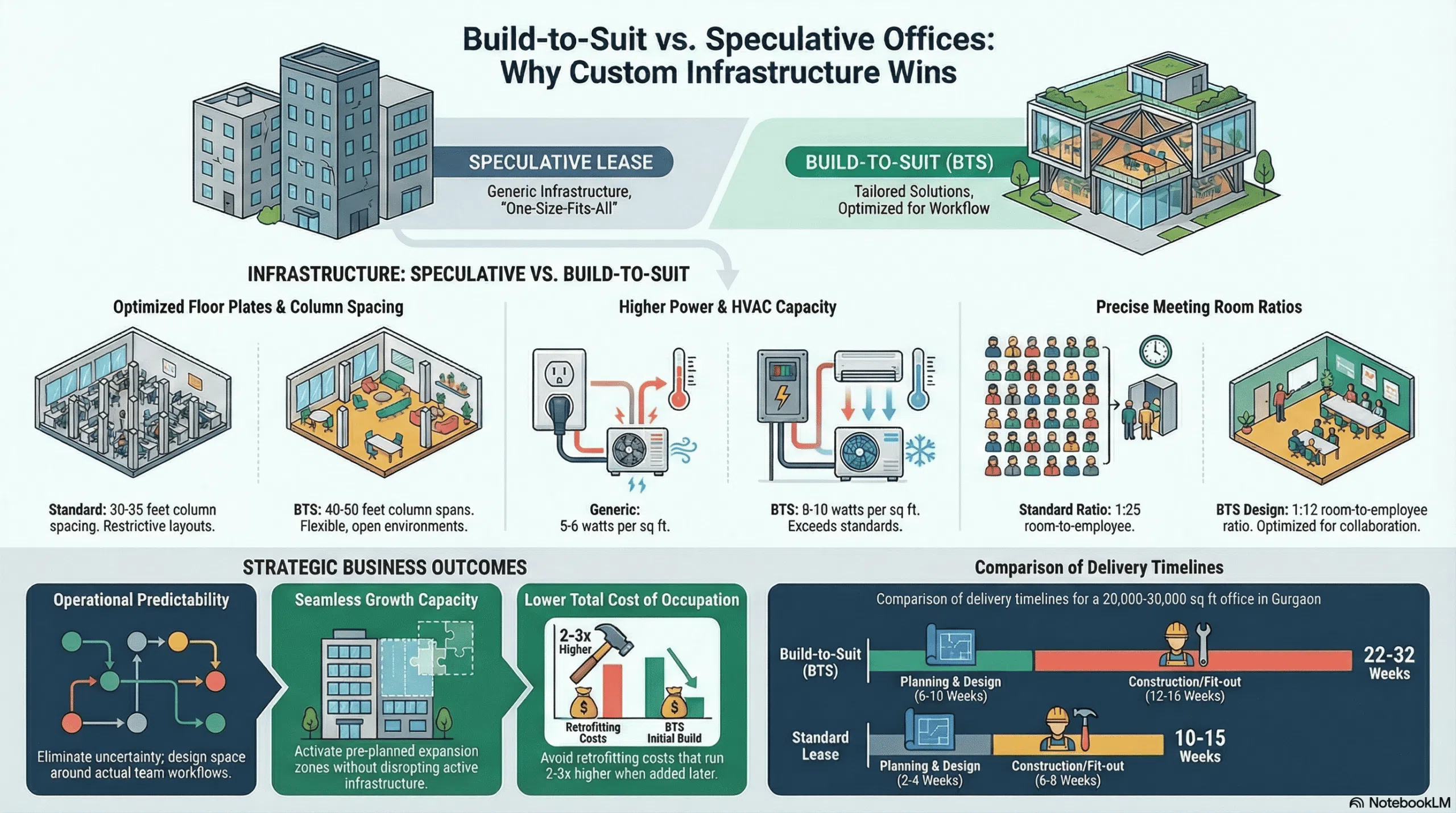
Floor plate dimensions and column spacing. Open floor plans need wider column spans. If you’re planning collaborative zones with minimal structural interruption, you need 40-50 feet between columns. Standard speculative buildings use 30-35 feet because it’s cheaper to build. That difference determines whether your layout actually works or requires constant compromise.
Electrical capacity and distribution. Tech companies need 8-10 watts per square foot. Standard offices are designed for 5-6 watts. If you’re running servers, high-density workstations, or equipment-heavy operations, you need infrastructure planned upfront. Retrofitting power capacity after construction costs 2-3x and creates permanent limitations.
HVAC zones and capacity. Your team clusters in specific areas during collaboration days. Conference-heavy zones need different cooling than quiet focus areas. Server rooms need dedicated climate control. Build-to-suit lets you zone HVAC based on actual usage patterns, not generic office assumptions.
Meeting room inventory and placement. If your culture runs on meetings—client pitches, design reviews, daily standups—you need one meeting room per 12-15 employees, not the standard one per 25. Build-to-suit lets you plan this ratio from the start instead of discovering the shortage after move-in.
Vertical transportation and circulation. How many elevator banks do you need for your headcount and floor distribution? Where do stairwells go to encourage movement between floors? These aren’t cosmetic choices—they determine daily traffic patterns and employee experience.
Future expansion capacity. If you’re growing 30% annually, you need space designed for phased expansion. Can you add 50 more workstations without reconfiguring infrastructure? Can you convert flex space to permanent teams? Build-to-suit builds this capacity in from day one.
The difference between build-to-suit and “nice finishes in a standard shell” is that build-to-suit makes permanent infrastructure decisions match your actual operational needs.
Difference Between Build-to-Suit and Speculative Offices
Speculative offices—what most companies lease—get built for the broadest possible tenant base.
Developers can’t predict who’ll lease the space, so they design for generic office use. Average power loads. Standard HVAC. Floor plates that work for most layouts but aren’t optimized for any specific one. Meeting room counts based on what “typical” tenants need.
This makes perfect sense from the developer’s perspective. They’re building for maximum flexibility across potential tenants.
But it creates mismatches for actual occupants.
Your specific needs don’t align with generic assumptions:
Tech companies need power capacity that speculative buildings don’t provide. Financial services firms need more enclosed spaces for regulatory compliance than open floor plans allow. Consulting firms need higher meeting room ratios than standard buildings offer. GCCs need infrastructure that supports 24/7 operations and global collaboration.
You end up compromising. You can’t run the equipment you need because power isn’t there. You can’t create the layout you want because the floor plate doesn’t support it. You’re short on meeting rooms because the building wasn’t designed for your collaboration intensity.
Then you spend money retrofitting solutions—adding power, building out rooms, reconfiguring HVAC. You’re paying twice: once for the infrastructure you got, again for the infrastructure you actually need.
Build-to-suit inverts this:
You start with your operational requirements. How many people, doing what kind of work, with what equipment and collaboration patterns? What does the space need to support today and in two years?
Then you design infrastructure around those specific needs. You’re not adapting to a generic shell—you’re building exactly what your operation requires.
The trade-off is that build-to-suit requires more upfront planning and typically longer timelines than just leasing available space. But you get predictable outcomes instead of hoping a standard building happens to match your needs.
Why Enterprises Prefer Predictable Outcomes Over Cheap Rent
When you’re scaling a 200-person team, cheap rent stops being the primary concern.
Here’s what actually costs money: Discovering six months after move-in that the space doesn’t work. That meeting rooms are always booked. That the HVAC can’t handle peak loads. That you can’t add the equipment you need because power capacity maxes out.
Now you’re dealing with:
Productivity loss from space friction
Retrofit costs that run 2-3x what building correctly would have cost
Potential need to relocate sooner than planned
Employee frustration that compounds into retention issues
For enterprises, these downstream costs dwarf whatever you saved on rent by taking a cheaper speculative space.
Build-to-suit provides three things cheap rent can’t:
Operational predictability. You know the space will support your workflows because you designed it for those workflows. There’s no “hope this works” uncertainty. Meeting room counts, power capacity, climate control, layout flexibility—all specified for your exact requirements.
Growth capacity without disruption. You’ve built in expansion zones, additional infrastructure capacity, and layout flexibility from day one. When you add 40 more people, you’re activating planned expansion space, not scrambling to reconfigure an office that wasn’t designed for it.
Fewer operational surprises. The operational failures that plague generic fit-outs—acoustic problems, climate control issues, maintenance complexity—get addressed during design when they’re easy to fix, not after construction when they’re expensive.
Enterprise CFOs calculate total cost of occupation over 5-7 years. Rent is one line item. Productivity, retention, retrofit costs, and growth disruption are others. When you run the full calculation, build-to-suit often delivers better economics than “cheap” space that creates operational friction.
The companies choosing build-to-suit aren’t overspending on real estate. They’re buying operational certainty, which has measurable value when you’re scaling teams and can’t afford space to become a growth constraint.
CapEx, Timelines, and Operational Integration
Build-to-suit requires different financial and operational planning than standard leases.
Capital expenditure models vary:
Option 1 – Developer-funded: The developer builds to your specifications and amortizes costs into rent. You pay higher monthly rent but zero upfront CapEx. This works if you want to preserve capital for business operations rather than tying it up in real estate fit-out.
Option 2 – Tenant-funded: You fund the build-out directly. This gives you more control over specifications and vendor selection, but requires significant upfront capital. Makes sense if you’re treating the space as long-term infrastructure and want to optimize costs rather than preserve cash.
Option 3 – Hybrid: Developer handles core and shell to your specs, you handle interior fit-out. Splits the capital burden and gives you control where it matters most—your actual workspace design.
For managed office space in Gurgaon operating on build-to-suit models, the CapEx typically sits with the provider. You get the benefits of custom-spec’d space without capital tied up in construction.
Timeline realities:
Build-to-suit takes longer than leasing existing space. You’re adding design and construction time upfront.
Typical timeline for 20,000-30,000 sq ft build-to-suit:
Planning and design: 6-10 weeks
Approvals and permitting: 4-6 weeks
Construction: 12-16 weeks
Total: 22-32 weeks (roughly 5-7 months)
Compare to leasing existing space:
Tour buildings: 2-4 weeks
Negotiate lease: 2-3 weeks
Basic fit-out: 6-8 weeks
Total: 10-15 weeks (roughly 2.5-4 months)
You’re trading 3-4 months of additional timeline for a space that’s designed specifically for your needs. For companies that can plan ahead, this trade makes sense. For companies that need space immediately, it doesn’t.
Operational integration happens during design:
This is where build-to-suit delivers value that’s hard to quantify but very real.
Your IT team specifies network infrastructure placement during design. Your facilities team plans maintenance access. Your operations team maps workflow patterns and validates that the layout supports them. Your finance team confirms that capacity planning aligns with hiring forecasts.
Everyone who’ll actually operate in the space has input before construction starts. Problems get solved when they’re easy and cheap to fix—on paper, during design—not after construction when changes cost 10x more.
The result is that when you move in, the space just works. IT infrastructure is where it needs to be. Maintenance can access systems without disrupting work. The layout supports actual workflow patterns. Growth capacity exists where you’ll need it.
This integration work happens either way. In speculative spaces, it happens after construction as retrofit and compromise. In build-to-suit, it happens during design as specification and planning.
When Build-to-Suit Makes Business Sense (And When It Doesn’t)
Build-to-suit isn’t universally superior to standard leases. It solves specific problems for specific company profiles.
Build-to-suit makes sense when:
You have predictable growth trajectory over 3-5 years. You know you’re going from 120 to 200 people. You can specify infrastructure for that expansion now and activate it as you grow. Build-to-suit lets you plan this capacity upfront rather than outgrowing space and relocating.
Your operation has specific infrastructure requirements. Tech companies with high power loads, financial services with compliance-driven space requirements, operations teams running 24/7 shifts, GCCs needing redundant systems for global operations. If your needs deviate significantly from standard office assumptions, build-to-suit solves problems that cheap rent can’t.
Relocation disruption costs more than the build-to-suit premium. Large teams with complex operations face high relocation costs. Moving 300 people means productivity loss, potential retention impact, vendor coordination complexity. If you’re likely to outgrow standard space and face another move in 3-4 years, build-to-suit that accommodates 5-7 years of growth reduces disruption.
Space friction affects your business model directly. If insufficient meeting rooms constrain your ability to run client pitches, inadequate power limits the equipment you can deploy, or poor layout reduces collaboration that drives your product development, space friction has measurable business impact. Build-to-suit eliminates this friction by designing for your specific workflow.
Build-to-suit doesn’t make sense when:
Your growth trajectory is highly uncertain. If you might scale from 50 to 150 people or you might pivot to 30 people, build-to-suit locks you into capacity assumptions that might not materialize. Flexible space models or shorter-term leases give you more adaptability.
You need space immediately. Build-to-suit timelines don’t work if you need to relocate in 60 days. Standard leases or ready-to-occupy managed offices solve immediate needs. Build-to-suit requires planning horizon.
Your space requirements are generic. If you’re running a team that fits standard office assumptions—moderate power loads, typical meeting room ratios, standard layouts—you won’t benefit much from build-to-suit customization. The premium doesn’t buy you material operational advantage.
Capital preservation is critical. If tying up capital in real estate fit-out constrains your ability to invest in product development, hiring, or growth initiatives, standard leases preserve flexibility. Build-to-suit (even developer-funded models with higher rent) commits more resources to real estate.
The decision framework is straightforward: Does custom-designed space solve operational problems that generic space creates, and do those problems cost more than the build-to-suit premium? If yes, build-to-suit makes economic sense. If no, standard space works fine.
How Gurgaon’s Market Enables Faster Build-to-Suit Delivery
Gurgaon has infrastructure advantages that compress build-to-suit timelines compared to other Indian metros.
Established developer ecosystem: Gurgaon has developers who’ve built hundreds of Grade A office projects. They understand enterprise requirements, have vendor relationships in place, and can move faster than developers in emerging markets learning as they go.
Pre-approved building systems: Many Gurgaon developers maintain pre-approved relationships with MEP (mechanical, electrical, plumbing) consultants, structural engineers, and core vendors. This cuts weeks off design and approval timelines because systems are standardized and regulatory relationships are established.
Available infrastructure capacity: Power, water, sewage, and telecommunications infrastructure in Gurgaon’s established commercial zones can handle new construction without requiring new grid connections or infrastructure upgrades. This eliminates delays that plague projects in areas with infrastructure constraints.
Regulatory familiarity: Local authorities in Gurgaon have processed thousands of commercial projects. Approval processes are predictable. Consultants know exactly what documentation is required. There’s less uncertainty and fewer surprise delays than in cities where commercial construction is less common.
Labor and material availability: Gurgaon’s construction ecosystem has deep labor pools and material supply chains. Contractors can staff projects without delays. Materials are readily available. Specialized vendors (raised flooring, glass partitions, HVAC) operate locally rather than requiring coordination from other cities.
The result: Build-to-suit timelines in Gurgaon that would take 9-12 months in emerging markets or tier-2 cities can happen in 5-7 months in established Gurgaon micro-markets like Udyog Vihar or Sector 32.
For companies evaluating build-to-suit, this timeline compression matters. The faster you can go from design to occupancy, the less disruption to business operations and the sooner you start getting value from the customized space.
Some managed office providers in Gurgaon advertise 60-day delivery timelines for build-to-suit spaces. This works because the core and shell already exists—they’re doing fit-out only, not ground-up construction. You get the customization benefits without full construction timelines.
What to Specify in Your Build-to-Suit Requirements
If you’re exploring build-to-suit, here’s what actually matters in your requirements document:
Power and data infrastructure:
Total electrical capacity (watts per sq ft based on equipment loads)
Number and placement of electrical panels
Generator backup capacity and what it needs to support
Network cabling pathways and riser locations
Redundancy requirements for critical systems
HVAC and climate control:
Zones based on actual team clustering and usage patterns
Capacity for peak occupancy, not average
Individual zone controls for different areas
Server room or equipment room dedicated cooling
Fresh air exchange rates (especially post-COVID)
Floor layout and structure:
Column spacing requirements for your planned layout
Floor loading capacity if you’re placing heavy equipment
Raised flooring for cable management (if needed)
Ceiling height requirements (especially if using overhead storage or specialized lighting)
Meeting room and collaboration space:
Total number needed based on team size and meeting culture
Size distribution (small huddle rooms vs large conference rooms)
Video conferencing infrastructure requirements
Acoustic treatment specifications
Placement relative to work zones
Growth and flexibility:
Swing space that can convert from flex use to permanent teams
Infrastructure capacity beyond day-one needs
Modular furniture systems that reconfigure as teams change
Cable and power access points in expansion zones
Operational access and maintenance:
Maintenance access panels for MEP systems
Storage for facility equipment and supplies
Loading dock or service elevator access
How often will systems need servicing and can it happen without disrupting work
The more specific you can be upfront, the better the final outcome. Vague requirements like “we want flexible space” or “design for growth” don’t give developers enough guidance. Specific requirements like “we need 8 watts per square foot with capacity to add 20% more workstations in south zone within 18 months” create clear design parameters.
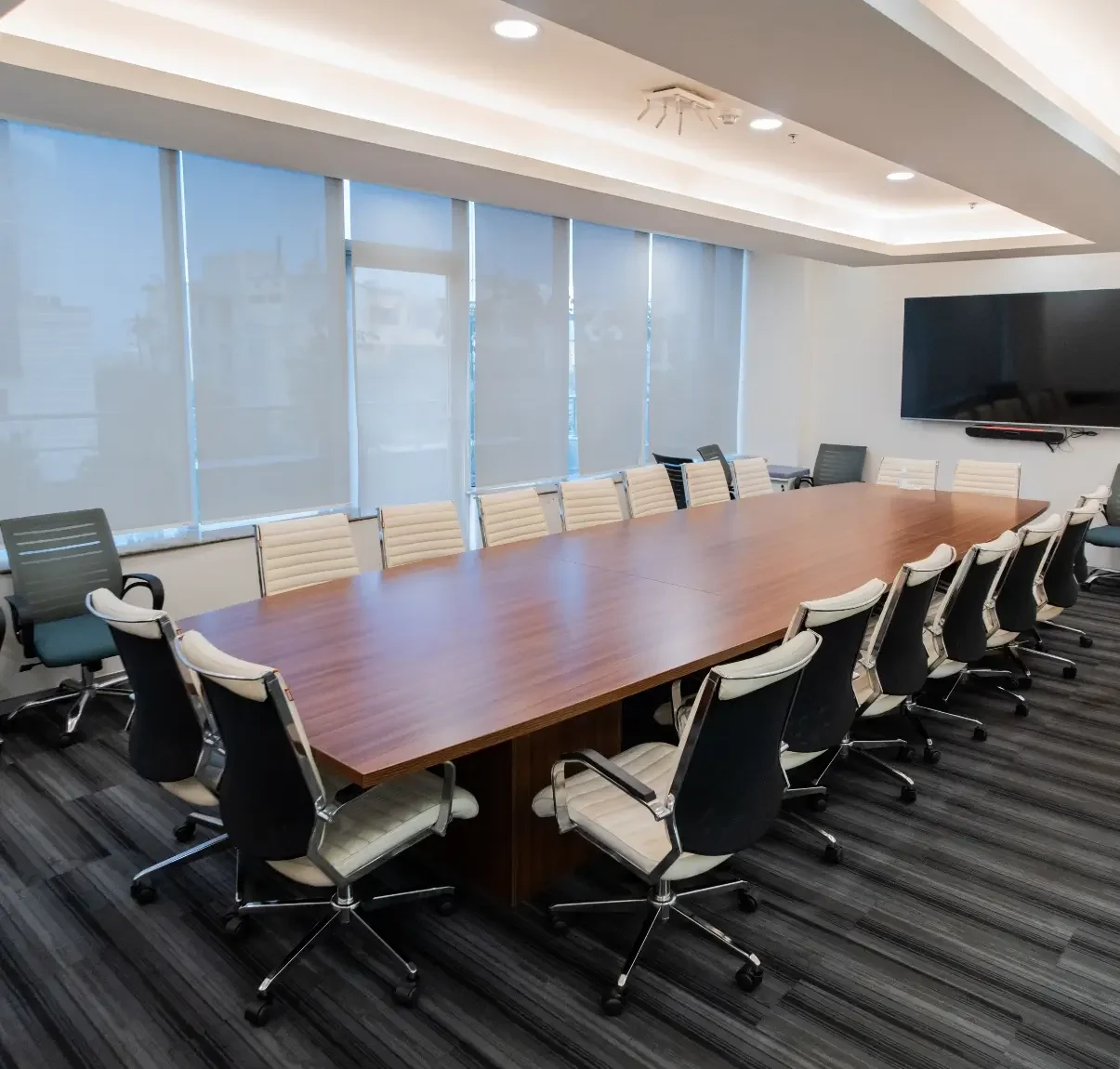
Build-to-Suit vs Managed Office Models
There’s overlap between build-to-suit and managed office models that’s worth clarifying.
Traditional build-to-suit: You work with a developer to design and construct space to your specs. You sign a long-term lease (typically 6-9 years). You handle or coordinate all operational aspects—facility management, maintenance, vendor relationships.
Managed office build-to-suit: The managed office provider designs and builds space to your specs, but also handles ongoing operations. You get customization without operational burden.
The managed model works well when:
You want build-to-suit customization but don’t want to manage facilities
You need faster timelines (managed providers often have existing shells ready for fit-out)
You want flexibility to scale up or down without renegotiating lease terms
Your core business is technology or services, not real estate operations
The traditional build-to-suit model works well when:
You’re large enough that managing your own facilities makes economic sense
You want complete control over every operational decision
You’re treating the space as long-term infrastructure (7+ years)
You have specific vendor relationships or operational preferences
Neither is universally better. It depends on whether you want to own the operational complexity of running your office or delegate it while retaining design control.
For companies evaluating both, the key question is: Does managing office operations create value for your business, or is it overhead that distracts from your core focus?
If it’s value, traditional build-to-suit gives you control. If it’s overhead, managed build-to-suit eliminates it while preserving the customization benefits.
Conclusion: Building for How You Actually Work
The offices that succeed long-term aren’t the ones that looked impressive in renders. They’re the ones where teams can actually get work done because the space was designed around how work happens.
Build-to-suit isn’t about luxury or status. It’s about operational fit. When infrastructure decisions match your actual business needs, space stops creating friction and starts enabling productivity.
For companies that have specific requirements, predictable growth, and can plan ahead, build-to-suit delivers better outcomes than hoping a generic building happens to work.
The premium you pay upfront—in time, planning effort, or cost—gets recovered through fewer surprises, less retrofit spending, and space that doesn’t constrain growth when you need to scale.
If you’re evaluating build-to-suit options in Gurgaon, get in touch with AIHP to discuss how to specify requirements that match your operational needs. For detailed frameworks on office planning and total cost analysis, download The Ultimate Guide to Managed Office Spaces.