Three years ago, ESG requirements in office leasing were aspirational. Companies talked about sustainability in annual reports but chose buildings based on rent and location.
That’s over.
In 2026, your office building’s environmental certifications affect whether institutional investors fund your growth, whether enterprise clients sign contracts, and whether experienced professionals accept job offers. ESG moved from the “values” column to the “business requirements” column.
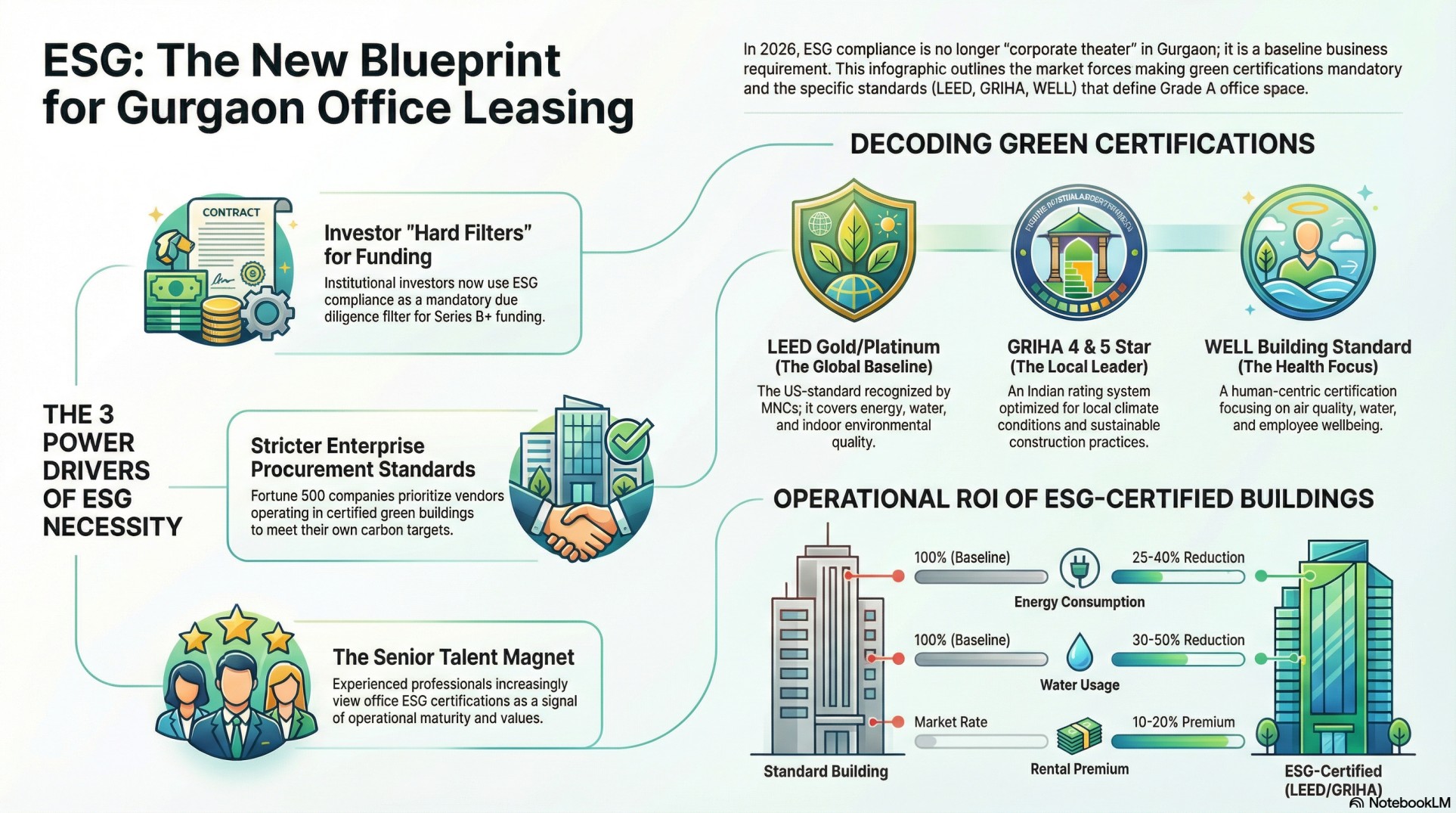
This shift happened fast. GCCs need LEED or GRIHA certifications because parent companies have carbon targets. Startups raising Series B encounter investor ESG due diligence that includes real estate footprint. Enterprise clients evaluating vendors check whether you operate in certified green buildings.
And in Gurgaon specifically, where developers are building to attract GCC tenants and institutional leases, Grade A increasingly means ESG-compliant by default.
Why ESG Suddenly Became Non-Negotiable
ESG wasn’t forced on companies by regulation or public pressure alone. It became business-critical because three separate forces converged.
Investor requirements hardened. Institutional investors—VCs, PEs, sovereign funds—added ESG criteria to investment decisions. Not as nice-to-have checkboxes, but as actual filters. Companies with poor ESG performance get passed over or face higher cost of capital.
For startups, this shows up in Series A and beyond. Early-stage investors might not care where your office is. Growth-stage investors do. They’re deploying larger checks and answering to LPs who track ESG metrics. Your real estate choices become part of investment due diligence.
Enterprise procurement got stricter. Large corporations—the Fortune 500 companies, global banks, consulting firms—now evaluate vendors on ESG compliance. When you’re bidding for enterprise contracts, your operational footprint matters.
If you’re in a building with no environmental certifications while your competitor operates from LEED Gold space, that becomes a vendor selection criterion. Not the only one, but enough to tip close decisions.
Talent expectations shifted. Senior engineers, product leaders, experienced executives—the people you’re competing for—increasingly consider ESG when evaluating offers. Not universally, but enough to affect acceptance rates.
A 32-year-old product manager choosing between similar offers will notice if one company operates from a certified green building while the other doesn’t. It signals values alignment and operational maturity.
These three forces don’t operate independently. They compound. Investors pressure companies on ESG. Companies respond by choosing certified buildings. Those buildings attract better talent. Better talent helps close enterprise deals. The cycle reinforces itself.
What ESG Actually Means in Office Real Estate
ESG is broad—Environmental, Social, Governance. In office real estate context, here’s what actually gets evaluated:
Environmental performance:
Building energy efficiency and carbon footprint
Water consumption and waste management
Green certifications (LEED, GRIHA, WELL Building)
Renewable energy usage (solar, wind)
Indoor air quality and ventilation
Sustainable materials in construction and fit-out
Social impact:
Employee health and wellbeing (natural light, ergonomics, air quality)
Accessibility for people with disabilities
Community impact (local employment, support services)
Safety protocols and emergency response
Commute accessibility (public transit, cycling infrastructure)
Governance and compliance:
Transparent environmental reporting
Third-party certification and auditing
Compliance with local environmental regulations
Corporate policies on sustainability
Tracking and disclosure of environmental metrics
In Gurgaon office leasing, environmental metrics dominate. When companies evaluate buildings, they’re looking at energy efficiency, certifications, and carbon footprint more than social or governance factors—though those matter for comprehensive ESG programs.
The certifications that carry weight in Indian commercial real estate:
LEED (Leadership in Energy and Environmental Design):
U.S. Green Building Council standard, globally recognized
Four levels: Certified, Silver, Gold, Platinum
In Gurgaon, LEED Gold is becoming baseline for Grade A+
Covers energy, water, materials, indoor environment
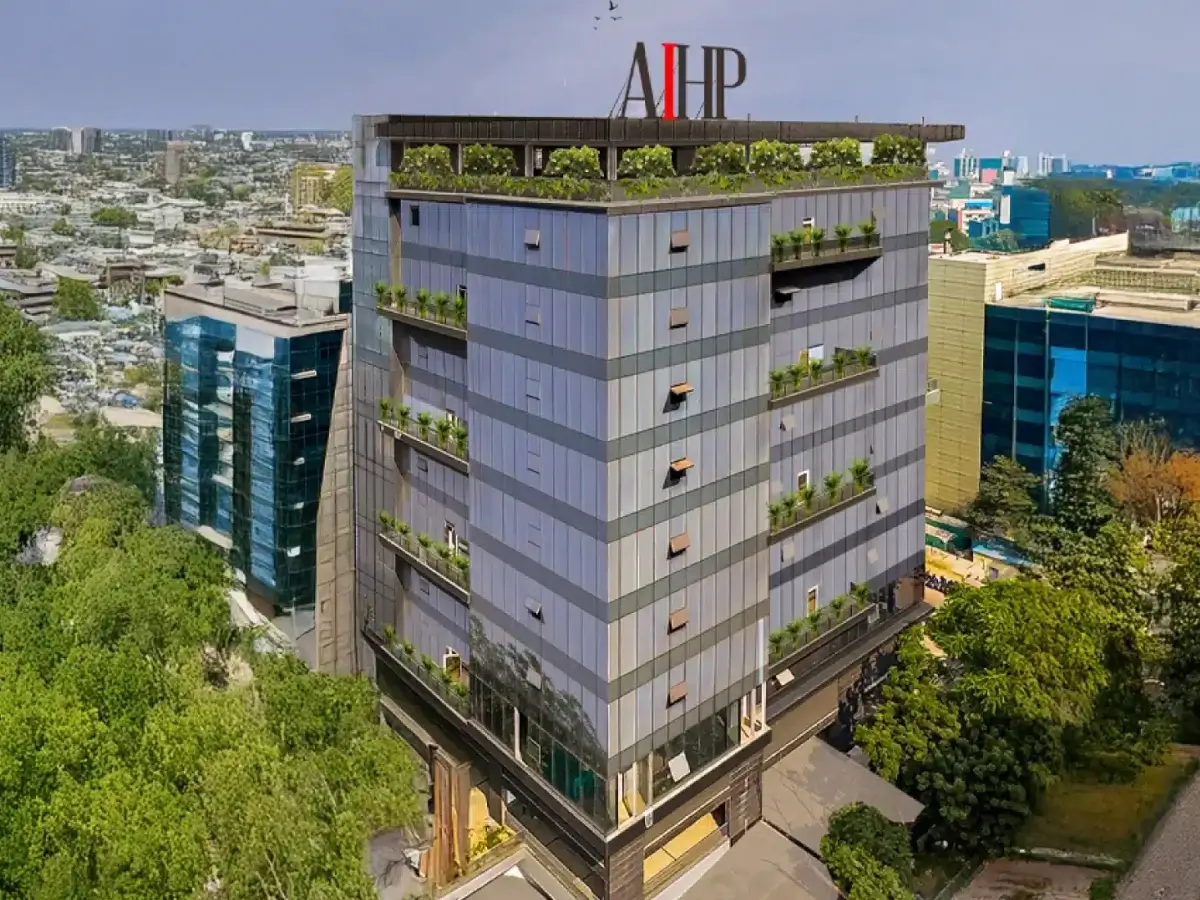
Buildings like AIHP Skyline in Sector 32 along NH-8 achieve LEED Gold certification, meeting international environmental standards
GRIHA (Green Rating for Integrated Habitat Assessment):
Indian green building rating system
More aligned with Indian climate and construction
Five-star rating scale, 4-star and above considered premium
Growing adoption in government projects, commercial following
Properties like AIHP Millennium in Udyog Vihar hold GRIHA 4-star certification, demonstrating commitment to climate-appropriate sustainable design
WELL Building Standard:
Focuses specifically on human health and wellbeing
Indoor air quality, water quality, nourishment, light, fitness
Complementary to LEED—some buildings pursue both
Particularly relevant for companies prioritizing employee experience
IGBC (Indian Green Building Council):
Indian rating system, adapts LEED framework
Gaining traction in commercial real estate
Platinum and Gold ratings carry similar weight to LEED
For companies evaluating office space in Gurgaon, LEED Gold or Platinum is most commonly specified. GCCs, enterprise tenants, and funded startups increasingly filter for LEED-certified buildings before evaluating other factors.
How Certified Buildings Differ Operationally
Green buildings aren’t just standard buildings with certificates. They operate differently in ways that affect daily experience.
Energy systems work smarter. LEED Gold buildings typically use 25-40% less energy than comparable standard buildings. This comes from:
High-efficiency HVAC systems with variable speed drives
LED lighting with occupancy sensors and daylight harvesting
Building management systems that optimize energy use in real-time
Insulated facades that reduce heating/cooling loads
Energy recovery ventilation that recycles conditioned air
Properties along NH-8 like AIHP Skyline (LEED Gold) and AIHP Millennium (GRIHA 4-star) implement these systems to deliver measurable energy efficiency for tenants. You notice this as consistent climate control, lower operating costs passed through rent or CAM charges, and fewer system failures because equipment isn’t constantly maxed out.
Air quality is measurably better. Certified buildings meet stricter indoor air quality standards:
MERV 13+ filtration (captures smaller particles than standard MERV 8)
CO2 monitoring with automatic fresh air intake adjustment
Low-VOC materials in construction and furnishings
Regular air quality testing and disclosure
Dedicated outdoor air systems (not just recirculated air)
This translates to fewer sick days, better concentration, reduced respiratory complaints. Not dramatic day-to-day, but measurable over quarters.
Water systems conserve without compromising function. Low-flow fixtures, dual-flush toilets, rainwater harvesting, greywater recycling—these reduce water consumption 30-50% while maintaining user experience. In Gurgaon where water security is increasingly critical, this matters operationally.
Maintenance runs more predictably. Certified buildings require documented maintenance protocols, regular performance verification, and system monitoring. This means fewer surprises like sudden HVAC failures or water quality issues. Operational discipline is built into certification requirements.
Waste management is structured. Recycling programs, composting, construction waste diversion—certified buildings have systems in place rather than hoping tenants handle it themselves. For companies with their own ESG targets, this removes operational burden.
The gap between certified and non-certified buildings isn’t cosmetic. You’re getting infrastructure designed and operated to different standards, with performance verification and ongoing monitoring that standard buildings don’t require.

ESG Requirements from Different Stakeholder Groups
Different stakeholders care about ESG for different reasons and evaluate it differently.
Venture capital and private equity investors:
They’re reporting to their own investors (LPs) who increasingly demand ESG compliance across portfolios. For VCs investing in Series B+, office real estate becomes part of due diligence.
They want to see: LEED or GRIHA certification of your office building, carbon footprint calculation including real estate, ESG policy that covers office selection criteria, energy usage data (available from building management in certified spaces).
This isn’t universal across all VCs, but it’s standard for institutional investors deploying $10M+ checks. Ignore it, and you’ll get passed over by ESG-focused funds—which increasingly includes major players.
Enterprise clients and procurement teams:
Large corporations have vendor ESG requirements. When you’re bidding for enterprise contracts, procurement evaluates your operational footprint.
They want to see: Certifications of facilities where work gets performed, environmental reporting aligned with their standards, evidence of sustainable operations (which certified buildings provide), alignment with their carbon reduction commitments.
For consulting firms, enterprise software vendors, BPO operations—anyone selling to Fortune 500 companies—this affects win rates. You’re not automatically disqualified without certifications, but you’re at disadvantage against competitors who have them.
Talent, especially senior hires:
Experienced professionals evaluate companies holistically. Office space signals operational maturity and values alignment.
They notice: Whether your office is in a certified green building, air quality and natural light (which certified buildings do better), commute accessibility (ESG social component), whether the company takes sustainability seriously
This matters most for senior hires who have options. A 35-year-old director choosing between two offers will weigh ESG factors more than a 25-year-old early-career hire. As you compete for experienced talent, ESG becomes a differentiator.
Employees and internal stakeholders:
Once you’ve established ESG commitments publicly, employees expect follow-through. If your website talks about sustainability but you’re in a non-certified building, that’s visible hypocrisy.
Internal pressure comes from: Employee resource groups focused on sustainability, executives who need to report on ESG targets, HR teams measuring employee satisfaction (which correlates with workplace quality), operations teams tracking costs (certified buildings often have lower utility costs)
Companies can’t claim ESG leadership while operating from buildings that don’t meet basic environmental standards. The contradiction is too obvious.
The Cost Premium Reality
ESG-compliant buildings cost more. The question is how much, and whether the premium is justified.
Rental premium for certified buildings:
In Gurgaon’s Grade A market, LEED Gold or Platinum buildings command 10-20% premium over comparable non-certified space. A building at ₹100/sq ft might be ₹110-120/sq ft with LEED Gold certification.
That premium reflects:
Higher construction costs (better systems, materials, certifications)
Operating costs partially offset by efficiency but still higher
Demand from GCCs and enterprise tenants willing to pay
Limited supply of certified Grade A inventory
Whether this premium is worth it depends on your stakeholder requirements. If investors or clients demand it, you’re paying for access to capital or contracts, not just rent. The premium becomes cost of doing business at scale.
Operating cost offsets:
Certified buildings typically have 15-25% lower utility costs through energy and water efficiency. In buildings where utilities are passed through, this reduces your CAM charges over time.
The rent premium might be 15%, but your total occupancy cost only increases 8-10% after factoring in lower utilities and fewer operational surprises. Still more expensive, but less than headline rent suggests.
Value in recruiting and retention:
If ESG-compliant space helps you close one senior hire you’d otherwise lose, or retain two employees who’d leave for companies with better ESG practices, the cost justifies quickly. Replacement costs for senior talent run 6-12 months of salary. One avoided resignation pays for years of rent premium.
Client acquisition and investor access:
If operating from a certified building helps you close enterprise contracts you’d otherwise lose, or secure funding from ESG-focused investors, the premium is trivial compared to revenue impact.
A consulting firm that wins a ₹2 crore annual contract partly because their office meets client ESG requirements just paid for decades of rent premium on 10,000 sq ft.
The financial case for ESG-compliant space isn’t that it’s cheaper—it’s that the stakeholder access it provides generates returns that dwarf the cost.

What to Actually Verify When Evaluating Buildings
Not all “green” claims are equal. Some buildings market sustainability without backing it up. Here’s what to verify:
Ask for actual certification documents. LEED and GRIHA certifications are public and verifiable. Request the certification letter showing rating level and date. Buildings sometimes claim “LEED registered” or “pursuing GRIHA”—that means not certified yet. Only accept actual awarded certifications.
Check the certification level. LEED Certified is the lowest tier. LEED Gold or Platinum carry more weight. GRIHA 4-star or 5-star are premium. Don’t let “LEED certified” without specifying level pass as equivalent to Gold or Platinum.
Understand what’s certified. Core & Shell certification means the building structure is certified, but tenant fit-outs aren’t. Interior certification means specific spaces meet standards. Whole Building certification is most comprehensive. Know which parts of your space are actually certified.
Request performance data. Certified buildings track energy use intensity (EUI), water consumption, waste diversion rates. Ask for this data. If they can’t provide it, the certification might be expired or poorly maintained.
Verify it’s current. Some certifications require recertification every few years. A building certified in 2018 that hasn’t recertified might not meet current standards. Check cert date and whether it’s been maintained.
Ask about tenant improvement standards. Your fit-out affects environmental performance too. Some certified buildings require tenant improvements to meet green standards (low-VOC paint, sustainable materials, energy-efficient lighting). Know these requirements upfront.
Understand utility metering. Individual tenant metering means you pay for your actual consumption, incentivizing efficiency. Shared metering means you pay averages, losing direct benefit of efficient practices. Prefer buildings with individual metering if you’re focused on reducing costs.
When evaluating managed office space in Gurgaon, ask whether the building holds certifications and whether the managed space provider’s fit-out maintains those standards. Some providers operate in certified buildings but don’t maintain green standards in their own build-outs.
How to Position ESG in Your Real Estate Strategy
If ESG is becoming non-negotiable for your stakeholders, here’s how to integrate it into office planning:
Start with stakeholder requirements, not aspirations. Don’t guess what investors or clients want—ask them directly. Your Series A investor might not care. Your prospective Series B investors might require it. Find out before committing to space.
Build it into location criteria from the beginning. If you need LEED Gold certification, filter for it upfront rather than falling in love with a building then discovering it doesn’t meet ESG requirements. Treat certification as a hard requirement like square footage or location.
Factor ESG into total cost calculations. Don’t just compare headline rents. Model total occupancy cost including utilities, plus the value of stakeholder access. A ₹110/sq ft certified building that helps close funding or contracts delivers better ROI than ₹95/sq ft space that doesn’t.
Use ESG as a recruiting tool explicitly. Mention your certified building in job descriptions, include it in offer conversations with senior hires, feature it on careers pages. You’re paying premium rent—extract the recruitment value.
Track and report performance. If you’re in a certified building, use the performance data in investor updates, client presentations, and employee communications. Don’t just pay for ESG compliance—leverage it.
Plan for future requirements. ESG standards are tightening, not loosening. If you’re signing a 5-year lease, consider where requirements will be in 2029, not just 2026. Buildings without certifications will face increasing headwinds.
Consider managed office models. Managed office providers operating in certified buildings let you access ESG-compliant space without long-term leases. If you’re uncertain about growth or how ESG requirements will evolve, flexible models reduce commitment while maintaining compliance.
Conclusion: ESG Is Infrastructure, Not Marketing
Companies still treating ESG as marketing are getting outcompeted by companies treating it as infrastructure.
Your office building’s environmental performance affects operational costs, employee health, stakeholder access, and competitive positioning. That’s not values signaling—it’s business fundamentals.
The shift happened fast, but it’s not reversing. Investor ESG requirements are tightening. Enterprise procurement standards are rising. Talent expectations are increasing. Gurgaon’s building inventory is adapting—more developers are building to LEED or GRIHA standards because that’s what tenants require.
If you’re planning office space for the next 3-5 years, ESG compliance isn’t optional add-on. It’s baseline requirement for operating at scale.
For guidance on evaluating ESG-compliant office options in Gurgaon, get in touch with AIHP. For comprehensive frameworks on sustainable office planning and total cost analysis, download The Ultimate Guide to Managed Office Spaces.