In Gurgaon, choosing the wrong micro-market can cost more than choosing the wrong building.
Because commute patterns, talent access, and client proximity shape daily productivity far more than interiors do. A company struggling with retention in Cyber City might thrive in Udyog Vihar—not because the office changed, but because the location aligned with where employees actually live.
The three major business corridors—Cyber City, Udyog Vihar, and Golf Course Road—each serve fundamentally different business needs. This guide breaks down what actually matters when choosing between them: not prestige or building aesthetics, but hiring pools, commute realities, and operational fit
Why Micro-Market Selection Matters More Than Building Selection
Most companies approach office search backward. They tour buildings, compare amenities, negotiate lease terms—and only then realize the location creates daily friction their team can’t tolerate.
The pattern shows up consistently: employees leave jobs not because of compensation or culture, but because forty-five minutes each way, five days a week, slowly erodes energy and commitment. Recent analysis of Gurgaon office leasing patterns shows companies increasingly prioritize commute accessibility over building grade when evaluating locations.
Micro-market choice determines three things that buildings can’t fix:
Talent pool accessibility: Can you hire the people you need? Are they willing to commute to this location? Does proximity to residential clusters give you competitive advantage in recruiting?
Client perception and convenience: For client-facing businesses, does the address signal credibility? Can clients reach you easily? Does the surrounding ecosystem support business development?
Operational costs and flexibility: Beyond base rent, what’s the total cost of operating here? Can you scale up or down as needed? Does the infrastructure support your business model?
Get the micro-market wrong, and no amount of interior design fixes the underlying mismatch.
Cyber City: Premium Positioning for Enterprise-Scale Operations
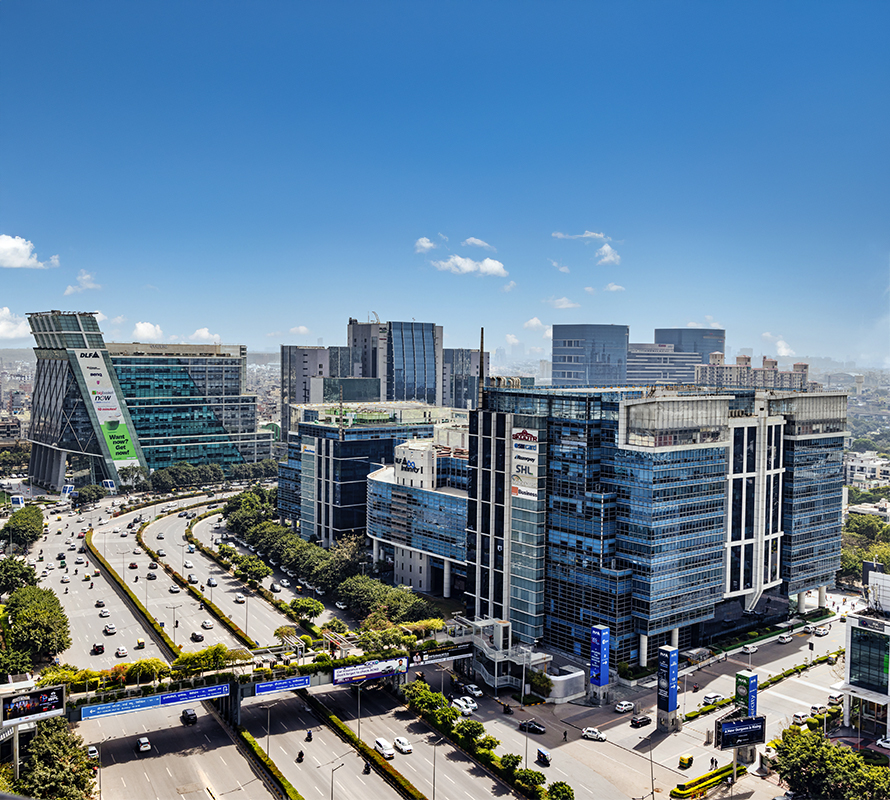
Cyber City represents Gurgaon’s premium enterprise district. This is where DLF built its flagship commercial towers, where Fortune 500 companies establish Indian headquarters, and where multinational presence concentrates.
What Cyber City Offers
Grade A+ Infrastructure: Buildings here meet international specifications for power redundancy, HVAC systems, fire safety, and seismic design. You’re getting institutional-quality real estate, not speculative development.
Enterprise Ecosystem: The surrounding environment includes business hotels, conference facilities, premium dining, and professional services infrastructure. When clients visit, everything they need sits within walking distance.
Brand Signal: The address itself carries weight. For consulting firms pitching to enterprise clients, financial services firms meeting institutional investors, or SaaS companies courting Fortune 500 buyers, Cyber City signals you’re playing at enterprise scale.
Transport Connectivity: Rapid Metro connects directly to major arterial roads. Commute access works well from South Delhi, Golf Course Road residential areas, and parts of South Gurgaon. International airport proximity matters for businesses with significant travel.
The Trade-Offs
Rental Premium: Office space in Cyber City commands ₹100-140 per square foot monthly, running 25-35% higher than comparable space in Udyog Vihar. For a 10,000 square foot office, that’s ₹2.5-3.5 lakhs additional monthly rent.
Commute Challenges from Key Residential Areas: While Cyber City connects well to South Delhi and Golf Course Road, employees living in Dwarka, Rohini, or West Delhi face 60-90 minute commutes during peak hours. If your hiring pool skews toward these areas, retention becomes difficult.
Limited Flexibility: Cyber City properties lean toward longer lease terms (5-9 years) with less flexibility on early exits or space modifications. The buildings are designed for stability, not rapid iteration.
Parking Costs: Premium parking charges add ₹3,000-5,000 per slot monthly, creating additional overhead for employee convenience.
Who Thrives in Cyber City
Client-Facing Professional Services: Consulting firms, investment banks, legal practices, and enterprise software companies where client meetings drive business development.
Multinational Headquarters: Global companies establishing Indian presence who need the address to match parent company standards and signal commitment to the market.
Large Enterprises with Stable Growth: Organizations past the high-volatility phase, with predictable headcount and established operational patterns. Companies that value infrastructure quality and ecosystem access over cost optimization.
Financial Services and Insurance: Firms where regulatory compliance, security infrastructure, and client confidence make premium positioning strategically valuable.
For companies where managed office space in Gurgaon needs to project enterprise credibility while maintaining operational flexibility, Cyber City’s Grade A+ buildings provide the positioning without requiring traditional 9-year lease commitments.
Udyog Vihar: Operational Efficiency and Metro Accessibility
Udyog Vihar represents Gurgaon’s operational backbone—an established industrial and commercial zone that’s evolved into a major employment hub. The area spans multiple phases (Udyog Vihar I through V), each with distinct characteristics but sharing core advantages: mature infrastructure, excellent metro connectivity, and significantly lower rental costs.
What Udyog Vihar Offers
Cost Efficiency: Rental rates in Udyog Vihar range from ₹60-85 per square foot monthly for Grade A space, running 30-40% below Cyber City rates. For cost-conscious operations, this translates to substantial savings over a 3-5 year lease term.
Metro Integration: Yellow Line connectivity serves multiple Udyog Vihar phases with dedicated stations. Employees commuting from Delhi, Dwarka, and North Gurgaon benefit from predictable, traffic-independent transit. This accessibility advantage shows up directly in hiring: candidates who would decline Cyber City roles due to commute challenges often accept equivalent positions in Udyog Vihar.
Operational Flexibility: The area accommodates diverse space requirements, from 3,000 square feet for growing startups to 50,000+ square feet for GCC operations. Building owners in Udyog Vihar typically offer more flexible lease structures and earlier exit clauses compared to Cyber City’s rigid terms.
Established Infrastructure: Unlike emerging micro-markets, Udyog Vihar benefits from decades of development. Power infrastructure, sewage systems, and telecommunications networks are mature and stable. You’re not betting on future development—the area already works.
The Trade-Offs
Brand Perception: Udyog Vihar doesn’t carry the same prestige signal as Cyber City. For businesses where client perception significantly impacts deal closure, the address matters. Enterprise buyers visiting for due diligence or strategic discussions notice the difference.
Mixed-Use Density: The area combines manufacturing, warehousing, and office spaces. This creates operational efficiency but means the surrounding environment feels industrial rather than corporate-polished. Lunch options and nearby amenities trend toward functional rather than premium.
Traffic Congestion: While metro access is excellent, road-based commutes face significant congestion during peak hours. Companies whose teams drive rather than use public transport don’t fully benefit from Udyog Vihar’s accessibility advantages.
Building Variability: Grade A buildings in Udyog Vihar vary more in quality than Cyber City’s standardized specifications. Due diligence on power backup, HVAC capacity, and structural quality becomes more important.
Who Thrives in Udyog Vihar
Technology Services and GCCs: Companies optimizing cost-per-seat metrics while maintaining quality workspace. Global capability centers focused on operational efficiency rather than client-facing positioning. Udyog Vihar’s established infrastructure particularly suits teams requiring stable, cost-effective operations at scale.
Back-Office and Operational Teams: Finance, HR, customer support, and operations centers where team productivity matters more than external brand positioning.
Growth-Stage Companies: Startups and scale-ups that have product-market fit but need to manage burn rate carefully. The 30-40% rental savings compound significantly over multi-year leases.
Large Teams Without Client Visiting Requirements: Organizations with 100-500+ employees where metro accessibility and cost efficiency drive location decisions more than prestige.
Metro-adjacent office space in Udyog Vihar solves a specific problem: how to provide quality workspace for large teams while maintaining unit economics that support sustainable growth.
Golf Course Road and Extension: Premium Talent Clusters
Golf Course Road and Golf Course Extension Road straddle residential and commercial, creating a live-work ecosystem that attracts young professionals, startup talent, and mid-senior executives who value work-life proximity. The area’s strategic advantage isn’t infrastructure or cost—it’s talent density.

What Golf Course Road Offers
Residential Proximity: High-end residential complexes like DLF Magnolias, Ireo Grand Arch, and numerous mid-range apartment buildings cluster along Golf Course Road and Extension. Your potential employees live here, reducing commute to 10-20 minutes for a significant portion of your hiring pool.
Talent Profile Match: The demographic skews toward exactly who growth companies want to hire: 25-35 year old professionals in product, engineering, design, and business roles. They chose Golf Course Road residential properties for lifestyle quality, and they’ll choose offices here for commute convenience.
Lifestyle and Amenities: The surrounding area includes premium gyms, restaurants, cafes, and retail—creating an environment where employees can handle personal tasks during work breaks. This matters more than companies realize: friction in daily logistics erodes workplace satisfaction.
Moderate Rental Costs: Pricing sits between Cyber City and Udyog Vihar, typically ₹75-100 per square foot monthly. You pay a premium over Udyog Vihar but avoid Cyber City’s top-tier costs while accessing distinct talent advantages.
Company Culture Signal: For startups and product companies competing on culture and workplace experience, Golf Course Road location signals you prioritize employee experience over corporate formality.
The Trade-Offs
Limited Accessibility from North and West: While Golf Course Road works brilliantly for employees living in South Gurgaon, it creates challenges for teams commuting from Dwarka, Rohini, or North Gurgaon. You’re optimizing for one talent cluster at the expense of another.
Fewer Large-Format Spaces: Unlike Cyber City’s purpose-built towers or Udyog Vihar’s industrial-scale buildings, Golf Course Road offers more fragmented inventory. Finding contiguous space for 200+ employees requires more extensive search.
Infrastructure Variability: Building quality varies significantly. Some properties meet Grade A standards; others are refurbished residential conversions with limited infrastructure. Due diligence on power, HVAC, and structural capacity becomes critical.
Traffic During Peak Hours: Road-based commutes face congestion, particularly during morning and evening peaks. The area lacks metro connectivity, making public transit challenging for employees not living nearby.
Who Thrives on Golf Course Road
Product and Design-Heavy Teams: Companies where talent competition centers on UX designers, product managers, and senior engineers. These roles cluster in Golf Course Road residential areas, making proximity a recruiting advantage.
Startups Post Series-A: Growth companies that have validated product-market fit and now compete for experienced talent. The location signals culture-forward thinking while remaining operationally practical.
Hybrid-First Organizations: Teams where most employees work 2-3 days weekly in office. When commute time matters more because it’s discretionary rather than mandatory, proximity becomes decisive.
Companies Prioritizing Retention: Organizations where keeping senior talent justifies premium location choices. If your team values short commutes and lifestyle quality, Golf Course Road location directly impacts retention.
The emerging availability of office space in Golf Course Extension Road provides newer Grade A inventory targeting exactly this segment: companies willing to pay moderate premiums for talent accessibility.
How to Actually Choose: Decision Framework
Stop touring buildings until you’ve answered these questions:
1. Map Your Employee Cluster Analysis
Current Team: Plot where your existing employees live on a map. Identify concentration zones. Calculate average commute time to each micro-market option.
Future Hiring: Where will you recruit in the next 18-24 months? Which residential areas host the talent profiles you need? Does your hiring strategy depend on pulling talent from competitors, or building teams from broader pools?
Commute Tolerance: Survey your team on commute preferences. Gurgaon employees will tolerate 30-45 minutes if the commute is predictable and the work justifies it. Beyond 60 minutes, you’ll face retention challenges regardless of compensation.
2. Classify Your Business Model
Client-Facing or Operations-Focused?
If clients visit regularly: Cyber City’s ecosystem and brand signal matter
If client-facing is virtual: Location prestige becomes secondary to operational fit
Brand Positioning or Cost Efficiency?
Enterprise positioning: Cyber City justifies premium
Growth efficiency: Udyog Vihar or Golf Course Road depending on talent strategy
Collaboration or Individual Work?
Teams coming to office for meetings and teamwork: Proximity to residential clusters (Golf Course Road) reduces friction
Teams executing individual work: Metro-accessible cost efficiency (Udyog Vihar) optimizes operations
3. Consider Commute Infrastructure Realities
Metro Accessibility:
Udyog Vihar excels for Delhi and Dwarka commuters
Cyber City works for South Delhi and South Gurgaon
Golf Course Road lacks metro, relying on road transport
Peak Hour Traffic Patterns:
Cyber City: Manageable with Rapid Metro
Udyog Vihar: Metro solves it; roads struggle
Golf Course Road: Congested unless you live nearby
Parking Requirements:
If 30%+ of employees drive: Add ₹3,000-5,000 per slot monthly to true costs
Cyber City parking is most expensive; Udyog Vihar most flexible
4. Evaluate Growth Flexibility Needs
Lease Term Comfort:
Stable growth: Cyber City’s 6-9 year leases work fine
Uncertain trajectory: Udyog Vihar’s flexibility reduces risk
Rapid scaling: Managed office space options across all three micro-markets provide expansion capacity without long-term commitment
Space Modification Ability:
Will you need to reconfigure layouts as teams evolve?
Do you expect significant team size changes within 2-3 years?
Does your business model require physical space experimentation?
If growth trajectory is uncertain, flexible space models across any micro-market beat rigid leases in premium locations.
Common Mistakes Companies Make
Mistake 1: Optimizing for Leadership Commute Over Team Commute
Founders and executives often live in South Delhi or Golf Course Road residential areas. They choose Cyber City or Golf Course Road offices because their commute is convenient—while 80% of the team struggles from Dwarka or North Gurgaon.
The fix: Map where your entire team lives, not just leadership. Weight location decisions by headcount distribution, not title hierarchy.
Mistake 2: Assuming All Grade A Buildings Are Functionally Equivalent
A Grade A building in Udyog Vihar serves different business needs than a Grade A building in Cyber City. The grade describes construction quality, not strategic fit.
The fix: Start with business model and talent strategy. Then find Grade A buildings in the micro-market that aligns with those requirements.
Mistake 3: Ignoring Hybrid Policy Impact on Location Value
With 3-day hybrid policies, location matters more because attendance is discretionary. Employees will skip office days if commute friction outweighs collaboration value.
The fix: For hybrid teams, prioritize locations within 30-40 minutes of residential clusters. The closer you are, the higher your actual office utilization.
Mistake 4: Overvaluing Prestige for Teams That Don’t Interface with Clients
Engineering, product, operations, and support teams rarely host client visits. Paying Cyber City premiums for these functions wastes capital that could fund hiring, tools, or growth.
The fix: Separate client-facing space needs from operational space needs. Many companies maintain a small Cyber City meeting/presentation space while housing operational teams in Udyog Vihar.
Mistake 5: Choosing Location Before Validating Hiring Pools
Companies pick locations, then struggle to hire because candidates won’t accept the commute. This is especially common when relocating from Bangalore or other cities.
The fix: Before committing to any location, run test recruitment for 3-4 key roles. Where do qualified candidates actually live? What commute times do they consider acceptable?
Conclusion: Match Location to Business Reality
The right Gurgaon micro-market isn’t determined by which area is “best”—it’s determined by which area matches your specific business model, talent strategy, and operational priorities.
Cyber City works when enterprise positioning, client visibility, and infrastructure quality justify premium costs. Udyog Vihar works when cost efficiency, metro accessibility, and operational scale drive decisions. Golf Course Road works when talent proximity and retention compete with moderate cost premiums.
The companies that succeed long-term make location decisions based on where their teams live and how their business actually operates—not based on where they think they should be.
If you’re evaluating office locations in Gurgaon, get in touch with AIHP to discuss how different micro-markets align with your specific requirements. For comprehensive market analysis and location strategy frameworks, download the Gurugram 2026 Office Market Outlook.