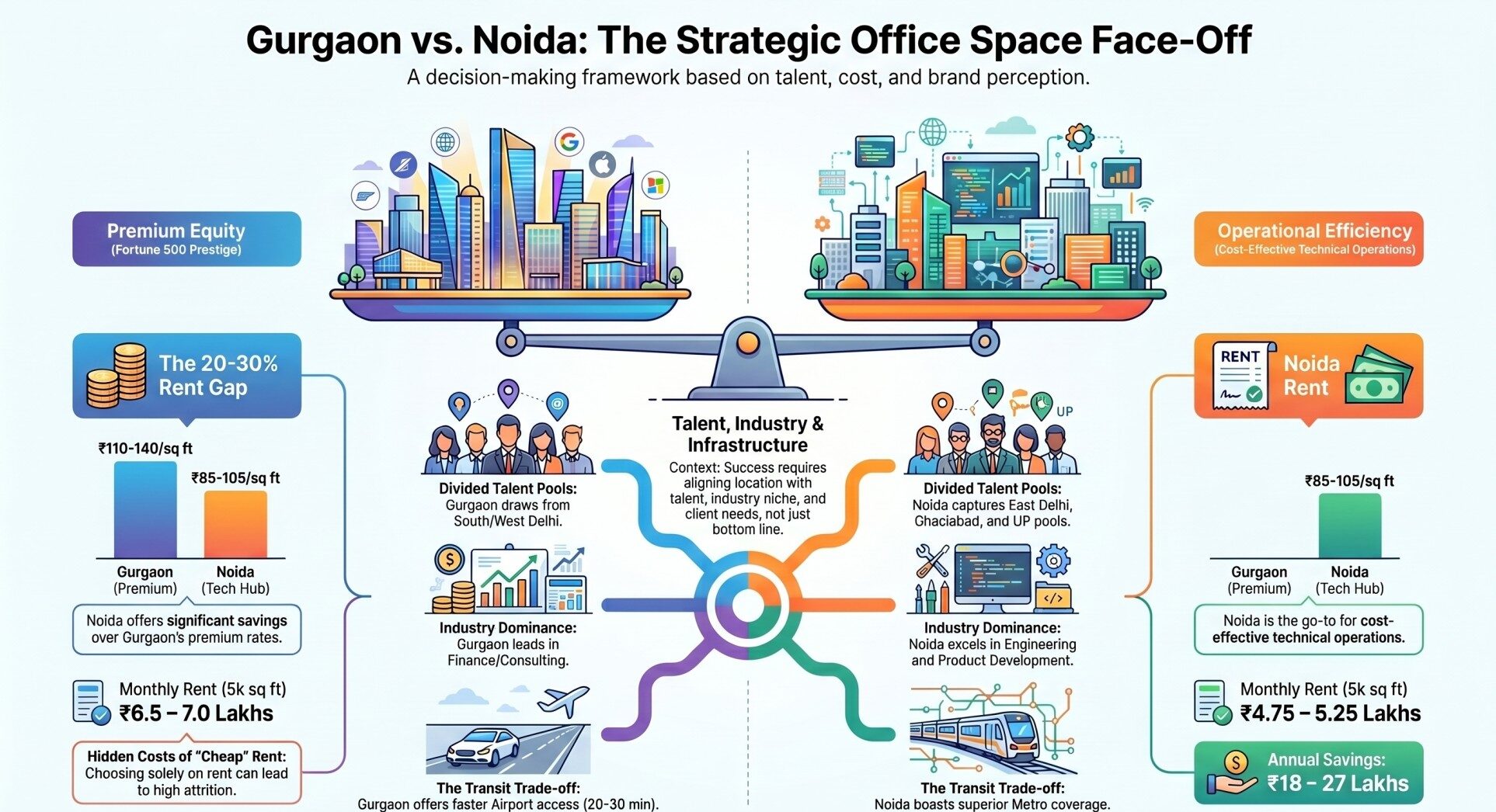
Companies expanding in NCR face a common decision: Gurgaon office space versus Noida. On spreadsheets, the choice looks simple—Noida’s ₹85-105/sq ft versus Gurgaon’s ₹110-140/sq ft saves 20-30% monthly rent.
In practice, rent is one variable in a complex equation involving talent geography, brand perception, infrastructure maturity, commute patterns, and industry positioning. Companies choosing purely on rent often discover hidden costs in talent acquisition, employee retention, or client perception.
Here’s the decision framework that matters.
Rent and Cost Comparison
Gurgaon Grade A office rent (2026):
– Cyber City: ₹130-140/sq ft
– Golf Course Road: ₹115-130/sq ft
– Udyog Vihar: ₹90-110/sq ft
– Sector 32: ₹95-115/sq ft
– Emerging corridors: ₹75-95/sq ft
Noida Grade A office rent (2026):
– Sector 62 (tech hub): ₹95-105/sq ft
– Sector 132 (expressway): ₹85-100/sq ft
– Sector 16: ₹90-100/sq ft
– Greater Noida West: ₹70-85/sq ft
– Film City: ₹80-95/sq ft
For 100-seat office (5,000 sq ft):
– Gurgaon (Udyog Vihar): ₹4.5-5.5 lakhs monthly
– Noida (Sector 62): ₹4.75-5.25 lakhs monthly (comparable)
– Gurgaon (Cyber City): ₹6.5-7 lakhs monthly
– Greater Noida West: ₹3.5-4.25 lakhs monthly (30-40% savings vs premium Gurgaon)
However, total cost of occupation extends beyond base rent. Utilities, commute costs, talent acquisition expenses, and productivity factors shift the comparison.
Talent Geography and Availability
This is often the deciding factor, not rent.
Gurgaon talent pools:
– South Delhi (GK, Defence Colony, Hauz Khas, Vasant Vihar)
– West Delhi (Rajouri Garden, Punjabi Bagh, Paschim Vihar)
– South-West Gurgaon residential sectors (47-57, DLF Phases)
– Faridabad (via NH-44, 30-40 minutes)
Noida talent pools:
– East Delhi (Mayur Vihar, Preet Vihar, Laxmi Nagar, Patparganj)
– North-East Delhi (Shahdara, Dilshad Garden)
– Noida residential sectors (50-78, 120-137)
– Ghaziabad and Greater Noida (via expressway)
– Faridabad (via DND, 45-60 minutes)
Overlap is minimal. Someone living in South Delhi faces 60-75 minute commute to Noida Sector 62. Someone in East Delhi faces similar journey to Gurgaon Cyber City.
This means:
If your current team or target talent lives in South/West Delhi → Gurgaon makes sense regardless of rent premium. Fighting against geography creates perpetual hiring and retention friction.
If your current team or target talent lives in East Delhi, Noida, or Ghaziabad → Noida makes sense. Rent savings are bonus; the real advantage is commute optimization.
Industry-specific talent concentrations:
Tech and product: Noida has deep engineering talent base (HCL, Adobe, Samsung, TCS in Sector 62-63). Gurgaon has consulting and enterprise software talent (Accenture, Deloitte, McKinsey alumni).
Finance and professional services:
Concentrated in Gurgaon (American Express, Citi, Deutsche Bank, EY, KPMG). Minimal presence in Noida.
BPO and operations: Both cities have large captive centers. Noida slightly edges due to lower operational costs.
Startups: Gurgaon has denser startup ecosystem (funded companies, co-working spaces, networking events). Noida has growing but smaller startup presence.
Infrastructure and Connectivity
Gurgaon:
– Metro: Yellow Line (Huda City Centre, Sikanderpur), Rapid Metro (Cyber City, Golf Course Road, Sector 55-56)
– Airport: 20-30 minutes from most office zones to IGI Terminal 3
– Highways: NH-48 (Delhi-Jaipur), Dwarka Expressway, Southern Peripheral Road
– Challenges: Traffic congestion on NH-48, limited east-west connectivity
Noida:
– Metro: Blue Line (Sector 15-18, 51-62), Aqua Line (Sector 51-148, connects to Greater Noida)
– Airport: 30-40 minutes from Sector 62 to IGI Terminal 3 via DND/Yamuna Expressway
– Highways: Noida-Greater Noida Expressway, DND Flyway, Yamuna Expressway, FNG Expressway
– Challenges: DND toll creates psychological barrier, limited direct connectivity to South/West Delhi
Both cities have comparable modern infrastructure. Gurgaon edges on airport proximity (matters for frequent business travelers). Noida edges on metro coverage (Aqua Line connects 29 stations vs Gurgaon’s limited rapid metro).
Brand Perception and Client-Facing Considerations
Gurgaon brand positioning:
Cyber City, Golf Course Road, and MG Road carry premium brand equity. When Fortune 500 companies establish India offices, default choice is Gurgaon. This creates perception feedback loop—being in Gurgaon signals “we’ve arrived.”
For client-facing businesses (consulting, professional services, enterprise sales), Gurgaon address facilitates:
– Client visits (easier for South Delhi/Gurgaon-based enterprise clients to visit your office)
– Brand perception (Cyber City address on business card carries weight)
– Ecosystem networking (more industry events, conferences, executive networks in Gurgaon)
Noida brand positioning:
Sector 62 has become recognized tech hub (HCL, Samsung, Adobe presence legitimizes it). But outside tech sector, Noida doesn’t carry same brand premium.
For operational businesses (product development, engineering, back-office, support functions), Noida is perfectly viable. You’re optimizing for cost and talent, not client perception.
However, if you’re selling to enterprise clients or recruiting senior executives from premium companies, Noida address can be subtle disadvantage. Candidates compare offers from Google Gurgaon versus YourCompany Noida, location factors into perception.
Operational Maturity and Amenity Ecosystem
Gurgaon:
– 25+ years of corporate office development
– Dense restaurant, retail, and hospitality ecosystem
– Multiple Grade A+ buildings with international operators
– Established residential neighborhoods nearby
– Mature service provider ecosystem (gyms, daycare, medical, etc.)
Noida:
– Rapid development in last 10-15 years
– Growing but less dense amenity ecosystem
– Newer buildings with modern infrastructure
– Residential development often separate from commercial zones
– Service ecosystem developing but less mature than Gurgaon
Gurgaon offers richer amenity ecosystem around office zones. Cyber City has 50+ restaurants within 1km, 3 hospitals within 3km, multiple gyms, retail, and entertainment. Noida Sector 62 has growing options but lower density.
This matters for employee experience. If your team values lunch variety, after-work activities, nearby services, Gurgaon delivers more. If they’re focused on work and commute home, Noida’s newer infrastructure suffices.
Regulatory and Administrative Environment
Both Gurgaon (Haryana) and Noida (Uttar Pradesh) have different regulatory environments:
Business registration and compliance:
Gurgaon (Haryana) has streamlined processes for business registration, labor compliance, and regulatory approvals. Noida (Uttar Pradesh) has improving but historically more bureaucratic processes.
Tax and incentives:
Noida offers tax incentives for certain industries (IT, electronics manufacturing) under UP government’s investment policy. Gurgaon has fewer state-level incentives but more established ecosystem for corporate operations.
For most service businesses (tech, consulting, finance), regulatory difference is minimal. For manufacturing or businesses seeking state incentives, Noida may have edge.
Decision Framework: When to Choose Gurgaon vs Noida
Choose Gurgaon when:
Your talent lives in South/West Delhi or Gurgaon:
Geography trumps rent. If 60%+ of current team or target hiring pool lives in South/West Delhi, fighting geography costs more than rent savings.
Brand perception matters significantly:
Client-facing businesses (consulting, professional services, enterprise sales) benefit from Gurgaon’s premium positioning. Cyber City or Golf Course Road address carries weight in client perception and candidate attraction.
You need mature amenity ecosystem:
Teams that value dense restaurant/retail/service options, networking events, and executive ecosystem prefer Gurgaon’s 25-year developed infrastructure.
Finance or professional services industry:
Industry concentration in Gurgaon creates network effects. Easier to hire from competitor down the street, attend industry events, access specialized service providers.
Airport proximity is critical:
Frequent business travel to US/Europe/Asia benefits from Gurgaon’s 20-30 minute airport access versus Noida’s 30-40 minutes (saves 20-30 hours annually for frequent travelers).
Choose Noida when:
Your talent lives in East Delhi, Noida, or Ghaziabad:
If majority of current team or target hiring pool lives east of Yamuna, Noida optimizes commute and talent access.
Cost optimization is priority:
20-30% rent savings (₹1.5-3 lakhs monthly for 100-seat office) compounds over lease tenure. For cost-conscious operations or back-office functions, this matters.
Tech and engineering focus:
Deep engineering talent pool in Sector 62-63. Ecosystem of tech companies creates hiring and collaboration advantages. GCC operations often find Noida’s tech ecosystem aligned with needs.
Operational vs client-facing:
Product development, engineering, support operations where client visits are rare. Optimizing for talent and cost rather than brand perception.
You value newer infrastructure:
Noida’s recent development means newer buildings with modern HVAC, power, and amenities. Some Gurgaon buildings are 15-20 years old requiring higher maintenance.
Hybrid Strategy: Why Some Companies Choose Both
Large companies (500+ employees) sometimes operate in both cities:
Gurgaon: Client-facing teams (sales, consulting, executive leadership), finance, HR
Noida: Product engineering, development centers, back-office operations, support
This optimizes each function for its needs:
– Client-facing teams get Gurgaon’s brand premium and client accessibility
– Engineering teams get Noida’s talent pool and cost efficiency
– Company captures benefits of both ecosystems
However, this only makes sense at scale (150+ employees minimum). Below that, operational overhead of managing two locations outweighs benefits.
What About Emerging Alternatives?
Greater Noida and Greater Noida West:
₹70-85/sq ft rent (30-40% below Gurgaon). Rapidly developing infrastructure. However, 45-60 minute commute from Delhi creates talent challenges. Works for companies hiring locally from Greater Noida/Ghaziabad residential markets.
Gurgaon emerging corridors (Dwarka Expressway, Sohna Road, SPR):
Covered in detail separately. Offer Gurgaon ecosystem proximity at Noida-like pricing (₹75-95/sq ft). Maturity timeline 3-5 years.
📥 RESOURCE:
Download the Gurugram 2026 Office Market Outlook for detailed NCR market analysis including Gurgaon and Noida supply pipelines, rent trends, and tenant migration patterns between cities.

Conclusion: Location as Talent and Perception Strategy
Gurgaon versus Noida isn’t rent comparison—it’s strategic choice about talent access, brand positioning, and operational priorities.
Gurgaon offers premium positioning, South/West Delhi talent access, mature ecosystem, and brand equity. You pay 20-30% premium for this. Worth it if geography, perception, or client access matter.
Noida offers cost efficiency, East Delhi/UP talent access, modern infrastructure, and growing tech ecosystem. You save 20-30% monthly rent. Worth it if operational focus, engineering talent, or cost optimization are priorities.
The wrong choice based purely on rent creates perpetual friction—either in talent acquisition (can’t hire from wrong geography), employee retention (team facing long commutes), or client perception (address doesn’t match positioning).
The right choice aligns location with where your team lives, who you need to hire, how clients perceive you, and what matters most to your business.
For companies evaluating both cities and needing guidance on which aligns with specific business model, talent strategy, and growth plans, get in touch with AIHP.