On 27 May 2026, the Haryana government gazetted its Global Capability Centre Policy 2026. Five years in force. Clear thresholds. Layered incentives that stack across setup, scale, and sustained operations.
If you’re evaluating Gurgaon for a GCC — or expanding one already running there — this policy changes the financial calculus. Not because it makes every GCC viable. Because for companies that qualify, the incentive stack materially reduces operational cost, particularly in years one through ten.
The numbers matter. India’s 1,700-plus GCCs generated approximately USD 64 billion in export revenue in FY24 — close to 1% of India’s GDP, according to NASSCOM’s GCC sector analysis. 170 new GCC setups were recorded in 2025 alone. The market is moving fast, and states are competing hard for a share of it. Haryana’s 2026 policy is its most substantive entry into that competition to date. Here’s what it actually offers — and what companies setting up in Gurgaon should know before they sign a lease.
Why Gurgaon Remains the GCC Capital of North India
Before the policy detail, context. The policy is a reason to choose Haryana. Gurgaon is the reason to choose Gurgaon specifically.
Gurgaon hosts the highest concentration of GCCs in North India by a significant margin. The talent pool is unmatched in the NCR: engineering graduates from Delhi University and IIIT Delhi within metro reach, experienced technology professionals from the existing IT/ITeS ecosystem, and a professional services talent base in consulting, BFSI, and finance that has accumulated over 25 years of corporate development. As explored in the GCC office requirements guide, this talent density is the primary driver of GCC location decisions — not policy, not rent.
Three other factors reinforce the thesis. IGI Terminal 3 is 20-30 minutes from Gurgaon’s main commercial zones — important when global leadership teams need regular access to the India centre. Existing GCC ecosystem density creates lateral talent mobility and benchmark data that helps newer GCCs hire and retain. And Gurgaon’s commercial real estate market has now developed enough supply, across enough price points, that GCC scale operations — 100 to 2,000+ seats — can be accommodated with 60-day delivery timelines.
The Haryana GCC Policy 2026 adds a financial layer on top of what was already a strong operational case.
Haryana GCC Policy 2026: The Incentives That Matter
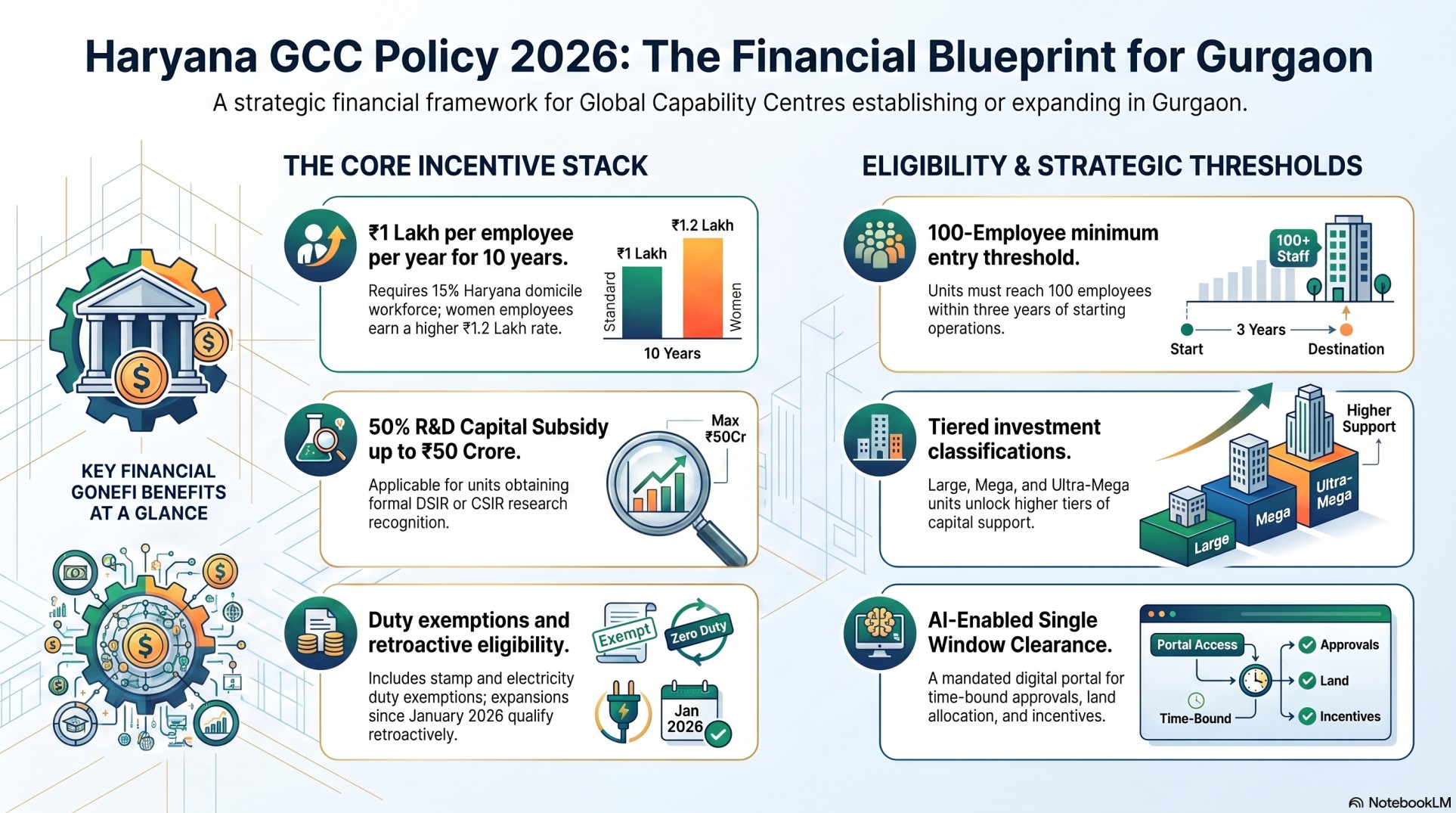
The policy does not rely on a single headline number. It stacks incentives across four categories. Here’s what each one means in practice.
1. CAPEX and OPEX Reimbursements
Capital expenditure support covers eligible costs for setting up GCC operations. Operational expenditure reimbursement covers ongoing running costs. Both are location-differentiated: Gurgaon qualifies for support, but the policy explicitly provides higher tiers for other Haryana districts to encourage balanced regional development.
Practical implication: if Gurgaon is the operational necessity — due to talent, client access, or existing employee base — the CAPEX/OPEX support is real but not at the policy’s maximum tier. Factor this into financial modelling rather than assuming top-tier benefits automatically apply.
The policy also covers stamp duty reimbursement on property purchases and electricity duty exemptions in designated development blocks — costs that add up significantly at GCC scale.
2. Employment Generation Subsidy: ₹1 Lakh Per Employee Per Year
This is the policy’s most commercially significant benefit for most GCC operators.
Companies where more than 15% of total workforce consists of Haryana local employees receive ₹1 lakh per employee per year for 10 years. Employees must have at least one year of continuous employment and valid ESI/PF numbers. Women employees attract an enhanced rate of ₹1.2 lakh per employee per year.
The math on this: a GCC operating 500 employees for 10 years with qualifying local hiring ratios receives ₹50 crore in employment subsidies over the decade. That is not a rounding error. It is a material reduction in net operational cost that changes the return profile of the GCC investment.
Two conditions to understand. First, the 15% Haryana domicile threshold — which requires five years of permanent Haryana residence by the employee. Second, the subsidy floor: ₹48,000 per annum when average monthly salary is below ₹48,000, which protects smaller operations from being ineligible due to salary level.
3. R&D Support: 50% Capital Subsidy Up to ₹50 Crore
For GCCs establishing DSIR or CSIR-recognised R&D centres, the policy provides 50% capital subsidy on eligible capital costs, distributed in five annual instalments, up to ₹10-50 crore. Operational cost reimbursement of 50% up to ₹2 crore per year stacks on top.
Separately, the policy reimburses 50% of internship stipends up to ₹15,000 per month for 50 interns annually — a targeted tool for building early talent pipelines through industry-academia partnership.
This R&D provision is the policy’s clearest signal that Haryana wants high-value innovation centres, not just service delivery back-offices. GCCs building product development, data science, AI, or engineering research functions have a financial incentive to formalise those R&D activities under DSIR/CSIR recognition.
4. Regulatory Reform: AI-Enabled Single Window Clearance
The policy establishes a Single Window 2.0 facilitation portal — AI-enabled — in Gurgaon for approvals, land allocation, and incentive access. The history of Indian industrial policy is littered with single-window systems that didn’t actually work. The 2026 version’s effectiveness will be proven in implementation, not in gazette notification.
What is known: time-bound approvals are mandated. Dedicated investor facilitation teams are provided. And the political intent to make the system function is evidenced by the policy’s overall design quality — more rigorous and specific than earlier Haryana investment frameworks.
Policy Incentives at a Glance
| Incentive Category | Benefit | Key Condition |
| Employment Subsidy | ₹1L/employee/year for 10 years | >15% Haryana domicile workforce |
| Women Employment | ₹1.2L/employee/year for 10 years | Enhanced rate for women employees |
| R&D Capital Subsidy | 50% of eligible cost, ₹10-50Cr | DSIR/CSIR-recognised R&D centre |
| R&D Opex Reimbursement | 50% up to ₹2Cr/year | DSIR/CSIR-recognised R&D centre |
| Internship Support | 50% of stipend up to ₹15K/month | Up to 50 interns per annum |
| Stamp Duty | Reimbursement on property purchase | Policy-designated units |
| Electricity Duty | Exemption in dev blocks | Designated development blocks |
| Night Shifts (Women) | 3 shifts permitted with safety provisions | Transport and safety mandated |
Who Qualifies: Entry Thresholds to Know
The policy is not open to all. Entry thresholds are specific and should be assessed before building financial projections around the incentive stack.
- Minimum threshold: 100 employees on payroll or contract with ESI/PF numbers within 3 years of commencing operations
- Large unit threshold: ₹125 crore fixed capital investment, OR ₹50 crore with 500 direct employees
- Mega unit threshold: ₹400-700 crore fixed capital investment, OR ₹125 crore with 1,250 direct employees
- Ultra-mega threshold: ₹1,500-6,000 crore fixed capital investment
Two provisions worth noting. First, existing GCC units expanding operations on or after 1 January 2026 are eligible — this is not a new-entrant-only policy. If you already operate a Gurgaon GCC and are scaling, you may qualify retroactively for investments made in the 12 months before 27 May 2026. Second, the phasing of hiring and investment relative to policy thresholds matters for incentive capture — a 90-seat GCC that reaches 100 employees in month eight unlocks a different benefit profile than one that reaches it in month thirty-six.
What to Read Carefully Before Assuming Full Benefits
The policy is substantive. It also has three features that companies should understand before building financial models around maximum benefits.
Gurgaon Gets Lower Tiers Than Other Haryana Districts
The policy is explicitly designed to incentivise GCC investment in non-Gurugram Haryana — Panchkula, Hisar, Ambala, and other districts receive higher capital support tiers. This reflects a balanced regional development objective.
For companies where Gurgaon is operationally non-negotiable — due to existing talent base, client proximity, or executive preference — this doesn’t change the conclusion. But it does mean Gurgaon GCCs should model the mid-tier rather than top-tier CAPEX/OPEX reimbursements when projecting incentive value.
Domicile Compliance Has Teeth
The Haryana domicile definition requires five years of permanent residence. The 15% domicile threshold triggers the ₹1 lakh per employee per year subsidy. If a GCC operates primarily with talent from Delhi, Noida, or other NCR locations — which is common for engineering and technology roles in Gurgaon — hitting the 15% threshold requires deliberate hiring from Haryana residential populations.
This is achievable, not impossible. But it needs to be factored into workforce planning from day one, not treated as a natural outcome of Gurgaon hiring.
Execution Fit Is as Important as Policy Fit
Most GCC policy benefits in India require diligent documentation, time-bound filings, and sustained compliance across the incentive period. The employment subsidy runs for 10 years. The R&D capital subsidy disburses over 5 annual instalments. Missing filing windows or failing to maintain qualifying employment ratios risks partial or full forfeiture of benefits.
The policy value is real. Capturing it requires operational discipline that should be built into the GCC’s administrative structure from launch, not retrofitted after incentives are announced.
Why Gurgaon Wins the GCC Location Argument Regardless
The policy tilt toward non-Gurugram districts is a real feature. Here is why most GCCs still choose Gurgaon.
The talent argument is decisive. Gurgaon’s IT, engineering, BFSI, and consulting talent pool is the densest in North India. A GCC at 500 seats needs to hire 500 qualified people within a reasonable timeframe — often 12-18 months. That is only achievable in markets where the talent pool is deep enough to absorb rapid hiring without driving up salary benchmarks by 30-40% through scarcity. Panchkula and Hisar cannot yet offer this at scale for most technology and professional services functions.
The ecosystem argument compounds the talent one. Gurgaon’s density of existing GCCs creates lateral movement — experienced talent who understand global operating models and have previously worked in high-performance GCC environments. As JLL India’s GCC sector research notes, GCC clusters create self-reinforcing talent ecosystems where concentration attracts more concentration. Gurgaon is already that cluster in North India.
Airport access seals the argument for companies where global leadership visits India operations regularly. IGI Terminal 3 in 20-30 minutes is a daily operational reality for Gurgaon GCCs. For Panchkula, the same journey is 45-60 minutes. That compresses over time into meaningful friction for senior leadership schedules.
From Policy to Operational Reality: The Workspace Decision
Policy incentives reduce the cost of running a GCC. Workspace determines whether it can actually function.
GCC setup failures in Gurgaon rarely happen because the policy wasn’t favourable. They happen because the space wasn’t ready when hiring started, because fit-out quality didn’t match the brand standards of a global company, because the building’s power or internet infrastructure failed under load, or because expansion didn’t happen smoothly when headcount grew past original projections.
These are solvable problems when workspace planning starts at the same time as policy evaluation. The GCC office requirements guide covers what multinational companies actually require from Gurgaon office space: power density for high-performance workstations, internet specifications for international collaboration, floor plate efficiency for dense seating configurations, and building infrastructure capable of operating 24/7 for follow-the-sun operations.
How AIHP Positions Your GCC for Success in Gurgaon
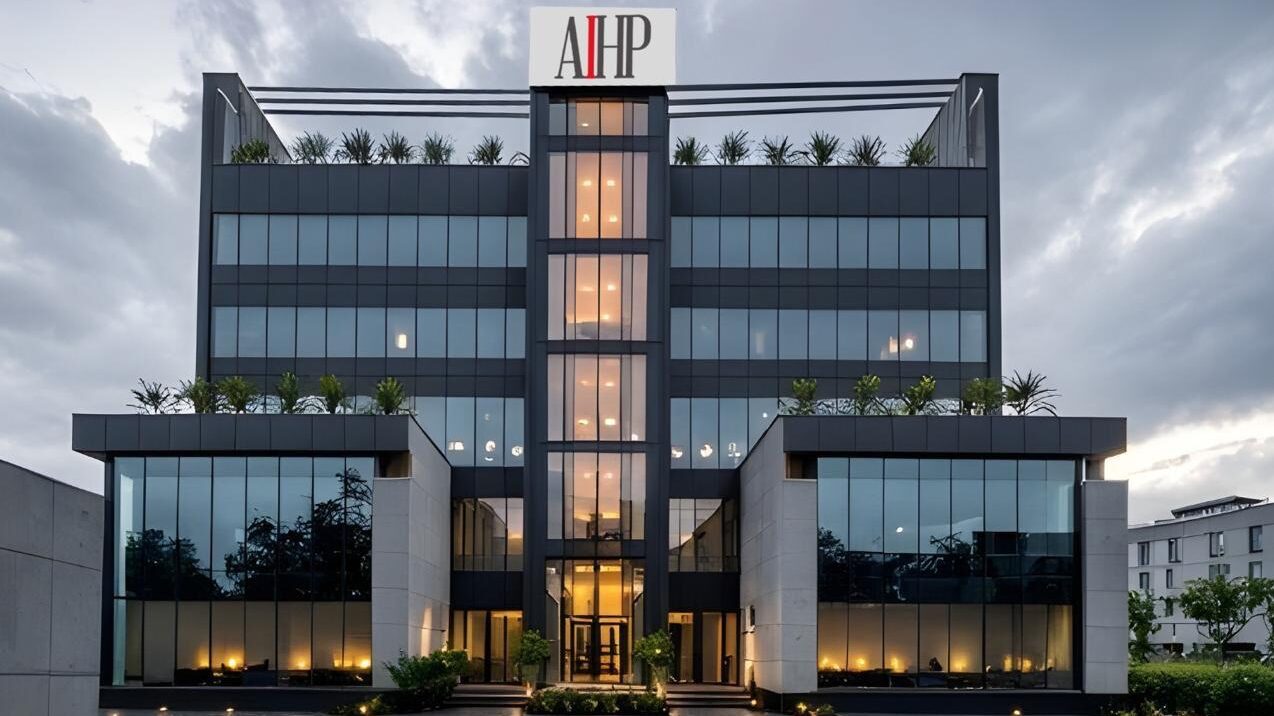
AIHP manages 30+ assets across Gurgaon. The buildings that matter most for GCC operations are concentrated in two owned portfolios: 10 buildings in Udyog Vihar and 6 buildings in Sector 32 — both with NH-48 access, HUDA City Centre metro proximity, and the infrastructure specifications that global companies require.
Zero Upfront CapEx Aligns with Policy Intent
The Haryana GCC Policy 2026 offers CAPEX reimbursements precisely because setup capital is a friction point for GCC launches. AIHP’s managed model eliminates the CapEx problem differently: fit-out, furniture, power backup, internet, housekeeping, and facilities management are all included in a single monthly per-seat fee. No upfront capital commitment on workspace. The capital that would have gone into office infrastructure stays in the business; in hiring, in technology, in the GCC’s actual operating function. This is what total cost of occupation analysis demonstrates: managed office frequently outperforms traditional lease over any 3-year horizon when all costs are accounted for.
60-Day Delivery Matches GCC Launch Timelines
GCC launches operate on hard timelines. When a global HQ approves the India centre, there is often a 90-180 day window to be operational before business pressure pushes the timeline back or leadership support erodes. A 60-day workspace delivery means the office is ready within that window. Traditional fit-out takes 16-20 weeks. The gap creates avoidable risk.
Build-to-Suit Within the Managed Model
AIHP’s build-to-suit capability means GCCs with specific requirements — dedicated server rooms, custom collaboration configurations, branded reception environments, specialised lab or studio spaces — can have these designed and built into the space without the CapEx burden of a traditional lease. AIHP absorbs the fit-out investment; the tenant occupies a purpose-built space on the managed per-seat model.
Scale Without Disruption
GCCs rarely stay at launch size. A centre that starts at 150 seats is typically at 300-400 seats within three to five years if the function succeeds. AIHP’s portfolio depth — 10 owned buildings in Udyog Vihar alone — means expansion happens within the same management framework, same building standards, same vendor relationships. No office move. No new lease negotiation. No disruption to operations that are finally running smoothly. This is the story behind the Daas Labs growth case: 85 to 200-plus seats across two AIHP buildings in Udyog Vihar without a single day of building disruption.
Udyog Vihar and Sector 32: The GCC-Ready Locations
For most GCC operations, the choice comes down to two AIHP corridors. Udyog Vihar offers the deepest portfolio (₹4,250-12,999/seat), the most established IT/ITeS ecosystem in Gurgaon, and the largest floor plates for high-density GCC configurations. Sector 32 offers NH-48 frontage, healthcare-adjacent positioning, and the premium mid-market address at ₹7,999-8,500/seat. Golf Course Extension Road — through AIHP One — serves GCCs that need premium positioning in South Gurgaon’s emerging corridor.

Conclusion: Policy + Location + Workspace
The Haryana GCC Policy 2026 is the most structured state-level GCC incentive framework Gurgaon has operated under. The employment subsidy alone — ₹1 lakh per qualifying employee per year for 10 years — is material at GCC scale. The R&D provisions signal a genuine push toward high-value operations rather than cost-arbitrage back-offices. The single-window clearance system, if it delivers on intent, removes a real friction point from India GCC setup.
But the policy is a financial input, not a location decision. Gurgaon wins on talent, ecosystem, airport access, and corporate density — factors that policy cannot manufacture in Panchkula or Hisar within the next five years. The policy makes Gurgaon more financially attractive. It doesn’t make anywhere else operationally equivalent.
The decision sequence for a GCC evaluating Gurgaon: validate operational fit (talent, ecosystem, timeline), model incentive capture honestly (threshold fit, domicile compliance, execution requirements), then solve the workspace question in a way that eliminates setup friction and preserves capital for the actual GCC function.
AIHP has been the workspace choice for GCC-scale operations in Gurgaon across both new launches and scaling companies. For companies evaluating the Haryana GCC Policy 2026 and wanting to understand how Gurgaon workspace fits their operating model, timeline, and budget, get in touch with AIHP.