Click on the Edit Content button to edit/add the content.
Blog
Sohna Road Office Space: Budget-Friendly Alternative to Golf Course Road
TL;DR (Brief article summary):
Sohna Road offers Grade A office space at ₹75-95/sq ft — 40-50% below Golf Course Road. SPR connectivity, growing IT and startup tenant density, and a planned metro extension are gradually closing the infrastructure gap. Best for cost-disciplined companies, funded startups, and back-office operations that want South Gurgaon positioning without Golf Course Road pricing.
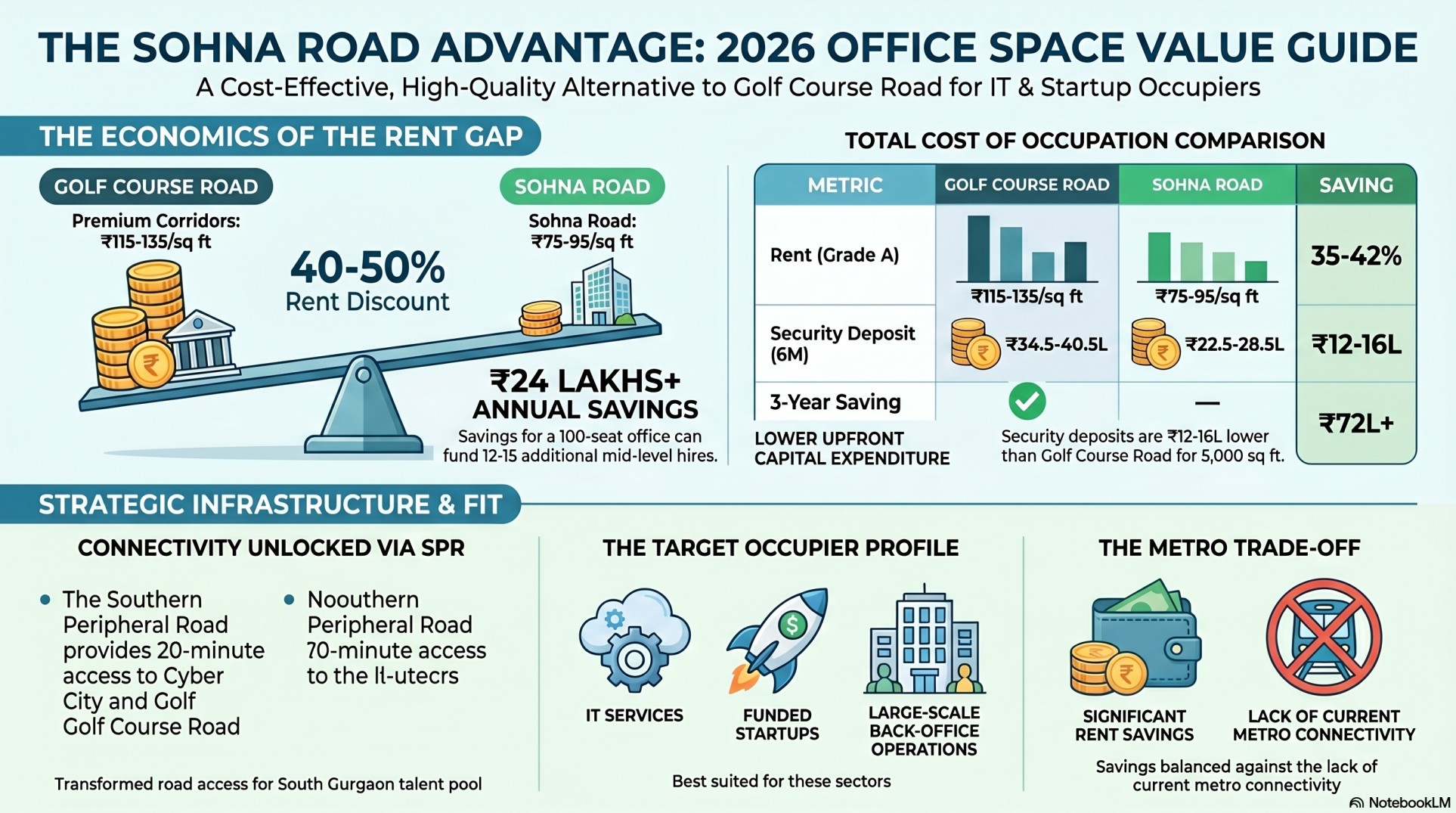
Golf Course Road runs at ₹115-135/sq ft. Golf Course Extension Road is at ₹100-125/sq ft. Sohna Road is at ₹75-95/sq ft. That 40-50% gap versus Golf Course Road is Sohna Road’s primary commercial argument, and for a growing segment of tenants — IT companies, funded startups, back-office operations, and ITeS firms — the math justifies the location choice.
Sohna Road (NH-248A, the Gurgaon-Sohna highway) runs south from Rajiv Chowk through Sectors 47-50, 56, and 57 before continuing toward Sohna town and the broader South Haryana corridor. The commercial cluster that matters for office occupiers is concentrated in Sectors 47-50, where institutional developers have built Grade A stock over the past decade and South Gurgaon’s residential density provides the surrounding talent pool. As Knight Frank India’s South Gurgaon research notes, South Gurgaon corridors including Sohna Road have recorded sustained absorption from IT and ITeS occupiers attracted by the rent differential and improving infrastructure.
The honest version of the Sohna Road pitch is this: it is the right choice when the rent gap materially affects the business, when the talent pool being targeted lives in South Gurgaon’s residential sectors, and when metro absence isn’t a disqualifying constraint. It is the wrong choice when client visits are frequent, when a significant portion of employees rely on public transit, or when brand perception of the office address matters to the business.
The Value Case: Understanding the Rent Gap
At ₹75-95/sq ft, Sohna Road undercuts Golf Course Road by ₹30-45/sq ft — a gap that compounds dramatically at scale. The total cost of occupation framework makes this concrete.
Metric
Golf Course Road
Sohna Road
Saving
Rent (Grade A)
₹115-135/sq ft
₹75-95/sq ft
35-42%
100 seats (5,000 sq ft)
₹5.75-6.75L/month
₹3.75-4.75L/month
₹2L/month
Annual saving
—
—
₹24L+
3-year saving
—
—
₹72L+
Security deposit (6M)
₹34.5-40.5L
₹22.5-28.5L
₹12-16L
For a 100-seat office, Sohna Road saves approximately ₹24 lakhs annually against Golf Course Road. Over a three-year lease, that’s ₹72 lakhs-plus — equivalent to 12-15 additional hires at mid-level salaries, or a meaningful runway extension for a funded startup. The capital case for Sohna Road is not subtle.
The secondary saving is on fit-out. Because base rents are lower, landlords on Sohna Road are more willing to offer fit-out contributions (rent-free periods or tenant improvement allowances) to attract quality tenants. Companies signing three-year-plus leases in Grade A Sohna Road buildings can frequently negotiate two to four months rent-free — further compressing the effective annual cost.
Infrastructure Trajectory: Where Sohna Road Is Headed
The critique of Sohna Road has historically been infrastructure: no metro, moderate amenity density, variable building quality. That critique was more accurate in 2018 than in 2026. The corridor has improved on each dimension, and the trajectory matters as much as the current state for companies signing 3-9 year leases.
Southern Peripheral Road: Connectivity Unlocked
The Southern Peripheral Road transformed Sohna Road’s commercial viability. SPR runs roughly parallel to the upper Sohna Road corridor, connecting NH-48 (Delhi-Jaipur Expressway) to NH-248A (Sohna Road) and creating a high-speed east-west route across South Gurgaon. As explored in the emerging micro-markets analysis, SPR made the South Gurgaon belt — including Sohna Road, GCER, and Sectors 47-57 — far more accessible from the broader Gurgaon market and from NH-48’s Delhi connection.
From Sohna Road Sector 48, SPR now provides access to Cyber City in 20-25 minutes, to Golf Course Road in 15-20 minutes, and to NH-48 and Delhi in 30-40 minutes. Before SPR, these journeys involved Rajiv Chowk and the most congested Gurgaon road network. The road fundamentally changed the calculus.
Metro Extension: The Game-Changer Still Coming
Gurgaon’s metro expansion plans include extensions into South Gurgaon, with Sohna Road among the proposed corridors. Timeline certainty remains limited — metro extension projects in India operate on timelines that routinely slip by years.
The implication for tenants is careful optimism. Companies signing 5-9 year leases on Sohna Road today are positioning for a corridor that may have metro connectivity within their lease term. Companies signing 3-year leases are taking a pure bet on current fundamentals — road connectivity, rent advantage, and existing amenity density — without metro upside materialising in time. The commute impact analysis makes clear that metro access is the single most important infrastructure variable for employee satisfaction. When it arrives on Sohna Road, the rent discount will compress.
Building Quality: Newer Stock in Sectors 47-50
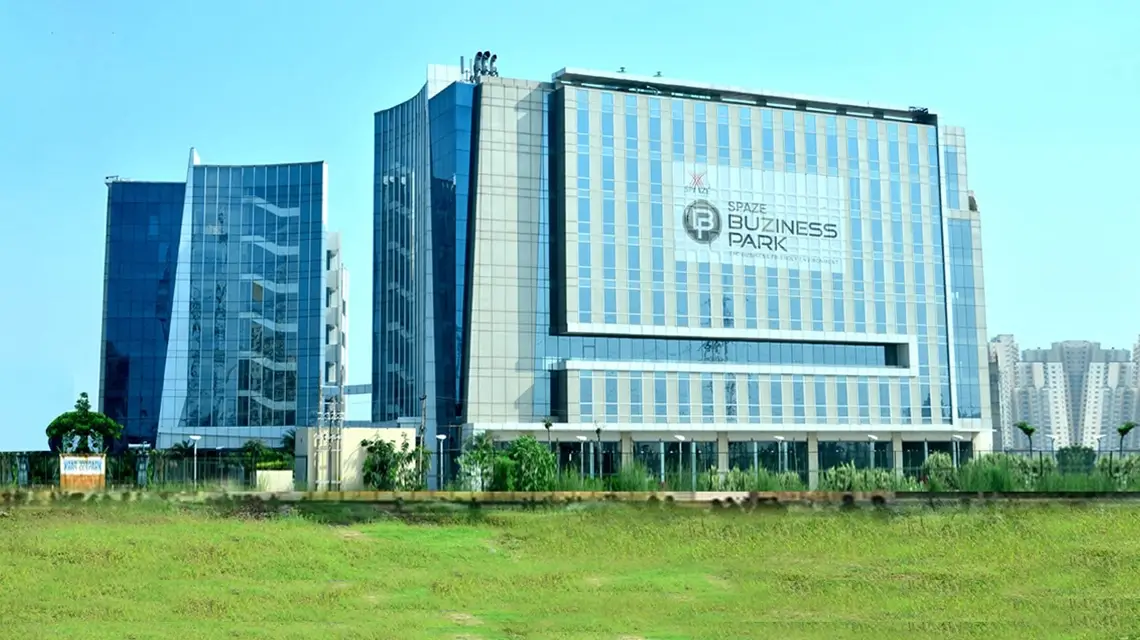
The commercial development in Sectors 47-50 is predominantly from the past decade — newer on average than Golf Course Road’s established stock and broadly comparable to GCER’s recent development. JMD Megapolis, Spaze IT Park, Bestech Business Tower, and AIPL Business Club represent the Grade A tier that enterprise occupiers require: 24/7 power backup, high-speed internet backbone, dedicated parking, and building management systems.
Outside this Grade A cluster, Sohna Road has older and more variable commercial stock that should be approached with the same infrastructure verification discipline applied to any established corridor. Power density, internet backbone, and CAM charges vary significantly between buildings. The Grade A cluster in Sectors 47-50 is where the right tenant-building match exists for corporate occupiers.
Who Occupies Sohna Road — and Why
According to CBRE India’s South Gurgaon office market data, Sohna Road’s tenant mix has shifted meaningfully over the past five years, with IT services and technology companies now representing the majority of Grade A absorption.
IT Services and ITeS Companies
Mid-size IT services companies (200-1,500 employees) seeking large floor plates at cost-efficient pricing have found Sohna Road’s Grade A cluster attractive. Companies that would pay Udyog Vihar rates for a well-known IT-hub address are weighing whether that premium justifies itself for teams whose work is primarily internally-facing — development, QA, operations — rather than client-facing. Many conclude it doesn’t. Sohna Road captures that conclusion.
Funded Startups and Scale-Ups
Series A to Series C companies — those past the co-working phase but not yet ready to pay Golf Course Road rates — have made Sohna Road one of Gurgaon’s more active startup office markets. The rent gap preserves runway. The South Gurgaon residential environment attracts the senior product, engineering, and operations talent that such companies typically seek. The Grade A buildings provide the professional environment needed for recruiting and investor visits.
Back-Office and Captive Operations
Large corporations establishing India back-office captives — finance shared services, HR operations, IT support, data processing — have used Sohna Road for cost-optimised operations that don’t require client-facing addresses. The corridor’s rent advantage makes it viable for larger floor-plate requirements (10,000-30,000 sq ft) that would cost significantly more in established corridors.
E-Commerce and New Economy
E-commerce operations, logistics tech, and new-economy companies — including those in edtech, healthtech, and fintech — have established South Gurgaon operations on Sohna Road. These businesses often have large teams (500-2,000 employees) in operations and support functions where rent efficiency matters significantly, paired with smaller premium office presence elsewhere for client and investor meetings.
Connectivity: The Honest Assessment
Sohna Road’s connectivity requires honest framing. There are genuine strengths and a significant gap.
Road Access: Strong Via SPR
Post-SPR, Sohna Road’s road connectivity is materially better than its reputation suggests. South Gurgaon residential sector employees — those in Sectors 56-67, GCER residential, and Golf Course Extension Road residential zones — face 10-20 minute commutes to Sohna Road Sector 48. For companies whose hiring pool concentrates in these zones, the corridor is highly accessible.
Delhi and North Gurgaon employees face longer commutes: 40-55 minutes from South Delhi (via NH-48 and SPR), 35-45 minutes from Udyog Vihar and Cyber City zones. These are workable commutes for senior roles where work-from-home flexibility reduces in-office frequency, but challenging for high-density junior teams required to be in office daily.
Metro: The Gap
Sohna Road has no metro connectivity as of 2026. This is the corridor’s most significant operational limitation. Companies hiring large volumes of junior staff from Delhi’s public-transit-dependent population face real challenges — either accepting longer commutes, subsidising company transport, or dealing with higher attrition among employees for whom the commute becomes unsustainable.
The gap is most acute for BPO and high-volume operations functions that depend on large workforces from Delhi’s eastern and northern zones. Premium and mid-market companies with senior, driving-capable workforces and South Gurgaon residential concentration find the metro gap largely manageable.
Airport: Moderate
IGI Terminal 3 is 35-50 minutes from Sohna Road Sector 48 via SPR and NH-48 — longer than Udyog Vihar (15-20 minutes) and comparable to Golf Course Extension Road (35-45 minutes). Companies with frequent international travel should factor this in.
Sohna Road vs Golf Course Extension Road: The Direct Comparison
Both corridors target similar tenant profiles — South Gurgaon location, cost below Golf Course Road, newer building stock. The decision between them is worth mapping explicitly. The GCER office guide covers that corridor in detail.
Factor
Sohna Road
Golf Course Ext Rd
Rent (Grade A)
₹75-95/sq ft
₹100-125/sq ft
Metro connectivity
None (2026)
None (2026)
Building age
8-15 years
5-12 years
Tenant brand perception
Value corridor
Emerging premium
Startup ecosystem density
High
Moderate
Large floor plates (10K+ sq ft)
Available
Limited
Airport
35-50 minutes
35-45 minutes
Choose Sohna Road when: the 20-30% additional savings versus GCER materially affect the business, when large floor plates are needed, or when the startup ecosystem density of the corridor is a sourcing advantage. Choose GCER when: premium positioning matters for client perception or talent attraction, when newer buildings are a priority, or when the corridor’s trajectory toward established premium pricing is a strategic consideration.
AIHP on Sohna Road
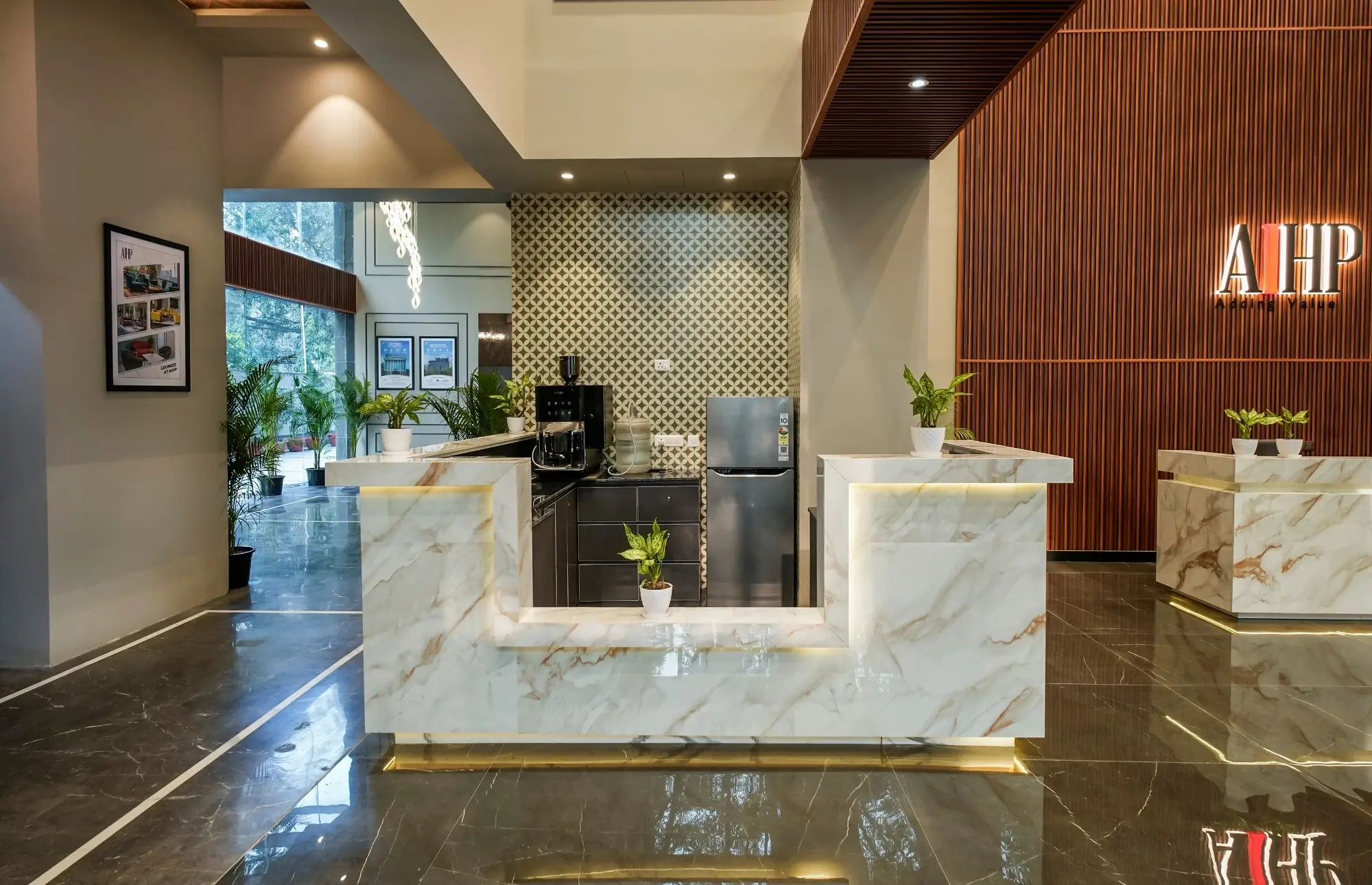
AIHP operates on Sohna Road through managed office space in the corridor’s Grade A buildings. Unlike AIHP’s Udyog Vihar and Sector 32 portfolios — where AIHP owns the buildings — Sohna Road operations are through leased floors in third-party buildings managed to AIHP’s standards. Tenants benefit from AIHP’s managed model — zero upfront CapEx, 60-day delivery, single monthly fee inclusive of operations — within Sohna Road’s cost-efficient rent environment. View Sohna Road availability.
For companies evaluating Sohna Road, the managed model resolves one of the corridor’s practical friction points: variable building quality. When AIHP manages a space, infrastructure standards, vendor relationships, and operational continuity are consistent regardless of the specific building. Companies get the rent advantage of Sohna Road without bearing the risk of discovering building infrastructure gaps after move-in.
📥 RESOURCE: Download The Ultimate Guide to Gurgaon Office Space for detailed Sohna Road building comparisons, lease negotiation templates, and total cost of occupation frameworks. Download the Ultimate Guide →
Conclusion: When Sohna Road Is the Right Answer
Sohna Road’s value proposition is straightforward and genuine. The 40-50% rent gap versus Golf Course Road is real money — ₹24 lakhs annually for a 100-seat office, ₹72 lakhs over three years. For companies where that capital is better deployed into headcount, product, or runway than into address prestige, the choice is clear.
The corridor works best for cost-disciplined IT and ITeS companies, funded startups whose team concentrates in South Gurgaon’s residential zones, back-office captives needing large floor plates, and new-economy operations with large non-premium teams. It works poorly for companies dependent on metro-reliant workforces from Delhi, those with frequent client visit requirements, or those where office address brand perception is a material business factor.
Infrastructure is improving. SPR has already changed the road connectivity story. Metro extension, when it arrives, will compress the discount against Golf Course Road and GCER. Companies with long lease terms are positioning for a corridor whose operational trade-offs diminish over time. The window to lease at today’s pricing, before that convergence happens, belongs to those who evaluate Sohna Road for what it is rather than what it isn’t. For guidance on availability and fit, get in touch with AIHP or explore Sohna Road options directly.
Grade A office space on Sohna Road runs ₹75-95/sq ft monthly, concentrated in the Sector 47-50 commercial cluster where the corridor’s best buildings are located. Some older or secondary stock runs ₹65-80/sq ft but with corresponding infrastructure trade-offs. This represents a 35-42% discount to Golf Course Road (₹115-135/sq ft) and a 20-30% discount to Golf Course Extension Road (₹100-125/sq ft). For managed office on Sohna Road, per-seat pricing reflects the full-service model inclusive of fit-out, utilities, and facilities management in a single monthly fee.
No — Sohna Road does not have metro connectivity as of 2026. This is the corridor’s primary operational limitation. Metro extension plans for South Gurgaon exist and include Sohna Road among proposed corridors, but firm delivery timelines have not been established. The nearest metro stations are HUDA City Centre (Yellow Line, serving Udyog Vihar and Sector 32) and Sector 54 Chowk (Rapid Metro), both 25-35 minutes by road from Sohna Road Sector 48. Companies with metro-dependent workforces should factor this gap seriously into their location decision.
Sohna Road is 20-30% cheaper than GCER (₹75-95/sq ft vs ₹100-125/sq ft). Neither corridor has metro connectivity as of 2026. GCER has newer buildings, stronger premium brand positioning, and higher startup-to-enterprise company quality mix. Sohna Road has larger available floor plates, higher startup ecosystem density, and the better rent case for large-format back-office operations. Choose GCER when premium positioning and building quality outweigh the additional rent. Choose Sohna Road when the rent gap is material and large floor plates are needed.
Four categories find Sohna Road most advantageous. First, mid-size IT services and ITeS companies (200-1,500 employees) where development and operations teams are internally-facing and don’t require premium address. Second, funded startups (Series A-C) past the co-working phase that want professional space at runway-preserving rents. Third, corporate captive back-office operations — finance shared services, HR operations, IT support — that need large floor plates at cost-efficient rents. Fourth, new-economy companies (edtech, healthtech, e-commerce, fintech) with large operations and support teams where per-seat cost matters significantly at scale.
No, not for high daily-commute volumes. Without metro connectivity, Delhi employees face 40-60 minute commutes by road depending on origin and traffic. For senior employees (typically driving, with some work-from-home flexibility) from South Delhi, this is workable. For large volumes of junior employees from Central, North, or East Delhi who depend on public transit, the commute is a real retention risk. Companies in this situation should either allocate budget for company transport (adding ₹1-3 lakhs monthly for a 100-seat office) or consider corridors with metro connectivity such as Udyog Vihar (HUDA City Centre) or IFFCO Chowk area. The rent saving on Sohna Road can be partially or fully offset by transport subsidies if the workforce geography requires it.