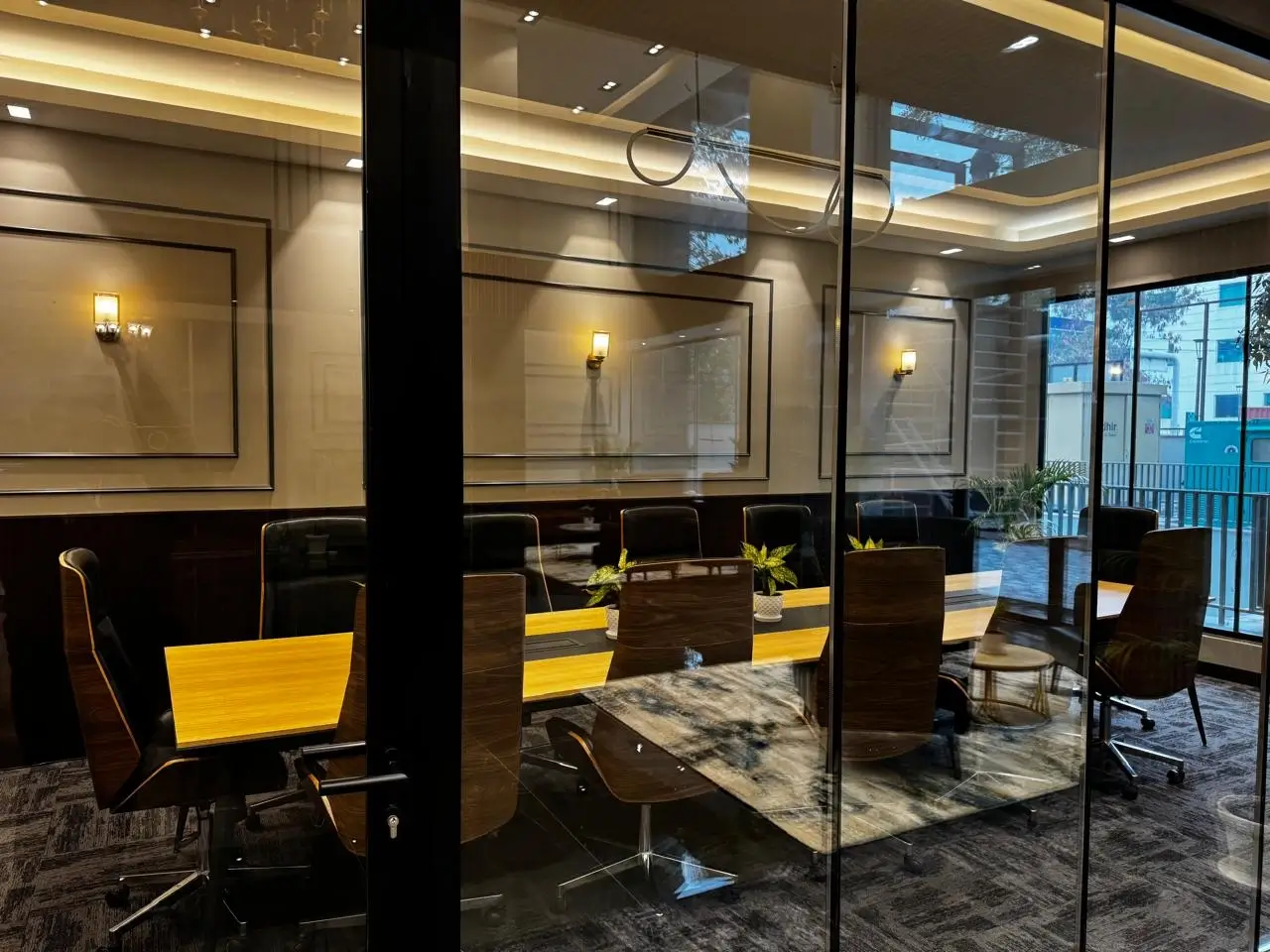
You signed a 3-year lease on beautiful open-plan office in Gurgaon. Glass walls, modern furniture, natural light everywhere. Three months in, your team is miserable.
Sales calls interrupted by loud engineering discussions. Client video calls picking up background noise from pantry conversations. Engineers wearing noise-canceling headphones full-time trying to concentrate. Managers booking meeting rooms for phone calls because open space is too loud.
The aesthetics work. The acoustics don’t. And noise is the #1 operational complaint in modern offices—more common than HVAC problems, parking shortages, or internet issues.
Office failures often stem from poor acoustic design. The good news: you don’t need to relocate. Acoustic problems can be fixed through retrofit solutions costing ₹2-5 lakhs for typical office, reducing noise 60-70%.
Here’s how.
Why Open-Plan Offices Became Acoustic Nightmares
Open-plan offices weren’t designed to be quiet. They were designed to maximize density and encourage collaboration. The assumption was benefits (flexibility, communication, efficiency) would outweigh costs (noise, distraction).

This assumption broke when:
Work became knowledge-intensive. Manufacturing workers tolerate ambient noise because physical tasks don’t require deep concentration. Knowledge workers—engineers, analysts, writers—need sustained focus for complex cognitive work. Noise directly degrades performance.
Hybrid changed office purpose. Pre-COVID, offices were for individual work plus occasional collaboration. Post-2026, people work from home for focus tasks and come to office for collaboration. This concentrates collaboration (loud activities) into fewer days with higher attendance. The office is louder more often.
Density increased. Companies went from 60-80 sq ft per employee to 40-50 sq ft to reduce costs. More people in same space = more conversations, phone calls, and ambient noise. Higher density creates acoustic problems even with same activities.
Materials prioritized aesthetics over acoustics. Glass, concrete, and hard surfaces look modern. They also reflect sound, creating reverberation. Soft materials (carpet, fabric panels, acoustic ceiling tiles) absorb sound but aren’t Instagram-worthy. Landlords choose aesthetics.
Result: beautiful offices where nobody can concentrate.
The Real Cost of Bad Acoustics
Noise isn’t just annoying. It has measurable business impact.
Productivity loss:
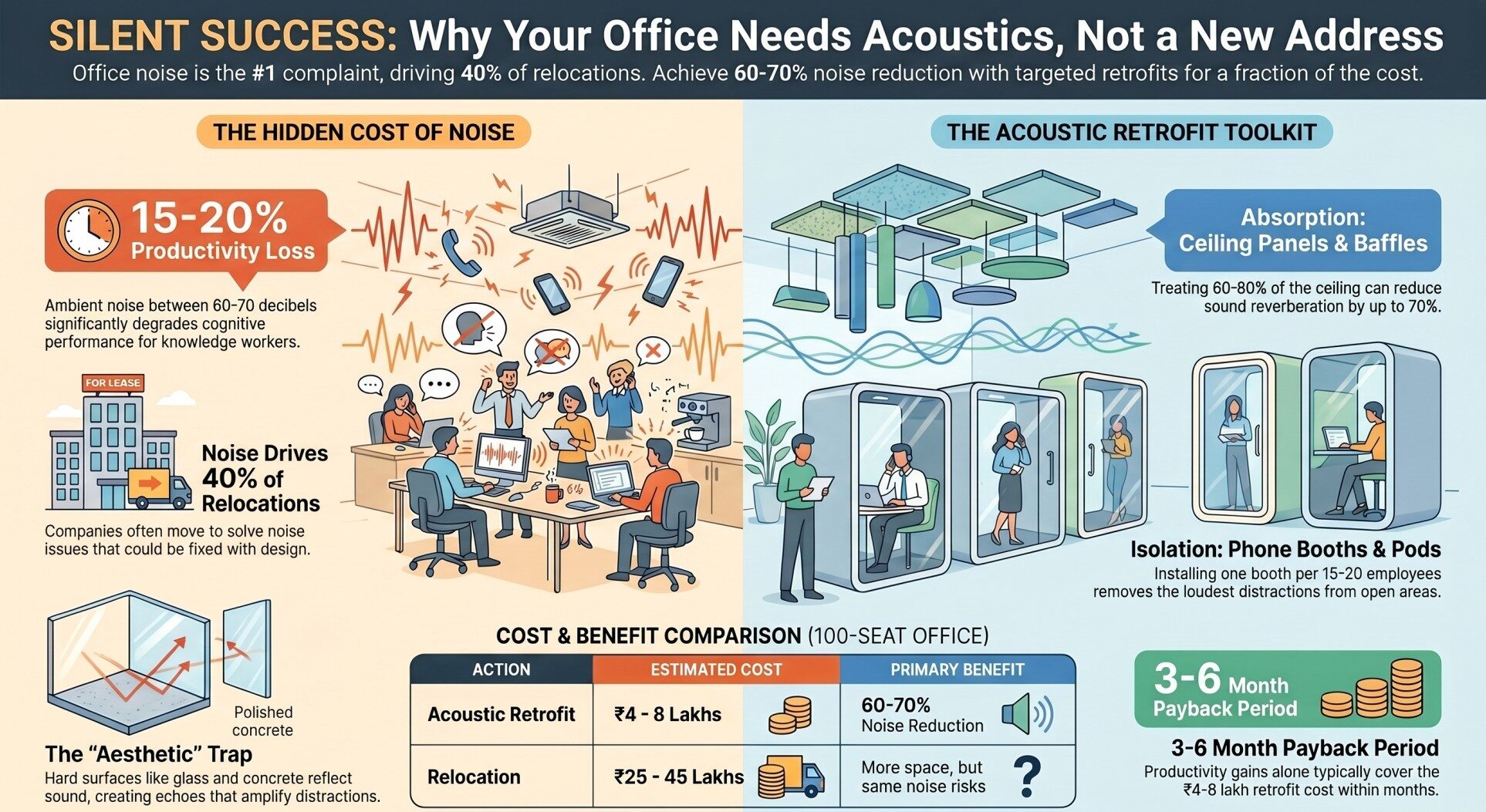
Studies show 60-70 decibel ambient noise reduces cognitive task performance 15-20%. For 100-person office where 60% do knowledge work, that’s 9-12 lost productive hours daily. At average ₹500/hour salary cost, that’s ₹4,500-6,000 daily or ₹1.35-1.8 lakhs monthly in pure productivity loss.
Meeting quality degradation:
Remote participants on video calls can’t hear clearly when background noise is high. Meetings with poor audio quality last 25-30% longer as people repeat themselves. Client calls with background noise create unprofessional perception.
Employee fatigue:
Working in noisy environment for 8 hours creates cognitive fatigue. Employees use mental energy filtering out noise rather than doing actual work. End-of-day exhaustion is real cost even if hard to quantify.
Talent retention:
Noise is cited in 30-40% of employee complaints about office environment. Companies tolerating chronic noise problems face higher attrition. Exit interviews often mention “couldn’t concentrate” as factor in leaving.
These costs—₹1.5-2.5 lakhs monthly for 100-person office—far exceed cost of acoustic retrofit solutions.
Acoustic Retrofit Solutions That Actually Work
You can’t rebuild office from scratch. But you can implement targeted acoustic solutions reducing noise 60-70% without major construction.
Solution 1: Acoustic Ceiling Panels and Baffles
What they do:
Absorb sound traveling upward, preventing reverberation. Hard ceilings (concrete, gypsum) reflect sound back down, amplifying noise. Acoustic ceiling panels absorb 60-80% of sound hitting them.
Types:
- Suspended acoustic ceiling tiles (replace existing ceiling grid tiles)
- Acoustic baffles (vertical panels hanging from ceiling)
- Acoustic clouds (horizontal panels suspended below ceiling)
Coverage needed:
60-80% of ceiling area for significant noise reduction. Partial coverage (20-30%) creates minimal improvement.
Cost:
- Acoustic ceiling tiles: ₹150-300 per sq ft installed
- Baffles/clouds: ₹200-400 per sq ft coverage
- For 5,000 sq ft office targeting 70% coverage: ₹5.25-10.5 lakhs
Installation:
Non-disruptive. Done during off-hours or weekends. No business interruption.
Effectiveness:
Reduces reverberation time 60-70%. Makes conversations at 15+ feet distance less audible. Doesn’t eliminate noise but prevents it from carrying across entire office.
Solution 2: Sound-Absorbing Desk Dividers and Screens
What they do:
Create partial acoustic barriers between workstations without fully enclosing people (which would require expensive partitions and HVAC modifications).
Types:
- Desktop screens (sit on desk surface, 12-18″ high)
- Freestanding panels (floor-to-ceiling or partial height)
- Hanging dividers (suspended from ceiling between desks)
Materials:
Fabric-wrapped acoustic foam or fiberglass. Absorbs sound rather than reflecting it like glass or acrylic dividers.
Cost:
- Desktop screens: ₹3,000-6,000 each
- Freestanding panels: ₹8,000-15,000 each
- For 100-seat office with dividers between adjacent desks: ₹3-6 lakhs
Installation:
Immediate. No construction required. Screens placed on desks or between workstation clusters.
Effectiveness:
Reduces conversation audibility 40-50% for adjacent neighbors. Doesn’t block noise completely but makes it harder to overhear specific words, reducing distraction.
Solution 3: Phone Booths and Acoustic Pods
What they do:
Provide enclosed quiet spaces for phone calls, video meetings, and focus work. Removes loud activities (calls) from open area.
Why they matter:
Without phone booths, employees take calls at desks (disrupting neighbors) or book meeting rooms for 15-minute calls (reducing meeting room availability).
Types:
- 1-person phone booths (sound-dampened enclosures)
- 2-4 person meeting pods (enclosed micro-rooms)
- Focus pods (individual quiet workspaces)
Cost:
- 1-person phone booth: ₹80,000-150,000 installed
- 4-person meeting pod: ₹2-3.5 lakhs installed
- For 100-seat office, budget 1 booth per 15-20 employees: 5-7 booths = ₹4-10.5 lakhs
Installation:
Prefabricated units. No construction. Positioned in available floor space, connected to power.
Effectiveness:
Removes loudest noise source (phone calls) from open area. Reduces ambient noise 30-40% by giving people quiet space option.
Solution 4: White Noise Systems
What they do:
Generate low-level ambient sound (like gentle air flow) that masks conversational noise. Makes it harder to distinguish individual words from background conversations.
How it works:
Array of small speakers throughout ceiling plays carefully calibrated white/pink noise. Human brain can’t filter it out like it does consistent AC hum, so it effectively masks speech.
Cost:
- Professional system: ₹30,000-50,000 for 5,000 sq ft
- DIY consumer system: ₹15,000-25,000 (lower quality)
Installation:
Speakers mounted in ceiling grid. Central controller. Takes 1-2 days.
Effectiveness:
Reduces speech intelligibility 30-40%. Doesn’t eliminate noise but makes conversations less distracting. Works best combined with other solutions.
Controversy:
Some people find white noise itself distracting. Test with small pilot area before full deployment.
Solution 5: Strategic Layout and Zoning Changes
What they do:
Reorganize space to separate quiet work from loud collaboration without expensive construction.
Acoustic zoning strategies:
Separate loud and quiet activities spatially:
- Place sales team (lots of calls) together in dedicated zone away from engineers
- Locate pantry and collaboration areas away from focused work zones
- Position meeting rooms as buffer between noisy and quiet zones
Use distance as acoustic tool:
Sound intensity follows inverse square law: doubling distance reduces noise 75%. Positioning loud activities 30 feet away rather than 15 feet makes dramatic difference.
Create “quiet zones” with soft signals:
Designate certain areas as quiet focus zones with visual signage. Cultural expectation (take calls elsewhere, use inside voice) reinforces acoustic solutions.
Cost:
Minimal—primarily furniture rearrangement and signage. Main cost is disruption during reorganization.
Effectiveness:
Combined with acoustic panels and dividers, proper zoning reduces noise complaints 50-60%.
Acoustic Design Principles for New Build-Outs
If you’re planning new office or have opportunity to renovate, design acoustics proactively rather than retrofitting later.
Material selection:
- Acoustic ceiling tiles throughout (not hard gypsum)
- Carpet or carpet tiles (not hard flooring in open areas)
- Fabric-wrapped wall panels in collaboration zones
- Soft furnishings (fabric chairs, upholstered seating in breakout areas)
Layout planning:
- Meeting rooms located together creating acoustic buffer zone
- Phone booths distributed throughout (1 per 15-20 people)
- Collaboration zones physically separated from focus work areas
- High-traffic circulation paths away from quiet work zones
Partition strategy:
- Full-height partitions (floor to ceiling) for private offices and meeting rooms
- Partial-height partitions (1.2-1.5m) between workstation clusters
- Glass partitions with acoustic glazing (not standard glass)
HVAC acoustic treatment:
- Properly sized ductwork (undersized creates noise)
- Sound-dampened diffusers
- Isolated mechanical equipment
Cost for acoustic-first design:
Adds 8-12% to base fit-out cost but eliminates need for later retrofit. For ₹2.5 lakh/seat fit-out, acoustic design adds ₹20-30K/seat but saves ₹30-50K/seat in later corrections.
Measuring Success: Before and After
How do you know if acoustic solutions worked?
Quantitative measurement:
- Decibel meter readings before and after (target: 55-65 dB in open areas, 45-55 dB in focus zones)
- Reverberation time measurement (target: <0.6 seconds in open areas)
Qualitative indicators:
- Employee noise complaints drop 70-80%
- Meeting room bookings for phone calls drop 60-70% (people use phone booths instead)
- Headphone usage decreases (people don’t need constant noise cancellation)
- End-of-day fatigue surveys show improvement
Business impact:
- Self-reported productivity increases 10-15%
- Meeting duration for remote calls decreases 20-25% (less repetition due to poor audio)
- Employee satisfaction scores for office environment improve 30-40 points
- Target improvement: 60-70% noise reduction, measured both objectively (decibels) and subjectively (complaints).
Budget Planning for Acoustic Retrofit
For 5,000 sq ft office (100 seats), realistic acoustic retrofit budget:
Minimal viable solution (₹2-3 lakhs):
- Acoustic ceiling panels: 40% coverage = ₹3 lakhs
- Desktop screens: 50 workstations = ₹1.5-3 lakhs
- White noise system: ₹50K
- Total: ₹5-6.5 lakhs
Comprehensive solution (₹8-12 lakhs):
- Acoustic ceiling panels: 70% coverage = ₹5.25-10.5 lakhs
- Desk dividers and screens: 100 workstations = ₹3-6 lakhs
- Phone booths: 5 units = ₹4-7.5 lakhs
- White noise: ₹50K
- Acoustic wall panels: selective placement = ₹1-2 lakhs
Total: ₹13.25-26 lakhs
Most offices find 60-70% noise reduction achievable with ₹4-8 lakhs investment—far cheaper than relocating to larger space or different building.
Payback period: 3-6 months through productivity gains alone (₹1.5-2.5 lakhs monthly productivity loss eliminated).
Conclusion: Fix Noise Without Relocating
Noise complaints drive 40% of office relocations. Companies move to larger spaces thinking more square footage solves problems. It doesn’t. Poor acoustics create noise at any density.
The real solution isn’t more space—it’s better acoustic design. Ceiling panels, desk dividers, phone booths, white noise, and strategic zoning reduce noise 60-70% for ₹4-8 lakhs investment. This costs far less than breaking leases, moving offices, or tolerating chronic productivity loss.
Acoustic problems are fixable. They require targeted investment in sound-absorbing materials, dedicated quiet spaces, and thoughtful layout—not expensive relocations.
For companies suffering noise problems in Gurgaon office spaces and evaluating whether to relocate or retrofit, acoustic solutions should be first consideration. Retrofit costs 5-10% of relocation costs while solving the actual problem.
For guidance on acoustic retrofit solutions specific to your office layout and noise complaints, get in touch with AIHP.