 Workspace
6 Jun 2019 · Roshan Gond · 6 min read

Workspace

TL;DR
Commercial space for rent in Gurgaon is priced per sq ft on a conventional lease and per seat in a managed office (₹6,500–15,000 per seat per month at AIHP). This guide covers what a lease includes, the three ways to take space, the corridors to shortlist, the checks before signing, how a lease proceeds from LOI to fit-out, what it costs, and the lock-in, escalation and exit clauses that matter.
Commercial space for rent in Gurgaon is priced per square foot per month on a conventional lease, and per seat per month in a managed office. A conventional lease gives you a floor and leaves fit-out, furniture and running costs with you. A managed private office gives you a ready floor at one per-seat rate. Across AIHP's portfolio that rate runs from ₹6,500 to ₹15,000 per seat per month, depending on the building and the corridor.
This guide is for occupiers who need 20 to 500 seats. It suits a regional headquarters, a delivery centre or a business unit that is growing out of its current floor. If your team is smaller than 20, a managed private office is not the right fit, because AIHP's minimum is 20 seats. The checks below still apply to any lease you sign.
You will find why teams lease in Gurgaon, what a lease includes, the three ways to take space, the corridors worth shortlisting, the checks to run before you sign, how a lease proceeds, what it costs, and the clauses that decide whether you can leave on good terms.
Gurgaon is the part of the Delhi region where large teams have settled over the past two decades. The expressway and the metro tie it to Delhi. Most of the commercial districts sit within reach of both. That matters on a Monday morning, when your staff arrive from three different directions.
The city also has depth in the supply of office floors. You can find a Grade-A tower with a large lobby, a smaller building with fewer tenants, or a floor in a business district built for backend operations. That range lets you match the building to the work your team does, rather than the other way round.
Demand has also changed shape. Companies bring people back to the office, but they do it with more care than before. They want a floor that fits a hybrid pattern, with less unused space and a lease that can grow when the team does. Leasing keeps your capital in the business. A purchase ties up money in a floor that may be too big or too small in three years.
For a team of 20 to 500 seats, the real question is not whether to lease. It is which type of lease gives you the right mix of control, cost and speed. The next sections take that in order.
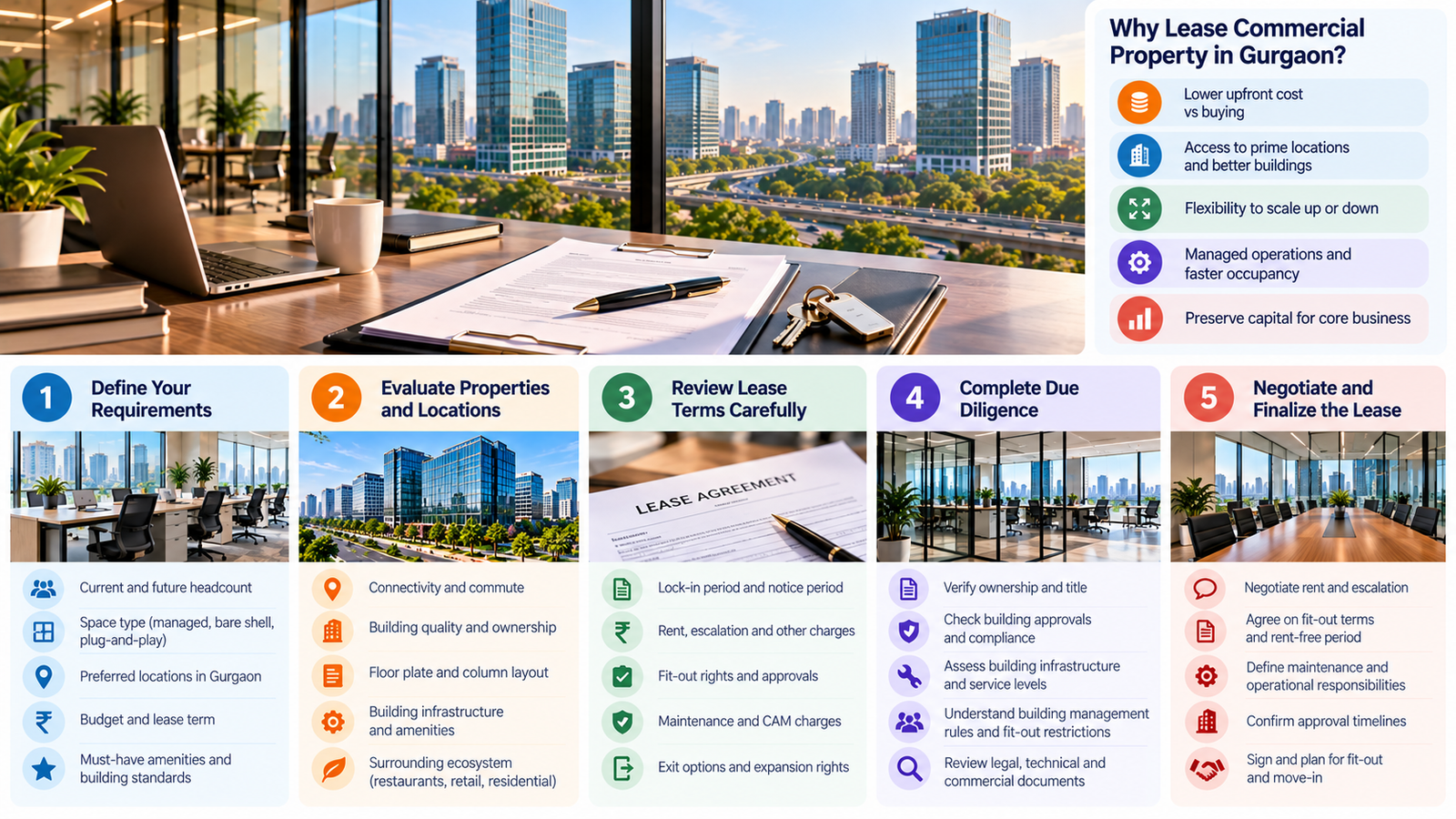
A commercial lease is a written agreement under which a business pays rent to use a property for a stated purpose and a stated period. For offices, the landlord hands over space, and you agree to use it only for office work.
Every office lease should state the same core terms. Read each one before you sign.
Two further terms are easy to miss. The first is permitted use. If the lease limits the premises to a particular activity, your plans must fit inside it. The second is the handover condition. A bare shell, a warm shell and a fitted floor are three different starting points, and the lease should say which one you are getting.
Understanding these terms early saves headaches later. A tenant who knows the lock-in and the escalation clause before the first site visit can compare buildings fairly. A tenant who learns them at the signing table has little room to negotiate.
Most occupiers meet three kinds of office offer in Gurgaon. They differ in who pays for the fit-out, who runs the floor and how fast you can move in.
You rent an empty floor and build everything yourself. That means partitions, ceilings, power, cabling, air conditioning, furniture and IT. You get full control of the design. You also carry the cost of the build and the time it takes. Fit-out is a capital expense that you pay before your team has sat down.
The landlord or an operator hands over a floor with furniture and basic fit-out in place. You save on the build and move in faster. You still run the office yourself: housekeeping, power, internet and repairs sit on your side unless the lease says otherwise. If this model suits you, our guide to fully furnished office space in Gurgaon sets out what to ask for.
A managed private office is a dedicated floor or suite for your team alone, built, furnished and run by the operator. You pay one per-seat rate each month. There is no fit-out cost to fund, which is what zero CapEx means in practice. AIHP offers private, fully managed offices only, with a minimum of 20 seats and a 60-day move-in.
A managed office is not a shared-desk arrangement. Your team has a private space, and nobody else works in it. If you want to see how the two differ, read how a managed office differs from a shared-desk setup.
The right choice depends on three things: how much control you need over the design, how fast you must move, and how much capital you want to commit up front.
AIHP's buildings sit across 8 Gurgaon corridors, in more than 30 buildings. Each corridor suits a different kind of team, and the per-seat rate moves with the building and its grade.
The portfolio rate runs from ₹6,500 to ₹15,000 per seat per month. Where a given building sits in that band depends on its location, its grade and its fit-out. We give a building-level rate on request, so ask for the rate for the exact building you are visiting rather than relying on a corridor average.
Three corridors come up most often in enquiries.
The wider market is usually described by districts such as Cyber City, Golf Course Road, MG Road and NH8. They differ in building grade, tenant mix and the type of work they suit. Some are better for client-facing offices, and others for large back-office teams.
Choose the corridor by looking at your people first. Map where your staff live and how they travel. Then check how your clients reach you. Parking, metro access and the walk from the nearest station often decide the shortlist. To compare corridors side by side, start with our overview of office space for rent in Gurgaon.
Before you sign any lease for 20 or more seats, run these checks in order. Each one is cheap to do now and expensive to fix later.
Decide your budget as a monthly figure per seat, not only as rent per square foot. Decide how long you want the space. Decide how many seats you need today, and how many you may need in two years. A lease for today's headcount alone often becomes a problem in the second year, when you either run out of room or pay for a floor you do not need.
Ask who travels to the office and how. Do your clients visit often? Do your employees commute from Delhi, from other parts of Gurgaon, or from further out? Pick a location that works for the people who will use it daily, not only for the people who sign the lease.
Ask for proof of ownership, the occupancy certificate and the approvals for the building. Ask whether the landlord has the right to lease the floor to you. Where a project is registered, check the registration and the builder's record. Have your lawyer review all of it.
Do not rely on glossy photographs. Visit during working hours. Check the mobile signal and the network options. Look at the lifts, the parking and the common areas. Ask who maintains them and how often.
Three mistakes repeat. The first is skipping the fine print, including the clause on page seven that changes the rent. The second is overlooking hidden charges for maintenance, electricity and security. The third is leasing for today's team and not allowing for growth.
Write your answers to all five checks on one page. If a building cannot satisfy them, remove it from the shortlist.
A lease moves through a predictable sequence. Knowing it helps you plan your own move.
Each step takes time. A bare-shell lease asks you to run design, approvals, vendors and construction in parallel with the legal process. A managed office compresses the final stage, which is why AIHP can offer a 60-day move-in.
Set your own dates backwards from the day your team must sit at their desks. Then add a margin for the legal review. Most delays come from the paperwork, not from the building.
An agent can help with the shortlist and the negotiation, and a lawyer should review the final lease. Do not ask one person to do both jobs.
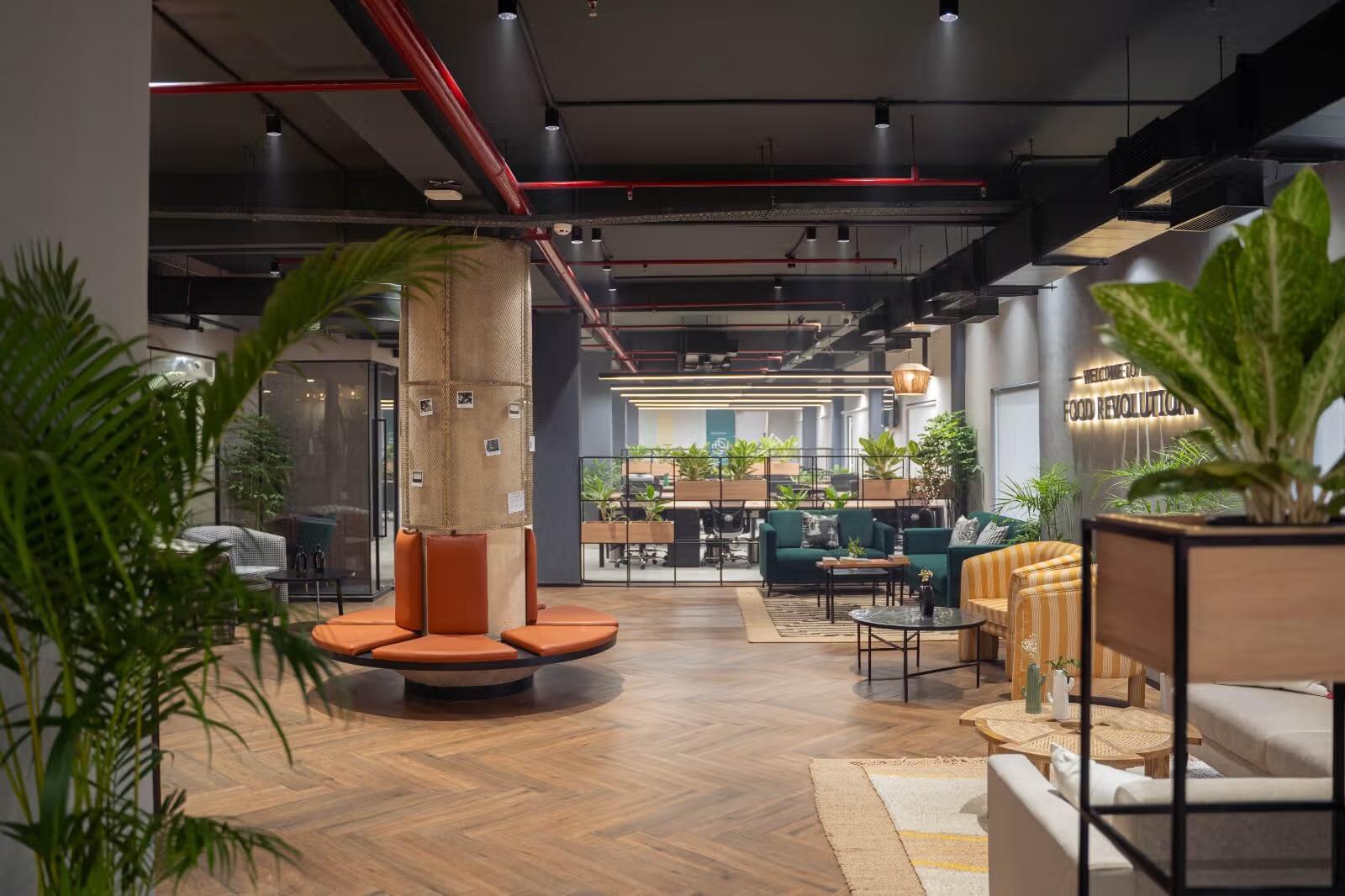
The first cost you will see is rent per square foot per month. It differs by corridor, building grade and floor. Ask each landlord for the current figure in writing, and ask what it includes.
On a conventional lease, rent is only part of the monthly bill. Add these.
Then add the costs that arrive before you start: the security deposit, the fit-out, the furniture and the IT build. Ask for a full break-up. A rent figure without one is a partial answer.
A managed private office replaces that list with one number. Across AIHP's portfolio it is ₹6,500 to ₹15,000 per seat per month. There is no fit-out to fund, so your CapEx is zero. The rate depends on the building, so ask for the figure for the floor you are considering.
Per sq ft rent and per-seat pricing are not directly comparable. Convert both into one monthly cost per seat over the same period. Use this method.
Compare that figure with the managed per-seat rate. Do the sum for the lock-in you would really sign, since a longer commitment spreads the fit-out cost thinner. Include the time cost too. A floor that takes months to build is a floor your team does not use.
The rent is the number everyone reads. The clauses decide how much you pay over the whole lease and how easily you can leave.
Most conventional leases in Gurgaon run for 3 to 9 years. The lock-in, during which neither side can exit, is typically 3 years, and that is AIHP's standard too. A longer lock-in should earn you something in return, such as a lower starting rent or a rent-free fit-out period. If it does not, push back.
Check how rent rises and when. Look for a fixed percentage on a fixed date, and note whether the increase applies to the base rent only or also to maintenance. A small difference in the escalation rate compounds over the term.
Read what happens if you need to leave early. Some leases demand rent for the whole lock-in. Others allow an exit on notice with a penalty. Check whether you can sub-let part of the floor if your plans change, and whether the landlord must approve it.
A force majeure clause says what happens to rent when events outside either side's control stop you from using the space. Read it closely. Also confirm who is responsible for approvals, safety certificates and building compliance. Keep that responsibility with the landlord where you can.
You can negotiate more than the rent. Start with market research. Know the going rates and the level of demand in your chosen area, so you can tell a fair offer from an inflated one. Then pick the terms that matter most to you.
Ask for these in the letter of intent, not at the end. Landlords concede more before you have signed the LOI than after the lawyers have started drafting.
Leasing commercial space in Gurgaon is a strategic move, not only a transaction. The right choice rests on a clear brief, a fair cost comparison and a careful reading of the lock-in, escalation and exit clauses.
If you need 20 to 500 seats and want a private, fully managed office with a 60-day move-in and zero CapEx, speak to our team. Share your seat count and preferred corridors on our contact page, or call +91-7861004918.
Workspace6 Jun 2019 · Roshan Gond · 6 min read
 Workspace
11 Apr 2019 · Roshan Gond · 5 min read
 Workspace
16 Mar 2019 · Roshan Gond · 4 min read
Ready to move your team?
Fully-managed private offices across Gurgaon's prime corridors — move-in ready, fully serviced, sized for your team.