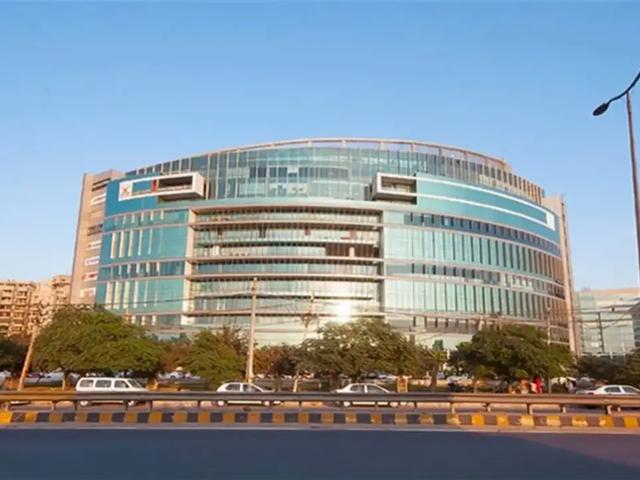
 Workspace
12 Jun 2026 · Sarthhak Kaluucha · 13 min read

Workspace
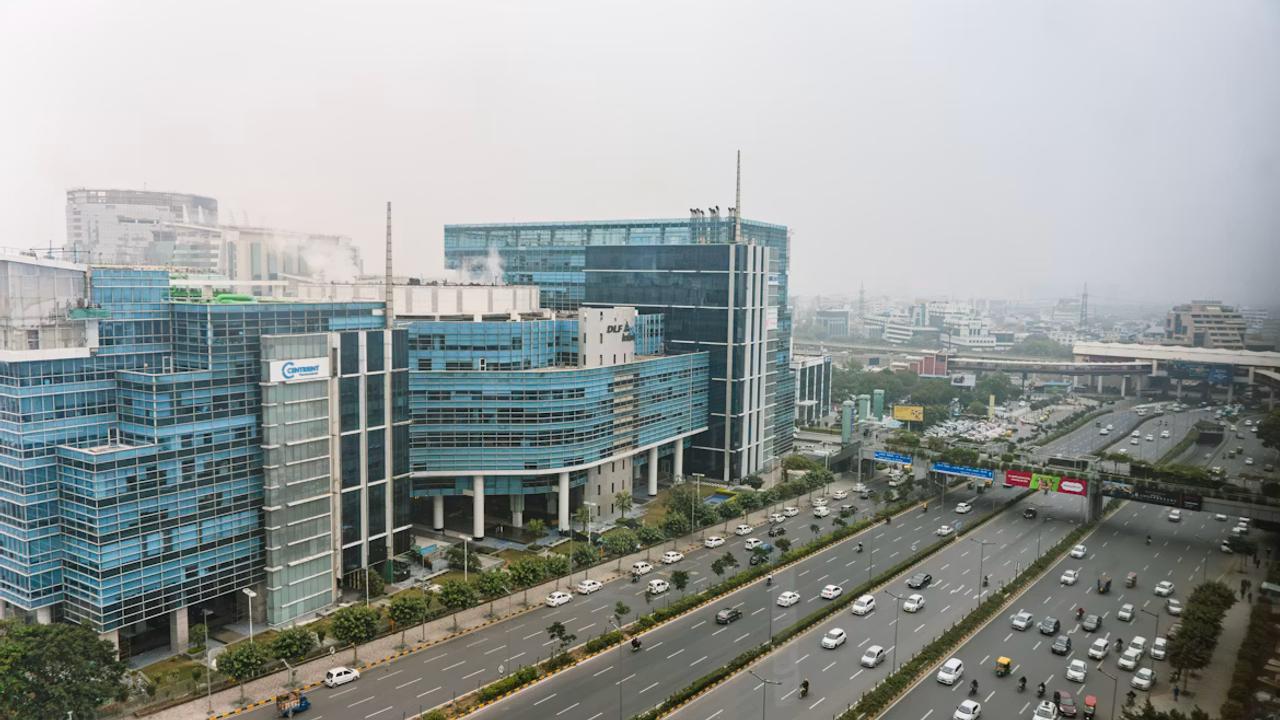
TL;DR
Haryana gazetted its GCC Policy 2026 on 27 May 2026 (valid five years). Verified against the official text: CAPEX reimbursement of 50% (Gurugram non-TOD), 65% (Gurugram TOD) or 75% (other districts) with ceilings up to ₹150 crore; OPEX reimbursement of 50–65% for 5–9 years covering lease rent, electricity duty, bandwidth and cloud; an employment subsidy of up to ₹1 lakh per Haryana-local employee per year for 10 years (₹1.2 lakh for women/SC/Divyang/ex-servicemen) once 15% of staff are local; EPF reimbursement for HKRN hires; R&D grants up to ₹50 crore; and 50% of claims paid within 7 working days. Minimum 100 employees within 3 years; apply before commencing operations. Gurgaon gets the lower tier but still wins on talent, ecosystem and airport access.
Updated 19 August 2026 — figures below are checked against the final gazetted text (Haryana Govt Gazette Extra., 27 May 2026, Notification No. 20/07/2026-4IB-1) and supersede the draft-policy numbers that still circulate online.
On 27 May 2026, the Government of Haryana gazetted the Haryana Global Capability Centres (GCC) Policy, 2026. It runs for five years, replaces the 2025 draft, and does something most state IT policies never did: it treats GCCs as their own category, with their own incentive schedule, their own mission office, and binding disbursement deadlines.
If you are evaluating Gurgaon for a GCC, or expanding one already running there, the Haryana GCC Policy 2026 changes the financial calculus. Not because it makes every GCC viable, but because for units that qualify, the stack of CAPEX, OPEX (including office rent), employment and R&D support materially lowers cost in years one through ten.
The backdrop explains the urgency. NASSCOM counts 2,117 GCCs in India employing 2.36 million people and generating USD 98.4 billion in revenue, and states are competing hard for the next wave (NASSCOM's policy note). Haryana's answer is this policy. Here is what it actually offers, who qualifies, how to claim it, and what a company setting up in Gurgaon should know before signing for space.
What is the Haryana GCC Policy 2026? It is a five-year state incentive framework, notified on 27 May 2026, that reimburses 50–75% of eligible capital expenditure and 50–65% of eligible operating expenditure (including lease rent, electricity duty, bandwidth and cloud charges) for Global Capability Centres that commence operations in Haryana on or after 1 January 2026 and employ at least 100 people within three years. It adds an employment subsidy of up to ₹1 lakh per Haryana-local employee per year for 10 years, an EPF booster, R&D centre grants of up to ₹50 crore, and a dedicated GCC single-window desk in Gurugram.
| Parameter | Haryana GCC Policy 2026 |
|---|---|
| Notified | 27 May 2026 (Gazette Extra., Notification No. 20/07/2026-4IB-1) |
| Validity | 5 years from 27 May 2026, or until a new policy/amendment supersedes it |
| Who is eligible | GCCs set up by MNCs, their parents, subsidiaries or affiliates to serve group entities (BOT, JV and hybrid structures may qualify) |
| Eligible from | Units commencing commercial operations on or after 1 January 2026 |
| Minimum size | 100 employees on payroll or contract with ESI/PF numbers, within 3 years of commencement |
| Targets | 100+ new GCCs; 30,000+ new jobs |
| Location tiers | Gurugram non-TOD zone · Gurugram TOD zone · all other districts |
| Overall cap | Total incentives (state + central) ≤ 100% of Fixed Capital Investment |
| Nodal agency | Department of Industries & Commerce, via the Haryana GCC Mission; GCC single-window desk at Gurugram |
| Disbursement promise | 50% of eligible claim within 7 working days, balance within 45 working days; 8% p.a. interest on departmental delay |
Source: official policy PDF, Department of Industries & Commerce, Haryana. The rest of this guide unpacks each line.
Before the policy detail, context. The policy is a reason to choose Haryana. Gurgaon is the reason to choose Gurgaon specifically.
Gurgaon hosts the highest concentration of GCCs in North India by a significant margin. The talent pool is unmatched in the NCR: engineering graduates from Delhi University and IIIT Delhi within metro reach, experienced technology professionals from the existing IT/ITeS ecosystem, and a professional services base in consulting, BFSI and finance built over 25 years of corporate development. As the GCC office requirements guide explains, talent density is the primary driver of GCC location decisions, ahead of policy and ahead of rent.
Three other factors reinforce the thesis. IGI Terminal 3 is 20–30 minutes from Gurgaon's main commercial zones, which matters when global leadership needs regular access to the India centre. Existing GCC density creates lateral talent mobility and benchmark data that helps newer GCCs hire and retain. And Gurgaon's commercial real estate market now has enough supply, across enough price points, that GCC-scale operations of 100 to 2,000+ seats can be accommodated on 60-day delivery timelines. Our Gurgaon GCC setup guide walks through the sequencing.
The Haryana GCC Policy 2026 adds a financial layer on top of what was already a strong operational case.
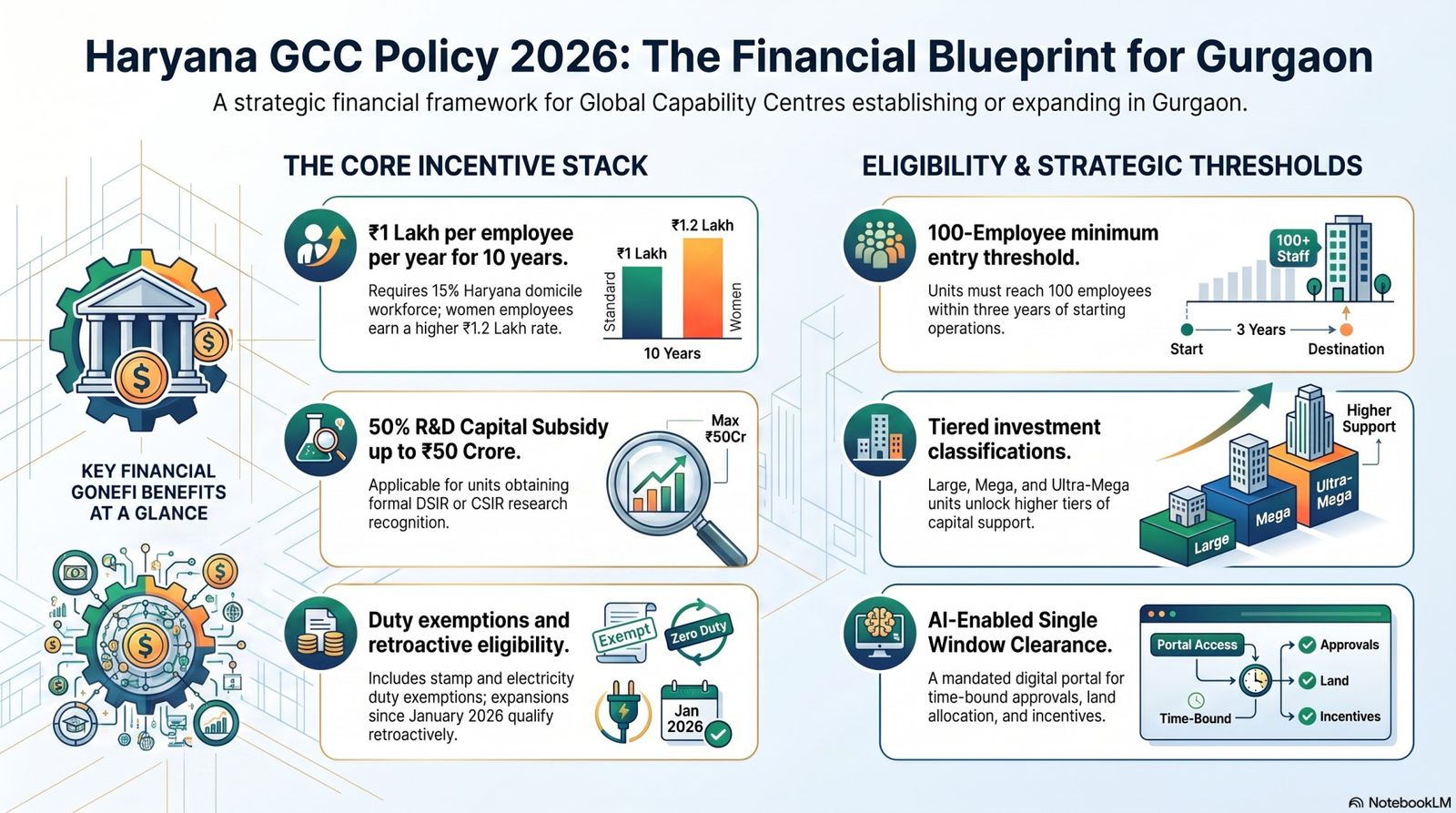
The policy does not rely on a single headline number. It stacks support across capital, operating, employment, R&D and regulatory heads, and, unlike the 2025 draft, every fiscal incentive is tiered by location. Gurugram district is split into Transit Oriented Development (TOD) zones and non-TOD zones, with a more generous third tier for every other district. Here is what each head means in practice.
An eligible unit is reimbursed a percentage of its eligible capital expenditure (ECE), paid out in ten annual instalments once operations begin or the committed investment is achieved, whichever is later. The percentage and the ceiling depend on where the unit sits and whether the office is owned or leased:
| Location of unit | CAPEX reimbursed | Ceiling — owned office | Ceiling — leased office |
|---|---|---|---|
| Gurugram district, non-TOD zone | 50% of ECE | Lower of ₹3.75 Cr per 100 eligible employees or ₹100 Cr | Lower of ₹2.50 Cr per 100 eligible employees or ₹50 Cr |
| Gurugram district, TOD zone | 65% of ECE | Lower of ₹3.75 Cr per 100 eligible employees or ₹125 Cr | Lower of ₹2.50 Cr per 100 eligible employees or ₹75 Cr |
| Any other district in Haryana | 75% of ECE | Lower of ₹3.75 Cr per 100 eligible employees or ₹150 Cr | Lower of ₹2.50 Cr per 100 eligible employees or ₹100 Cr |
What counts as ECE: construction, fit-out and furnishing, new machinery, IT hardware and software, stamp duty paid on purchase or lease of land or office space, external development charges for owned buildings, captive renewable energy of 100 kW or more, and the cost of green building certifications (LEED, IGBC, GRIHA, BEE). Land cost is excluded, and so is transferred (as opposed to newly purchased) equipment.
Two details matter for Gurgaon. First, TOD zones are whatever the Town and Country Planning Department, Haryana has notified as transit-oriented development areas along mass-transit corridors; confirm your building's status before modelling 65% rather than 50%. Second, employee headcount for the ceiling is counted in 100-employee blocks with a 50-employee shift rule: 151 eligible employees puts you in the 200 block, 150 keeps you in the 100 block.
This is the head that most directly touches the workspace decision. The policy reimburses a share of eligible operating expenditure every year for a fixed window:
| Location of unit | OPEX reimbursed | Duration | Annual ceiling |
|---|---|---|---|
| Gurugram district, non-TOD zone | 50% of eligible OPEX | 5 years from commercial operations | Lower of ₹0.75 Cr per 100 eligible employees or ₹15 Cr |
| Gurugram district, TOD zone | 65% of eligible OPEX | 7 years | Same ceiling |
| Any other district in Haryana | 65% of eligible OPEX | 9 years | Same ceiling |
Eligible OPEX is defined narrowly: electricity duty actually paid; lease rentals, eligible at 75% of actual rent paid and capped at 6% of the property's valuation by a registered valuer; internet bandwidth charges; and cloud rental charges, provided the service providers are India-registered with a valid GST number.
Worked example: a 200-seat unit in non-TOD Gurugram paying ₹8,500 per seat per month spends roughly ₹2.04 crore a year on workspace. A managed-office agreement for fitted space is a lease of office premises, so that fee is lease rent for the OPEX head: 75% of it (₹1.53 crore) is eligible expenditure, subject to the 6% registered-valuer cap, and 50% of that (about ₹76 lakh a year, for five years) is reimbursable — comfortably inside the ₹1.5 crore annual ceiling for a 200-employee block. In a TOD zone the same unit would recover 65% for seven years.
This is the benefit most often misquoted, so read the mechanics carefully. The subsidy applies per Haryana-local employee, not per employee, and it scales with the share of local employees in your workforce:
The maths, corrected: a 500-seat Gurgaon GCC that holds 20% Haryana-local staff (100 employees) at the ₹1 lakh cap collects about ₹1 crore a year, or roughly ₹10 crore over the decade. Push the local share to 30% and the per-employee rate rises toward the cap while the eligible headcount grows to 150. It is material, but it is earned by hiring plan, not by headcount alone.
New in 2026. Units that recruit Haryana-local employees through Haryana Kaushal Rozgar Nigam (HKRN) can claim 100% reimbursement of the employer's statutory EPF contribution for those employees for five years, subject to a ceiling of 12% of basic salary plus DA and a cap of ₹25,000 per employee per year. A parallel benefit reimburses the employee's own EPF contribution via Direct Benefit Transfer on the same cap.
For GCCs that establish DSIR- or CSIR-recognised R&D centres, the policy reimburses 50% of eligible capital cost, disbursed in five annual instalments: up to ₹50 crore per centre for ultra-mega projects, ₹25 crore for mega projects and ₹10 crore for all other approved centres. A 50% operating-cost reimbursement, capped at ₹2 crore per centre per year for five years, covers scientist and researcher salaries, conference participation, publication fees and consumables. Units have three years from commencement to apply, to allow for DSIR/CSIR recognition, and the track is capped at five R&D centres statewide.
This is the policy's clearest signal that Haryana wants innovation centres, not just service delivery back-offices. GCCs building product, data science, AI or engineering research functions have a financial reason to formalise those activities under DSIR/CSIR recognition.
The state reimburses 50% of the stipend paid to interns or apprentices, up to ₹15,000 per person per month for up to six months, for a maximum of 50 interns per unit per financial year; a targeted tool for building an early-career pipeline through industry–academia partnership.
The policy sets up a dedicated Haryana GCC Mission under the Administrative Secretary, Industries and Commerce, with a GCC single-window desk in Gurugram that offers handholding from location identification through approvals, and a GCC Advisory Council of officials, GCC leaders, service providers and academia as the apex strategic body. Clearances route through the Invest Haryana Single Window Portal, which covers 140-plus services against published service timelines. Self-certification is permitted under 14 labour Acts, a single online return replaces multiple labour filings, and GCC units may run three shifts with women on night shifts, subject to safety norms, with auto-renewal of permissions.
The most consequential clause is the one on timeliness: 50% of an eligible incentive claim is to be released within seven working days of preliminary scrutiny, the balance within 45 working days after detailed scrutiny, and interest at 8% per annum is payable on delays purely attributable to the Department. Mega and ultra-mega projects can additionally negotiate bespoke packages with the Haryana Enterprise Promotion Board (HEPB).
| Incentive | Benefit | Key condition |
|---|---|---|
| CAPEX support | 50% (Gurugram non-TOD) · 65% (Gurugram TOD) · 75% (other districts) of eligible capex; 10 annual instalments | Ceilings ₹50–150 Cr by tier and owned/leased; land excluded |
| OPEX support | 50% for 5 yrs · 65% for 7 yrs · 65% for 9 yrs by tier | Lease rent (75% of actual, ≤6% of valuation), electricity duty, bandwidth, cloud; ceiling ₹0.75 Cr per 100 employees or ₹15 Cr/yr |
| Employment generation subsidy | Up to ₹1 lakh per Haryana-local employee per year (₹1.2 lakh for women/SC/Divyang/ex-servicemen) for 10 years | ≥15% local workforce for general category; PPP-verified; ₹48,000 floor |
| HKRN recruitment booster | 100% employer EPF reimbursed for 5 years, ≤₹25,000 per employee per year | Local employees hired via HKRN |
| R&D capital grant | 50% of eligible capex; ₹10 / ₹25 / ₹50 Cr cap by project size | DSIR/CSIR-recognised centre; apply within 3 years |
| R&D opex reimbursement | 50% up to ₹2 Cr per centre per year for 5 years | DSIR/CSIR-recognised centre |
| Internship support | 50% of stipend, ≤₹15,000/month, ≤6 months | Up to 50 interns per unit per year |
| Stamp duty on office purchase/lease | Counted as eligible capital expenditure under CAPEX support | Not a separate exemption |
| Electricity duty | Counted as eligible operating expenditure under OPEX support | Not a separate exemption |
| Disbursement | 50% within 7 working days, balance within 45 working days | 8% p.a. interest on departmental delay |
| Night shifts for women | 3-shift operations permitted | Safety norms; self-certified auto-renewal |
The policy is not open to all. Check these before building financial projections around the incentive stack.
Phasing matters. A 90-seat GCC that reaches 100 employees in month eight unlocks a different benefit profile from one that crosses it in month thirty-six, and a unit that crosses 150 eligible employees moves up a ceiling block.
Gurgaon already hosts the densest cluster of GCCs in North India, and the 2025 to 2026 announcements show the policy landing on fertile ground rather than empty fields. Three names from the last twelve months:
Expansions tell the same story. Alvarez & Marsal plans to grow its Gurugram advisory GCC from about 700 people to nearly 2,000 by 2028. National Australia Bank, in Gurugram since 2022, opened a second office at DLF Downtown in June 2026 and was the one GCC named among the day-one signatories under the Haryana GCC Policy.
The established base is larger still. American Express opened its biggest campus anywhere in the world, about 1 million sq ft in Sector 74A, in May 2024. Expedia Group has run a technology centre here since 2010 with more than 3,800 people. Fidelity International, in Gurugram since 2001, calls its India operation the largest capability hub in the group, with more than 4,500 employees.
What the new entrants have in common: they signed for finished, operator-run floors in Grade-A towers rather than building their own, and they staged headcount in phases. That is exactly the shape a managed office is built for, and the policy's OPEX reimbursement covers the lease rent on it.
The policy is explicit that the application precedes operations. A practical sequence:
The policy is substantive. It also has three features that companies should understand before modelling maximum benefits.
The tiering is deliberate: Panchkula, Hisar and other districts get 75% CAPEX and a nine-year OPEX window, against 50% and five years in non-TOD Gurugram. That reflects a balanced regional development objective. For companies where Gurgaon is operationally non-negotiable, it doesn't change the conclusion, but it does mean Gurgaon GCCs should model the 50%/65% tier rather than the headline 75%.
The 15% local-workforce threshold and PPP verification mean the employment subsidy is earned by recruiting Haryana residents deliberately. Gurgaon's engineering and technology talent draws heavily from Delhi, Noida and the wider NCR; hitting 15% (and growing it) needs to be in the workforce plan from day one, not treated as a natural outcome of Gurgaon hiring. HKRN-routed hiring compounds the benefit through the EPF booster.
Every head requires documentation, time-bound filings and sustained compliance across the incentive period; the employment subsidy runs ten years, CAPEX disburses over ten instalments, R&D over five. Missing filing windows or falling below qualifying ratios risks partial or full forfeiture. Build the administrative structure in at launch, not after the first claim is queried.
Karnataka, Telangana, Tamil Nadu and Maharashtra are the states Haryana is explicitly competing with for GCC investment, per Grant Thornton's analysis, and several have GCC-specific policies or frameworks of their own. Without reproducing every state's schedule here, Haryana's differentiators are structural: a standalone GCC policy rather than an IT/ITeS umbrella; CAPEX and OPEX support that is location-tiered and explicitly includes lease rent; binding 7/45-working-day disbursement with interest on delay; an EPF booster tied to local recruitment; and a dedicated mission office in Gurugram. For a company choosing between North India and the south, the honest comparison is total cost of operation after incentives, plus the talent and ecosystem factors below.
The talent argument is decisive. Gurgaon's IT, engineering, BFSI and consulting talent pool is the densest in North India. A GCC at 500 seats needs to hire 500 qualified people in a reasonable window, often 12–18 months, and that is only achievable where the pool is deep enough to absorb rapid hiring without scarcity pushing salary benchmarks up 30–40%. Panchkula and Hisar cannot yet offer this at scale for most technology and professional-services functions.
The ecosystem argument compounds it. Gurgaon's density of existing GCCs creates lateral movement: experienced talent who understand global operating models. As JLL India's GCC research notes, clusters are self-reinforcing, and Gurgaon is already the North India cluster. Our analysis of office leasing drivers for tech, BFSI and GCC occupiers to 2030 shows the same concentration in the leasing data.
Airport access seals it for companies whose global leadership visits regularly: IGI Terminal 3 in 20–30 minutes is a daily reality for Gurgaon GCCs; from Panchkula the same journey is 45–60 minutes.
Policy incentives reduce the cost of running a GCC. Workspace determines whether it can actually function.
GCC setup failures in Gurgaon rarely happen because the policy wasn't favourable. They happen because the space wasn't ready when hiring started, because fit-out quality didn't match a global brand standard, because power or connectivity failed under load, or because expansion didn't happen smoothly when headcount outgrew the original plan. These are solvable when workspace planning starts alongside policy evaluation. The GCC office requirements guide covers what multinationals actually need from Gurgaon office space: power density, international bandwidth, floor-plate efficiency and 24/7 building operations for follow-the-sun teams.
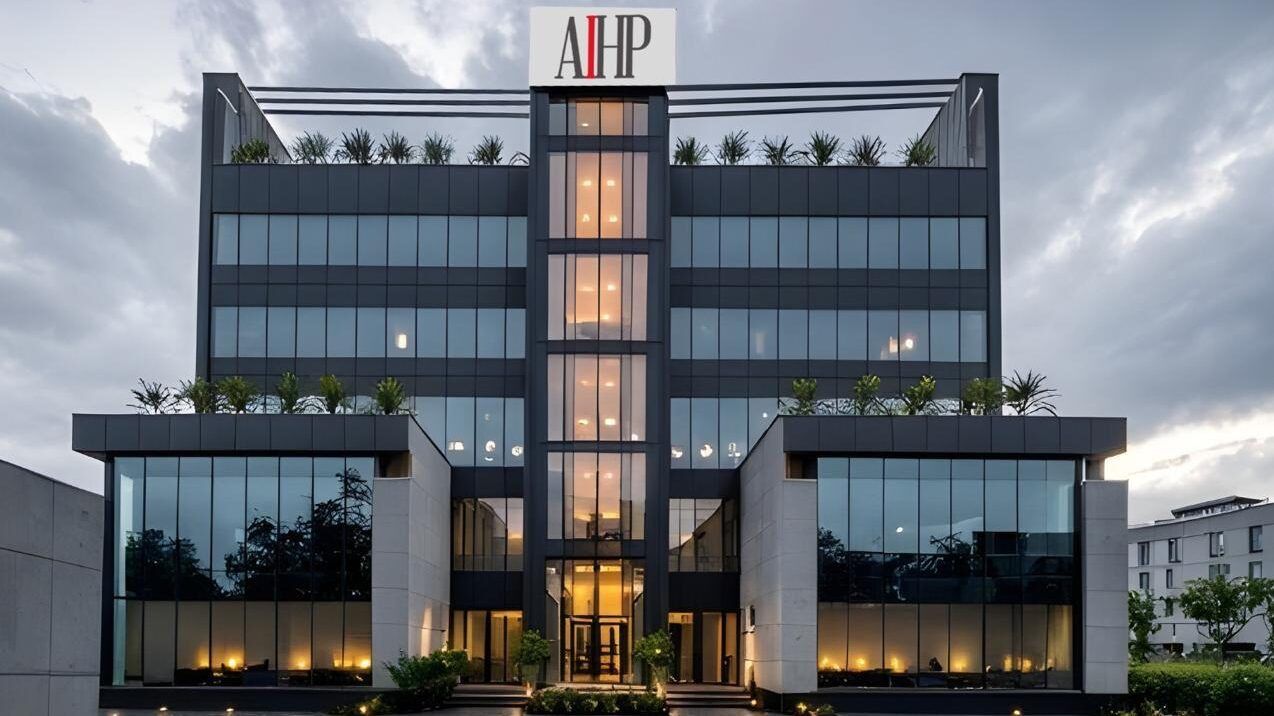
AIHP manages 30+ assets across Gurgaon. The buildings that matter most for GCC operations sit in two owned portfolios, 11 buildings in Udyog Vihar and 7 in Sector 32, both with NH-48 access, metro proximity and the infrastructure specifications global companies require. Our GCC office space solution is built for exactly this brief.
The policy reimburses capex precisely because setup capital is a friction point for GCC launches. AIHP's managed model removes the problem differently: fit-out, furniture, power backup, internet, housekeeping and facilities management are included in a single monthly per-seat fee, with no upfront capital on workspace. And because AIHP's agreement is a lease of fitted office premises, the per-seat fee sits squarely in the policy's OPEX head as lease rent (75% of actual rent eligible, subject to the valuation cap), alongside the bandwidth and electricity duty it already includes — the state shares 50–65% of it for five to nine years. Our total cost of occupation analysis shows why managed office frequently outperforms a traditional lease over any three-year horizon even before incentives.
When a global HQ approves the India centre there is typically a 90–180 day window to be operational before business pressure or leadership attention shifts. A 60-day workspace delivery lands inside that window; a traditional fit-out of 16–20 weeks often does not.
GCCs with specific requirements, from dedicated server rooms to branded reception environments and lab or studio space, can have them designed and built into the space without the capex burden of a traditional lease. AIHP absorbs the fit-out investment; the tenant occupies a purpose-built space on the per-seat model.
A centre that starts at 150 seats is typically at 300–400 within three to five years if the function succeeds. AIHP's portfolio depth, 10+ owned buildings in Udyog Vihar alone, means expansion happens within the same management framework, building standards and vendor relationships: no office move, no new lease negotiation, no disruption. That is the story of the Daas Labs case study: 85 to 200-plus seats across two AIHP buildings in Udyog Vihar without a single day of building disruption.
For most GCC operations the choice comes down to two AIHP corridors. Udyog Vihar offers the deepest portfolio (₹6,500–15,000 per seat per month), Gurgaon's most established IT/ITeS ecosystem and the largest floor plates for high-density configurations; see the Udyog Vihar office market guide. Sector 32 offers NH-48 frontage and a mid-market address at ₹6,500–12,500 per seat. Golf Course Extension Road, through AIHP Central, serves GCCs that want premium positioning in South Gurgaon's emerging corridor.
📥 RESOURCE: Daas Labs grew from 85 to 200+ seats across two AIHP buildings in Udyog Vihar. Zero CapEx on fit-out. Zero disruption during the move. Read the Daas Labs case study →

The Haryana GCC Policy 2026 is the most structured state-level GCC incentive framework Gurgaon has operated under. Tiered CAPEX and OPEX support that reaches into office rent, an employment subsidy of up to ₹1 lakh per local employee per year for a decade, R&D grants of up to ₹50 crore and a 7/45-working-day disbursement promise with interest are all material at GCC scale.
But the policy is a financial input, not a location decision. Gurgaon wins on talent, ecosystem, airport access and corporate density, factors that policy cannot manufacture in Panchkula or Hisar within five years. The policy makes Gurgaon more financially attractive; it doesn't make anywhere else operationally equivalent.
The decision sequence for a GCC evaluating Gurgaon: validate operational fit (talent, ecosystem, timeline); model incentive capture honestly (tier, local-hiring plan, documentation burden); then solve the workspace question in a way that eliminates setup friction and keeps capital in the GCC's actual function. AIHP has been the workspace choice for GCC-scale operations in Gurgaon across new launches and scaling companies. To understand how Gurgaon workspace fits your operating model, timeline and budget, get in touch with AIHP or find your office.
Workspace12 Jun 2026 · Sarthhak Kaluucha · 13 min read
 Workspace
9 Jun 2026 · Sarthhak Kaluucha · 13 min read
 Workspace
5 Jun 2026 · Sarthhak Kaluucha · 11 min read
Ready to move your team?
Fully-managed private offices across Gurgaon's prime corridors — move-in ready, fully serviced, sized for your team.