Every CFO evaluating Gurgaon office space faces the same calculation: flex office quotes come in at ₹15-20K per seat monthly. Traditional lease is ₹10-14K per seat. The math seems obvious—traditional is 30-40% cheaper.
But that comparison ignores upfront CapEx, security deposits, fit-out timelines, and operational costs that make traditional leases far more expensive in years 1-2. The real question isn’t “which has lower monthly cost?” It’s “which has lower total cost over our actual occupancy period?”
Here’s the financial analysis that matters.
The True Cost Structure: Flex vs Traditional
Flex/Managed Office Model (AIHP-style):
Monthly per-seat cost: ₹15-20K depending on location and specifications
Includes:
– Fully furnished workstations and meeting rooms
– Utilities (electricity, internet, water)
– Housekeeping and maintenance
– Pantry services and consumables
– Reception and administrative support (some providers)
– Building management and security
– Equipment (printers, TVs, AV systems)
– 3-year warranty on AC and lighting systems
Upfront costs:
– Security deposit: 6 months rent (₹90K-120K per seat)
– Zero fit-out CapEx
– Zero furniture procurement
– Zero equipment purchases
Timeline to occupancy: 0-7 days (move-in ready)
Lock-in period: Typically 3 years (though AIHP offers flexibility)
Traditional Lease Model:
Monthly per-seat cost: ₹10-14K base rent only
Additional monthly costs:
– Common area maintenance (CAM): ₹15-25/sq ft (₹750-1,250/seat at 50 sq ft/seat)
– Electricity: ₹2,500-4,000/seat (varies by power consumption)
– Internet and telecom: ₹800-1,500/seat
– Housekeeping: ₹600-1,000/seat
– Maintenance and repairs: ₹400-800/seat
– Security: ₹300-600/seat
– Pantry consumables: ₹500-800/seat
Actual monthly cost: ₹16-23K per seat (not ₹10-14K)
Upfront costs:
– Security deposit: 6-9 months rent (₹60K-126K per seat at ₹10-14K)
– Fit-out CapEx: ₹2-3.5 lakhs per seat (furniture, partitions, electrical, HVAC modifications, flooring, paint, branding)
– Equipment: ₹15-25K per seat (printers, AV, pantry equipment)
– Professional fees: ₹50-80K (architect, interior designer, project management)
Timeline to occupancy: 3-6 months (planning, approvals, construction, installation)
Lock-in period: 3 years minimum (often 5-9 year lease)
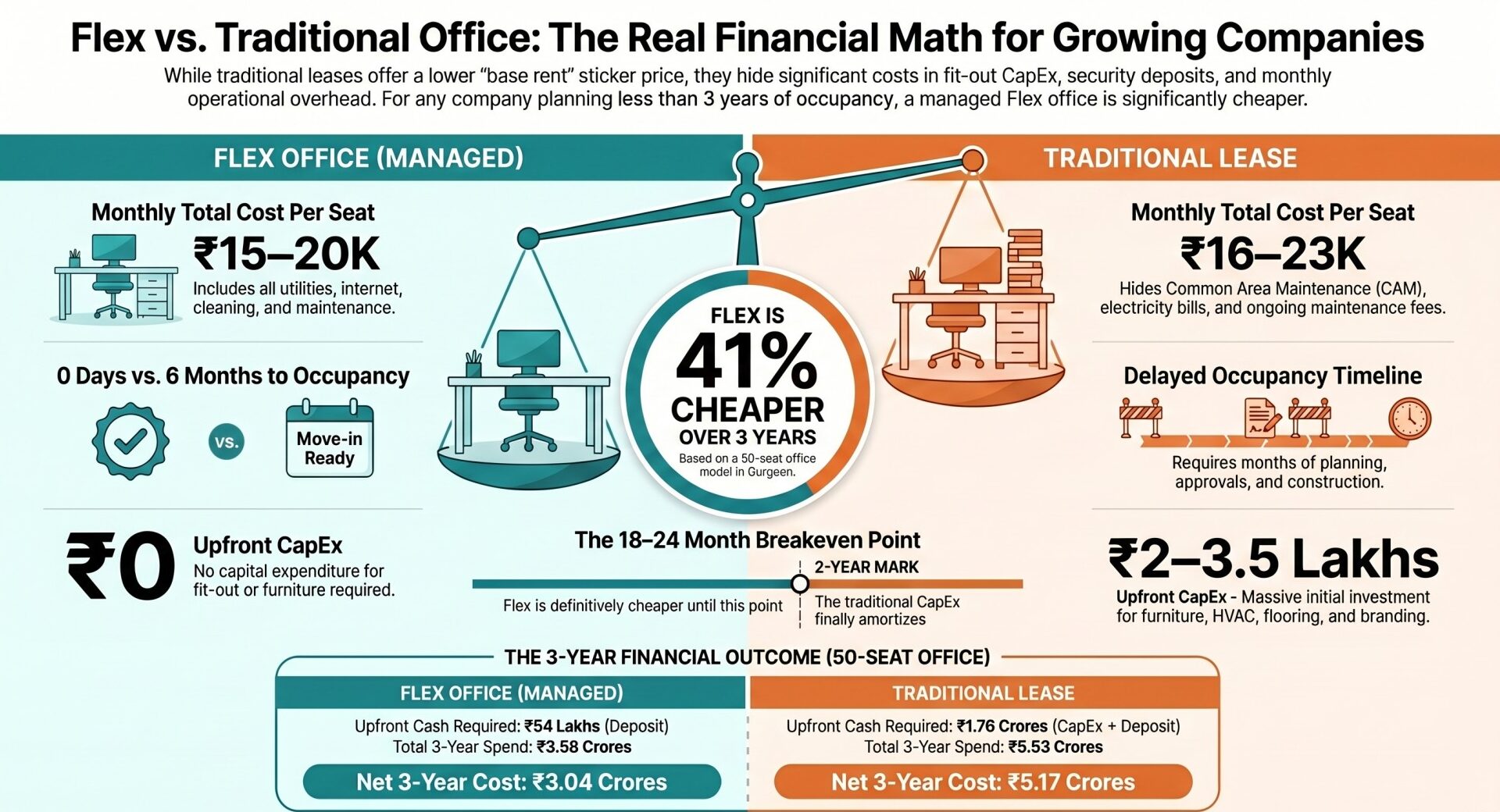
The Real Financial Comparison: 50-Seat Office Over 3 Years
Let’s model actual costs for a 50-person company taking 2,500 sq ft office space in Gurgaon over 3 years.
FLEX OFFICE (₹18K/seat):
Year 1:
– Security deposit: ₹54 lakhs (6 months × ₹18K × 50 seats)
– Monthly cost: ₹9 lakhs (₹18K × 50)
– Annual cost: ₹1.08 crores
Year 2:
– Annual escalation (10%): Monthly ₹9.9 lakhs
– Annual cost: ₹1.19 crores
Year 3:
– Annual escalation (10%): Monthly ₹10.89 lakhs
– Annual cost: ₹1.31 crores
3-year total: ₹3.58 crores
Security deposit returned: ₹54 lakhs
Net 3-year cost: ₹3.04 crores
TRADITIONAL LEASE (₹12K/seat base rent):
Upfront (Year 0):
– Security deposit: ₹36 lakhs (6 months × ₹12K × 50)
– Fit-out CapEx: ₹1.25 crores (₹2.5 lakhs × 50 seats)
– Equipment and furniture: ₹10 lakhs
– Professional fees: ₹5 lakhs
– Total upfront: ₹1.76 crores
Year 1:
– Base rent: ₹6 lakhs monthly
– CAM: ₹0.5 lakhs monthly
– Utilities: ₹1.75 lakhs monthly
– Maintenance, housekeeping, security: ₹0.95 lakhs monthly
– Pantry and consumables: ₹0.3 lakhs monthly
– Total monthly: ₹9.5 lakhs
– Annual: ₹1.14 crores
Year 2:
– Annual escalation (10%): Monthly ₹10.45 lakhs
– Annual cost: ₹1.25 crores
– Furniture refresh/replacement: ₹8 lakhs
Year 3:
– Annual escalation (10%): Monthly ₹11.5 lakhs
– Annual cost: ₹1.38 crores
3-year total: ₹5.53 crores (including ₹1.76 crore upfront)
Security deposit returned: ₹36 lakhs
Net 3-year cost: ₹5.17 crores
FLEX IS 41% CHEAPER OVER 3 YEARS (₹3.04 crores vs ₹5.17 crores)
Where Traditional Lease Costs Hide
The ₹10-14K per seat “rent” number ignores five major cost categories:
1. Upfront CapEx (₹2-3.5 lakhs/seat)
This isn’t recovered if you vacate before lease end. Companies planning 3-year occupancy that exit in year 2 lose entire CapEx investment. Flex office converts this to operating expense—you pay monthly, stop when you leave.
2. Opportunity cost of capital
₹1.25 crores in fit-out CapEx for 50-seat office could fund 4-5 additional hires, product development, or marketing. That capital is locked in office infrastructure for 3+ years. Flex office preserves capital for growth.
3. Fit-out timeline (3-6 months)
Traditional lease requires 3-6 months between signing and occupancy. That’s 3-6 months of paying rent with zero productivity. Flex office is move-in ready—sign today, operate tomorrow. For scaling companies, 3-month delay can mean lost contracts or delayed launches.
4. Operational overhead
Traditional lease means your team manages vendors (housekeeping, maintenance, security, pantry), negotiates service contracts, handles equipment breakdowns, and coordinates repairs. Flex office bundles this into single vendor relationship. Your office manager focuses on business support, not facility management.
5. Replacement and refresh cycles
Furniture wears out. AC units fail. Carpets stain. In traditional lease, you fund replacements. In flex office, provider maintains quality through warranty periods and planned refresh. This costs ₹50K-100K annually in traditional setup.
Breakeven Analysis: When Does Traditional Become Cheaper?
The crossover point where traditional lease total cost drops below flex depends on occupancy duration:
18-24 month breakeven:
If you occupy for less than 18-24 months, flex is definitively cheaper because traditional’s upfront CapEx doesn’t amortize. Even if monthly costs are similar, you haven’t recovered initial ₹1.5-2 crore investment.
3-4 year neutral zone:
Years 3-4 are roughly cost-neutral when you factor in all costs. Traditional’s lower base rent starts offsetting upfront CapEx, but you’re still funding operational expenses that flex bundles.
5+ years traditional advantage:
Beyond year 5, traditional lease becomes cheaper if your operation is stable and space needs are predictable. The CapEx has amortized, monthly costs are lower, and you’re not paying for flex flexibility you don’t use.
However, this assumes zero changes to team size, layout, or location—unrealistic for most growing companies.
Decision Framework: When Flex Makes Financial Sense
Choose flex/managed office when:
Your occupancy timeline is uncertain (0-3 years):
Startups raising Series A/B planning 12-18 month runway. Companies testing new markets. Teams with undefined growth trajectory. Flex protects downside—if business doesn’t scale as expected, you’re not stuck with 9-year lease and unusable CapEx.
You’re scaling rapidly (20%+ annual headcount growth):
Companies growing 50 → 75 → 110 seats over 3 years can’t predict space needs accurately. Traditional lease locks you into fixed square footage. Flex providers offer expansion options within same building or portfolio without re-negotiation.
Capital is constrained or better deployed elsewhere:
Early-stage companies with limited cash. Growth-stage companies where ₹1-2 crores in CapEx means 2-3 fewer quarters of runway. Better to preserve capital for product, sales, or hiring than tie it up in office infrastructure.
You need fast deployment (30-60 days):
Winning a major contract requiring immediate team ramp. Opening GCC operation with tight launch timeline. Relocating team due to infrastructure or commute issues. Flex office delivers occupancy in days, not months.
Operational complexity is unwanted:
Small teams (20-50 people) don’t want dedicated facilities management. Leadership wants to focus on business, not vendor coordination. Flex office consolidates operational overhead into single monthly bill.
You value newer infrastructure:
Flex providers maintain modern buildings, recent furniture, current technology. Traditional spaces age—your 2026 fit-out looks dated by 2029. Flex ensures consistent quality through provider’s maintenance cycles.
When Traditional Lease Makes Financial Sense
Choose traditional lease when:
You have 5+ year stable occupancy:
Established operations with predictable headcount. Companies with long client contracts justifying multi-year commitment. Businesses where office is core to culture (not remote-first). Traditional’s lower monthly costs compound over long tenures.
Your space needs are fixed and well-defined:
Mature teams with stable structures. Operations where layout is standardized (call centers, back-office processing). You know exactly what you need and won’t change it. Worth investing in [build-to-suit] customization.
Capital is available and CapEx is preferred accounting:
Profitable companies with strong balance sheets. Organizations preferring asset ownership over operating expense. Businesses where office quality signals market positioning (law firms, consulting, finance).
You need extreme customization:
Specialized operations requiring unique infrastructure (labs, secure facilities, custom HVAC). Standard flex office specifications don’t meet technical requirements. Worth paying for ground-up customization.
Your team is location-stable:
Employees committed to specific micro-market. Low turnover means established commute patterns. Not testing new locations or considering relocations. Traditional lease locks favorable location for long term.
How This Fits Into Total Cost of Occupation
The flex vs traditional decision is part of broader total cost of occupation analysis. Beyond rent and CapEx, consider:
Commute costs:
Flex providers often have multiple locations, giving optionality to optimize for team geography. Traditional lease locks single location. If employee distribution shifts, you’re stuck with suboptimal commute patterns costing productivity.
Scaling friction:
Growing from 50 → 80 seats in traditional space requires subleasing excess capacity elsewhere or cramming more desks than designed. Flex providers offer staged expansion within portfolio. Friction costs show up in delayed hiring or operational inefficiency.
Exit costs:
Breaking traditional lease early triggers penalties (remaining rent obligation, lost deposits, legal costs). Flex contracts typically have shorter notice periods (60-90 days). For companies with uncertain futures, exit flexibility has real option value.
Meeting room and amenity costs:
Traditional lease requires you to size meeting rooms upfront. Flex providers pool resources across tenants, giving access to larger inventory without building it yourself. Undersizing meeting rooms in traditional space leads to external booking costs (₹30-50K monthly).
The Hybrid Approach: Phased Strategy
Smart companies often use phased approach:
Phase 1 (Year 0-2): Flex office
– Prove business model
– Stabilize team size
– Understand actual space needs
– Preserve capital for growth
– Fast deployment
Phase 2 (Year 3-5): Traditional lease
– Team size stabilized at 100+ people
– Business model proven and funded
– Long-term location identified
– CapEx investment justified
– Custom build-out worthwhile
This approach captures flex benefits early (speed, flexibility, capital preservation) while transitioning to traditional economics once operations stabilize.
📥 RESOURCE: Download The Ultimate Guide to Gurgaon Office Space for complete cost comparison templates, lease negotiation checklists, and fit-out CapEx calculators covering both flex and traditional models.

Conclusion: Match Model to Business Stage
Flex office isn’t universally better or worse than traditional lease—it’s optimized for different business stages and needs.
The headline rent comparison (₹15-20K flex vs ₹10-14K traditional) is misleading. Real comparison includes upfront CapEx (₹2-3.5 lakhs/seat), security deposits, operational costs, and timeline to occupancy. When you model total costs over actual occupancy period, flex is cheaper for 0-3 year timelines.
For growing companies with uncertain trajectories, capital constraints, or fast deployment needs, flex office delivers better financial outcomes. For stable operations with 5+ year horizons and available capital, traditional lease amortizes CapEx into lower long-term costs.
The decision isn’t “which is cheaper?”—it’s “which model matches our growth stage, capital position, and timeline certainty?”
For detailed cost modeling specific to your situation and guidance on structuring optimal lease terms, get in touch with AIHP.