Six months ago you signed a 3-year lease for 100-seat office anticipating Series B growth. The round fell through. Strategy pivoted. Team downsized from 100 to 60 employees. You’re stuck paying ₹18 lakhs monthly for space designed for 100 when you only need seating for 60.
Traditional lease lock-in means you’re committed for 30 more months. Walking away triggers penalties: remaining lease obligation (₹5.4 crores), lost security deposit (₹1.08 crores), legal costs. You need solutions that don’t destroy the balance sheet.
Here’s how to right-size office space during pivots without breaking leases or business.
Why Office Space Becomes Misaligned During Pivots
Office leases are planned during optimistic projections. Reality diverges. Common pivot scenarios:
Growth projection missed:
Planned 80 → 150 employees over 24 months based on Series B funding. Round delayed or reduced. Actual growth: 80 → 95 employees. Office sized for 150 sits 40% empty.
Business model pivot:
B2C company with 100-person sales team pivots to B2B enterprise model. New model needs 40-person team (fewer people, higher deal sizes). Office space suddenly 60% oversized.
Strategic contraction:
Company exits unprofitable segment, refocuses on core business. Headcount drops 30-40%. Office lease doesn’t shrink with strategy.
Acquisition or merger:
Parent company consolidates operations. Your 80-person team merges into acquirer’s existing office. Your lease has 24 months remaining on space you no longer need.
Remote/hybrid shift:
Pre-COVID planned for 100% in-office. Post-COVID operates 60% remote. Need 40 seats, have 100.
In each case, the lease was reasonable when signed. Circumstances changed. Office space didn’t.
Five Strategies to Right-Size Without Breaking Leases
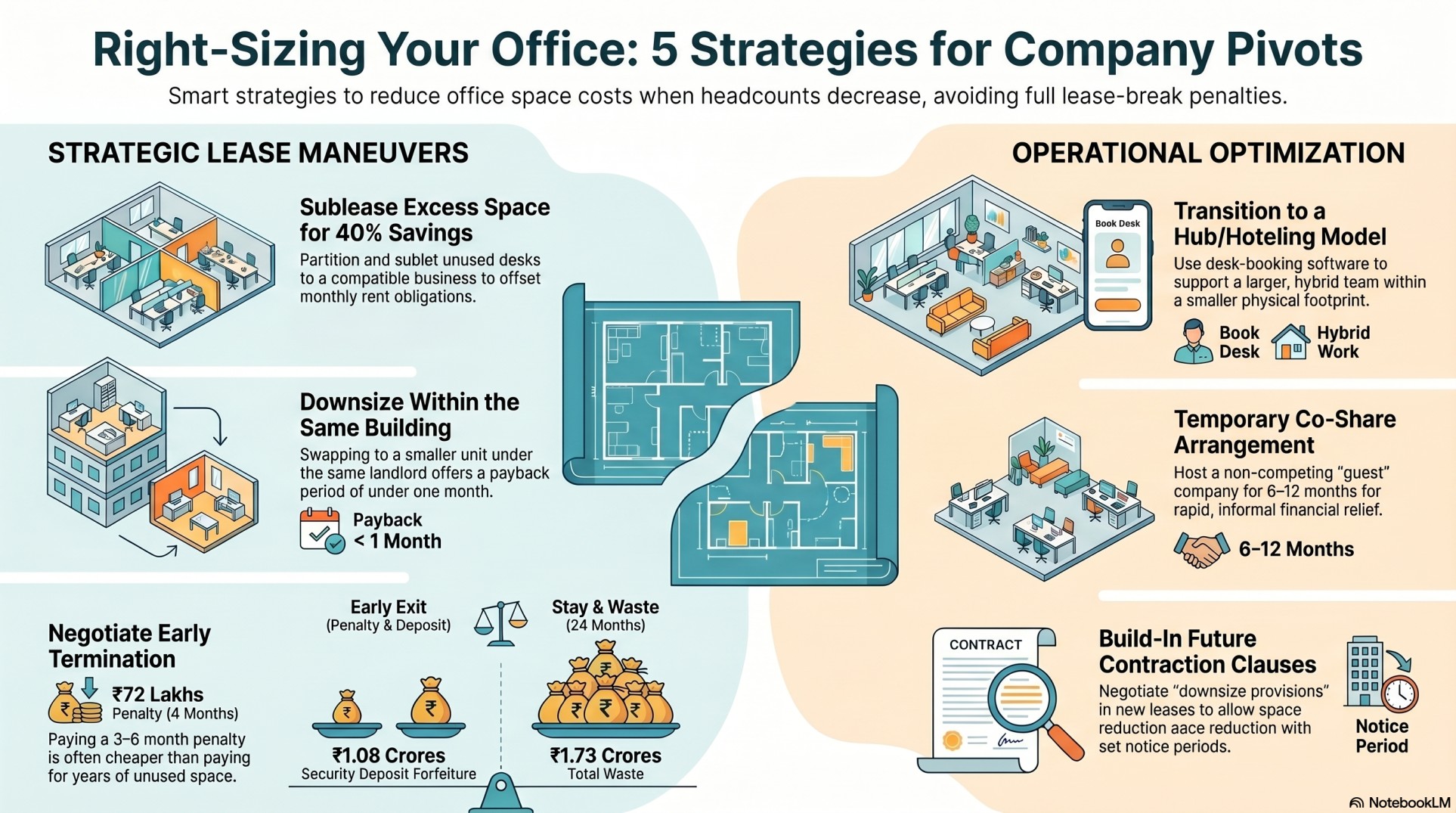
Strategy 1: Sublease Excess Space
How it works:
Partition your 100-seat office into 60-seat zone (which you occupy) and 40-seat zone (which you sublease to another company). Sublessee pays rent directly to you, you pay full rent to landlord.
Requirements:
– Lease must permit subleasing (many don’t, or require landlord consent)
– Physical layout allows clean partition without disrupting your operations
– You have time/capability to find sublessee
– Sublessee’s business is compatible with yours (no competitors, cultural fit, complementary hours)
Economics:
If your rent is ₹18 lakhs monthly for 100 seats (₹18K per seat), you sublease 40 seats at market rate (₹15-18K per seat depending on location):
– Your payment to landlord: ₹18 lakhs
– Sublessee payment to you: ₹6-7.2 lakhs (40 seats × ₹15-18K)
– Your net cost: ₹10.8-12 lakhs (vs ₹18 lakhs)
– Savings: 33-40%
Challenges:
Finding qualified sublessee takes 2-4 months. You carry full cost during search. Sublessee may want shorter term than your remaining lease, creating gap risk. You remain liable to landlord if sublessee defaults. Partitioning space requires minor construction (₹3-5 lakhs).
When it works:
Your lease explicitly permits subleasing. Physical layout enables clean split. You have 18+ months remaining lease (enough to justify search effort and construction). Your location is desirable market where subtenants exist.
Strategy 2: Negotiate Early Termination With Landlord
How it works:
Approach landlord with proposal: You pay termination penalty (typically 3-6 months rent), exit lease early, landlord re-lets space to new tenant.
Negotiation leverage:
Landlords prefer dealing with one direct tenant over managing sublease situation. If you sublease and sublessee creates problems (damages, non-payment, lease violations), landlord has limited recourse against sublessee. Early termination removes this risk.
Additionally, if your lease is below current market (you signed at ₹16K/seat 18 months ago, market is now ₹18K/seat), landlord benefits by re-letting at higher rate.
Typical terms:
Penalty: 3-6 months remaining rent
+ Security deposit treatment: Forfeited or partially refunded
+ Notice period: 60-90 days
+ Condition restoration: Return space to original condition
For 100-seat office at ₹18 lakhs monthly with 24 months remaining:
– Full lease obligation: ₹43.2 lakhs (24 × ₹18L)
– Early termination penalty (4 months): ₹72 lakhs
– Security deposit forfeit: ₹1.08 crores
– Total exit cost: ₹1.8 crores
Compare to continuing lease while downsizing (60 seats occupied, 40 empty):
– 24 months × ₹18 lakhs = ₹4.32 crores
– New smaller space (60 seats at ₹18K): 24 months × ₹10.8L = ₹2.59 crores
– Net waste: ₹1.73 crores
Early termination (₹1.8 crores) is similar to waste from staying (₹1.73 crores), but you move to right-sized space immediately versus suffering 24 months in wrong space.
When it works:
You have 18-24+ months remaining lease (makes negotiation worthwhile). Landlord has demand for your space (can re-let quickly). Your lease rate is below current market (landlord gains from re-letting). You have capital available for penalty payment upfront.
Strategy 3: Downsize Within Same Building
How it works:
If landlord owns multiple units in same building, negotiate swap: exit your 100-seat space, move into available 60-seat unit in same building.
Advantages over full relocation:
Minimal moving cost (same building, same floor possibly). Team familiarity with location and amenities. Simpler logistics than changing buildings entirely. Landlord retains you as tenant (better than losing you completely).
Negotiation:
– Transfer remaining lease term to smaller unit
– Adjust security deposit to match new rent
– Landlord re-lets your old space
– Minimal penalty (1-2 months rent) for switch
For 100-seat to 60-seat swap:
– Old rent: ₹18 lakhs monthly
– New rent: ₹10.8 lakhs monthly
– Penalty: ₹1.8-3.6 lakhs (1-2 months old rent)
– Moving cost: ₹2-3 lakhs (same building)
– Total cost: ₹4-7 lakhs one-time
– Ongoing savings: ₹7.2 lakhs monthly
Payback: <1 month
When it works:
Landlord has smaller available unit in same building. You can move within 30-60 days. Your team is location-dependent (don’t want to change commute patterns). Landlord values tenant retention over maximizing penalty.
This is most common in managed office buildings where provider operates multiple floor plates and can shuffle tenants flexibly.
Strategy 4: Convert to Hub/Hoteling Model
How it works:
Instead of exiting oversized space, convert operating model. Keep 100-seat office but implement hub model where 60 assigned seats + 40 hot-desking/hoteling seats support 80-90 total employees rotating through office.
How it supports downsizing:
Your 60 core employees (always in office) occupy 60 assigned seats. You hire additional 20-30 employees as remote-primary with occasional office access. They use 40 hot-desking seats on rotation. Total team: 80-90 employees in space designed for 100, but only 60-70 present on any given day.
This converts “space waste” into “strategic flexibility.” You’re no longer paying for empty space—you’re paying for optionality to scale team without hitting capacity constraints.
Operational requirements:
– Implement desk booking system (Robin, Envoy, or similar)
– Convert fixed seats to hoteling stations
– Increase meeting room allocation (hot-desking employees use more meeting rooms)
– Clear hoteling policies (how to reserve, storage for personal items, etc.)
When it works:
Your pivot includes remote/hybrid shift (so rotational model fits). You can hire additional remote employees who benefit from occasional office access. Team accepts hoteling model culturally. You have 12+ months remaining lease (enough time to realize value from model).
Cost dynamics:
You still pay full ₹18 lakhs monthly rent, but you support 80-90 employees instead of 60. Effective cost per employee drops from ₹30K (60 employees) to ₹20-22K (80-90 employees). This partially offsets “wasted” space cost.
Strategy 5: Temporary Co-Share Arrangement
How it works:
Find non-competing company in similar situation (needs temporary space while building permanent office, testing Gurgaon before committing, short-term project team). Offer informal co-share: they occupy 30-40 seats in your space, pay you directly for 6-12 months.
Difference from sublease:
Sublease is formal lease transfer with landlord awareness. Co-share is informal arrangement where you maintain master lease, other company is essentially your guest. Less legal complexity, more flexibility, but also more risk.
Typical arrangement:
– Company B needs 30 seats for 9-month GCC pilot
– You have 40 empty seats in your 100-seat office
– Company B pays you ₹5.4 lakhs monthly (30 seats × ₹18K)
– You pay landlord ₹18 lakhs monthly
– Your net cost: ₹12.6 lakhs (vs ₹18 lakhs)
– Duration: 9 months
– Total savings: ₹48.6 lakhs over 9 months
When it works:
You need short-term (6-12 month) relief while waiting for natural lease end or other solution. Your landlord relationship is flexible (they won’t object to additional people in space). Compatible company exists in your network. You’re comfortable with informal arrangement risk.
Risks:
Landlord may object or demand rent increase if they discover arrangement. Co-sharing company has no direct obligation to landlord (if they default, you’re liable). Cultural/operational fit issues (noise, meeting room conflicts, security concerns). Insurance and liability questions.
This is highest-risk strategy but fastest to implement and requires no landlord negotiation.
Lease Flexibility Advantage in Managed Office Models
Traditional leases create exactly this problem: companies commit to 3-9 year leases at projected peak occupancy, then get stuck when reality diverges.
Managed office models build in flexibility:
Shorter lock-ins:
3-year minimum versus 5-9 years traditional. Easier to wait out wrong-size situation.
Built-in contraction options:
Many managed providers offer downsize clauses: if occupancy drops >25%, you can reduce seats with 90-120 days notice. Pay small adjustment fee (3-6 months rent differential), avoid being trapped.
Portfolio mobility:
Providers with multiple buildings can move you between locations or floor plates based on changing needs. Your 100-seat lease converts to 60-seat lease in different building within same provider’s portfolio.
This is why flex versus traditional analysis isn’t just about month-1 cost—it’s about cost over uncertain future. If there’s 30% chance your space needs change in years 2-3, managed model’s flexibility premium is insurance against being stuck.
Decision Framework: Which Strategy Fits Your Situation
Choose sublease when:
– Lease permits and you have 18+ months remaining
– Clean physical partition possible
– You have bandwidth to find/manage subtenant
– Want to preserve optionality to re-expand if pivot succeeds
Choose early termination when:
– You have capital for penalty payment
– New business direction clearly needs different space (different location, size, or type)
– Remaining lease is short enough (18-24 months) that penalty is <50% of remaining obligation
– Landlord has demand for your space
Choose within-building downsize when:
– Landlord has suitable smaller unit available
– Same location still works for your pivoted strategy
– Relationship with landlord is good
– Want lowest-friction option
Choose hub/hoteling model when:
– Pivot includes remote/hybrid element
– You can hire additional remote employees
– Team culturally accepts hoteling
– Want to avoid moving disruption
Choose co-share arrangement when:
– Need temporary 6-12 month relief
– Have flexible landlord relationship
– Compatible company in your network
– Comfortable with informal arrangement risk
Preventing Future Office-Size Mismatch
Stage space commitments:
Don’t sign 3-year lease for peak projected occupancy. Sign for current +20% buffer, add expansion options. Better to trigger expansion option when needed than be stuck with excess space.
Build in contraction clauses:
Negotiate downsize provisions at lease signing. “If occupancy drops >30%, tenant can reduce space with 120 days notice and 6-month rent penalty.” Landlords resist this, but it’s negotiable for creditworthy tenants.
Use managed/flex for uncertain phases:
During pivot periods (post-fundraise, post-acquisition, major strategy changes), use managed space with shorter lock-ins. Once strategy stabilizes and occupancy predictable, consider traditional lease.
Plan around natural lease cycles:
Time major pivots around lease renewal dates when possible. Easier to right-size at renewal than mid-lease.

Conclusion: Flexibility Has Value Beyond Monthly Rent
Getting stuck in wrong-sized office during pivot is common. Traditional 3-9 year leases lock companies into space commitments made under different strategic assumptions.
Five strategies offer partial solutions: sublease excess, negotiate early termination, downsize within building, convert to hub model, or temporary co-share. Each has cost and complexity trade-offs. Right choice depends on remaining lease term, capital availability, landlord relationship, and pivot direction.
The deeper lesson is lease flexibility has real value that doesn’t show up in month-1 rent comparison. Companies paying ₹2-3K more per seat monthly for managed space with flexible terms often save ₹20-40 lakhs over 3 years by avoiding wrong-size mismatch costs.
When evaluating office space in Gurgaon, especially during growth or uncertain phases, consider flexibility as part of total cost of occupation—not just a luxury, but insurance against strategic changes.
For guidance on right-sizing office space during pivots or evaluating lease flexibility options, get in touch with AIHP.