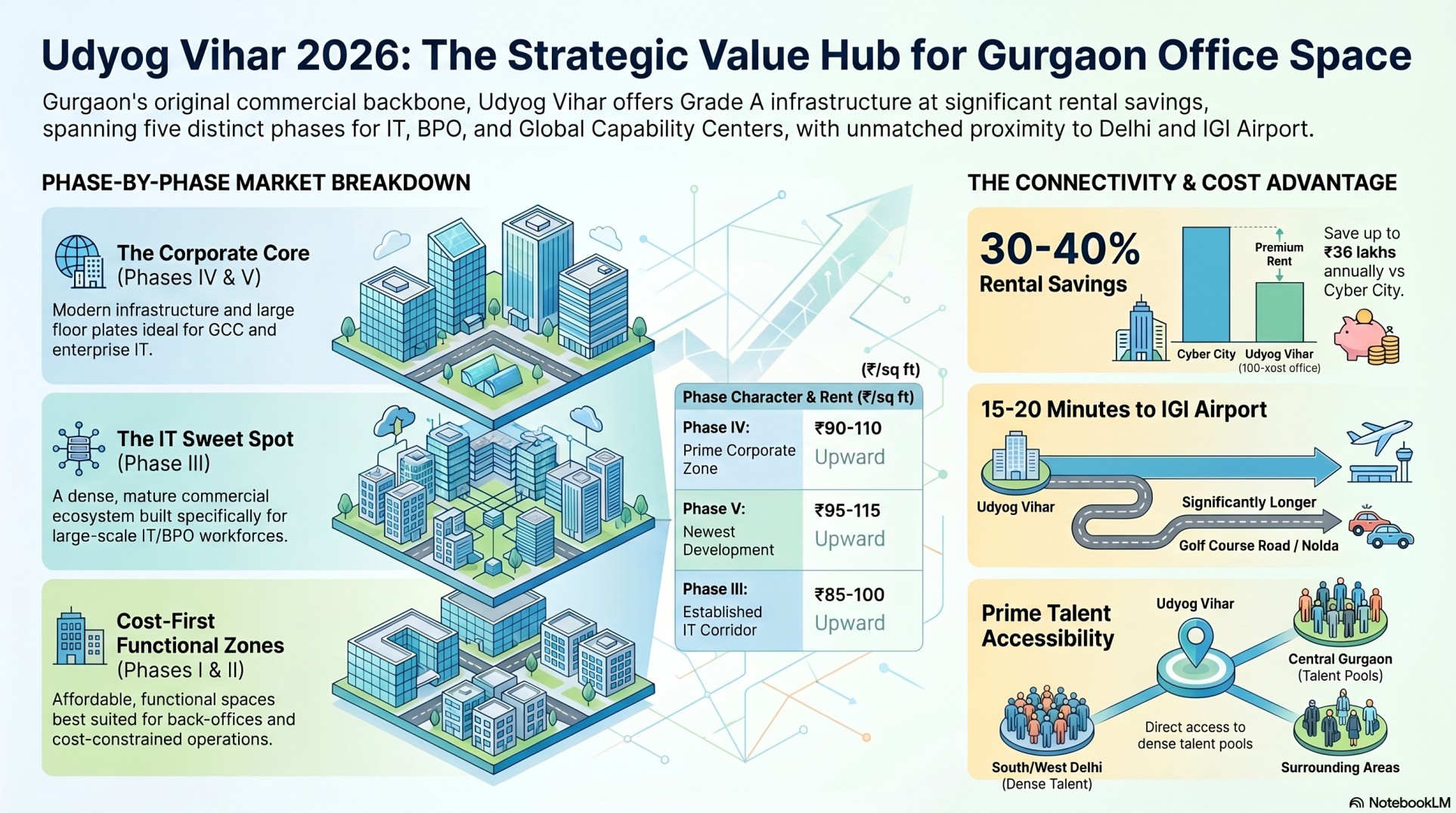
Udyog Vihar is Gurgaon’s original commercial backbone. While Cyber City gets the headlines and Golf Course Road gets the prestige, Udyog Vihar has quietly housed some of the largest IT, ITeS, and BPO operations in the NCR for over two decades.
The draw is straightforward: Grade A infrastructure at 30-40% below Cyber City rents, direct NH-48 access connecting to Delhi in 20-25 minutes, and a mature vendor ecosystem built up over 20+ years of corporate tenancy.
For companies that need large-format office space, operational predictability, and cost discipline, Udyog Vihar competes with any micro-market in Gurgaon. Understanding how its five phases differ — in rent, building quality, and tenant profile — is what separates a smart location decision from a costly one. Factor in total cost of occupation, and Udyog Vihar’s value case becomes even stronger.
Udyog Vihar at a Glance
Udyog Vihar spans five phases running roughly parallel to NH-48 (the Delhi-Jaipur Expressway), stretching from the Delhi border southward through central Gurgaon. Unlike purpose-built commercial zones such as Cyber City or DLF Cyber Park, Udyog Vihar evolved organically from industrial zoning into one of the NCR’s largest mixed-use commercial corridors. According to JLL India’s office market research, established micro-markets like Udyog Vihar continue to attract significant IT and ITeS absorption year on year.
The area supports a diverse tenant base — IT services, ITeS, BPO, BFSI back-offices, and increasingly, GCC operations — alongside residual light manufacturing and logistics presence, particularly in the earlier phases.
Key facts at a glance:
- Location: Parallel to NH-48, Gurgaon — accessible from Delhi via Dhaula Kuan and Sheetla Mata Road
- Metro access: HUDA City Centre station (Yellow Line) — 1-3 km depending on phase
- Airport proximity: 15-20 minutes to IGI Terminal 3 via NH-48
- Rent range (2026): ₹85-115/sq ft depending on building grade and phase
- Primary tenant industries: IT, ITeS, BPO, BFSI, GCC, professional services
Phase-by-Phase Breakdown
| Phase | Character | Building Age | Rent (₹/sq ft) | Best For |
| Phase I | Mixed use, older stock | 15-25 years | ₹75-90 | Cost-first operations |
| Phase II | IT/ITeS transition zone | 12-20 years | ₹80-95 | Mid-size IT, back-office |
| Phase III | Established IT corridor | 10-18 years | ₹85-100 | IT services, BPO, BFSI |
| Phase IV | Prime corporate zone | 8-15 years | ₹90-110 | GCC, enterprise IT, managed offices |
| Phase V | Newer development | 5-12 years | ₹95-115 | Premium IT, large floor plates |
Phase I and II: Affordable, Functional, Not For Everyone
Phases I and II sit closest to the Delhi border and carry the area’s industrial heritage most visibly. Building stock is older, floor plates vary significantly, and the tenant mix includes light manufacturing and logistics alongside IT operations. For back-office operations, technology teams, and cost-constrained companies, the ₹75-95/sq ft range delivers functional space that works.
Phase III: The Sweet Spot for IT/ITeS
Phase III is where Udyog Vihar’s IT identity is strongest. The area has attracted sustained IT and ITeS tenancy for 15+ years, creating a dense commercial ecosystem of restaurants, support services, and vendor infrastructure built around corporate workforces. Building quality is a mixed bag, so due diligence on individual buildings matters more here than blanket assumptions about the phase.
Phase IV: The Corporate Core
Phase IV is where Udyog Vihar’s modern corporate identity concentrates. Buildings are newer, infrastructure more reliable, and tenant quality higher. It is the phase where managed office providers, GCC operators, and enterprise IT companies have concentrated their footprint. AIHP’s headquarters sits at 249-G, Udyog Vihar Phase IV, and the company has built its largest building portfolio in this zone precisely because the infrastructure and tenant ecosystem support enterprise-grade operations.
Phase V: Udyog Vihar’s Premium End
Phase V represents the newest development within Udyog Vihar and carries the highest rents in the corridor — ₹95-115/sq ft for top-tier buildings. Floor plates tend to be larger, buildings more modern, and infrastructure newer. For companies needing large-format space (200+ seats) with modern infrastructure, Phase V competes with newer corridors like Sohna Road while retaining Udyog Vihar’s connectivity advantages.
Connectivity: Why Udyog Vihar Works for Talent
Location decisions should start with where your talent lives, not where the offices look nicest. Udyog Vihar’s connectivity profile suits specific talent geographies well — and poorly serves others.
Metro Access
HUDA City Centre station (Yellow Line) is the primary metro anchor for Udyog Vihar. The station connects directly to Central Secretariat, Rajiv Chowk, and Kashmere Gate — covering South, Central, and parts of North Delhi. Depending on the phase and building, walking distance to HUDA City Centre ranges from 10-15 minutes (Phase IV/V) to 20-25 minutes (Phase I/II).
Road Connectivity
NH-48 (formerly NH-8) runs the length of Udyog Vihar, providing direct access to Delhi via Dhaula Kuan in 15-20 minutes and southward toward Cyber City, Sohna Road, and the rest of Gurgaon. Sheetla Mata Road connects to MG Road and Central Gurgaon. Employees from Faridabad can reach Phase IV in 35-45 minutes via NH-44.
Airport Proximity
IGI Terminal 3 is 15-20 minutes from most Udyog Vihar phases via NH-48 — one of the best-connected micro-markets for frequent business travelers. This is a meaningful advantage over Golf Course Road or Noida Sector 62, where airport travel runs 25-40 minutes.
Talent Geographies Served
Udyog Vihar’s talent catchment is strongest from:
- South Delhi: GK, Defence Colony, Hauz Khas, Vasant Vihar (25-35 minutes via NH-48)
- West Delhi: Rajouri Garden, Punjabi Bagh, Paschim Vihar (25-35 minutes)
- Gurgaon residential sectors: DLF Phases, Sushant Lok, Sector 40-57 (15-25 minutes)
- Faridabad: NH-44 corridor (35-45 minutes)
As the Gurgaon vs Noida comparison shows, talent geography is often the deciding factor in location strategy. Udyog Vihar draws from South and West Delhi — among the densest pools of IT and professional services talent in the NCR.
Rent Benchmarks 2026: What Grade A Office Actually Costs
Headline rent per square foot is only part of the cost picture. CBRE India’s office market data consistently shows that total occupancy costs in managed office environments — inclusive of fit-out amortisation, utilities, and facilities — run 15-25% below what traditional bare-shell leases cost when all components are factored in.
| Category | Per Sq Ft/Month | Per Seat/Month (approx) |
| Entry-level managed (Phase I-II) | ₹75-90 | ₹4,250-6,500 |
| Mid-tier managed (Phase III-IV) | ₹90-105 | ₹6,500-10,000 |
| Premium managed (Phase IV-V) | ₹105-115 | ₹10,000-13,000 |
| Traditional bare-shell lease | ₹85-110 | Add fit-out and ops costs |
When comparing Udyog Vihar rents with Cyber City (₹130-140/sq ft) or Golf Course Road (₹115-130/sq ft), the 25-40% cost differential compounds significantly at scale. A 100-seat office saves ₹1.5-3 lakhs monthly versus Cyber City — ₹18-36 lakhs annually. The flex vs traditional lease analysis covers this math in detail for companies weighing managed versus conventional lease structures.
What to Look for in Udyog Vihar Buildings
Building quality in Udyog Vihar varies significantly within phases. Age alone doesn’t predict quality — some older buildings have been extensively renovated, while some newer buildings have cut infrastructure corners. Verify these before committing:
Power Infrastructure
Generator backup is non-negotiable. Verify N+1 generator redundancy and that total backup capacity covers full building load — not 70% capacity with load-shedding of AC during outages. Minimum 8 watts per square foot power density for modern IT workloads.
Internet Backbone
Older Udyog Vihar buildings may have inadequate internet infrastructure relative to modern bandwidth requirements. Verify dual ISP availability with symmetric connections of at least 1 Gbps for 100-person operations.
Floor Plate Size and Efficiency
Udyog Vihar buildings range from 5,000 to 30,000+ sq ft per floor. Irregular floor plates waste significant area to columns, core, and circulation — effectively raising cost per usable seat even when headline rent looks attractive.
CAM Charges
Common Area Maintenance charges in Udyog Vihar run ₹15-35/sq ft monthly — a cost that never appears in headline rent comparisons. Ask for a detailed CAM breakdown before signing.
AIHP’s Presence in Udyog Vihar
AIHP has built its largest portfolio concentration in Udyog Vihar, with 10 owned buildings across the corridor: Millennium, Milestone, Palms, Signature, Tower, Horizon, Cyber Greens, Cyber Greens 2, AIHP 867, and AIHP 390-91. This reflects a deliberate thesis — Udyog Vihar’s connectivity, cost structure, and talent access make it the most defensible long-term position in the Gurgaon managed office market.
The portfolio spans entry-level managed spaces starting at ₹4,250/seat to premium suites at ₹12,999/seat, covering the full range of company sizes and budget requirements within a single micro-market.
Unlike leased floors in other Gurgaon micro-markets, AIHP’s Udyog Vihar buildings are owned assets — meaning infrastructure investment, building standards, and long-term commitment are genuine rather than dependent on a third-party landlord. Tenants scaling within AIHP’s Udyog Vihar portfolio — as Daas Labs did, growing from 85 to 200+ seats — can do so without changing buildings, vendors, or management teams.
View AIHP’s Udyog Vihar office spaces for current availability across all 10 buildings.
📥 RESOURCE: Download The Ultimate Guide to Gurgaon Office Space for detailed micro-market comparisons, lease negotiation templates, and infrastructure verification checklists. Download the Ultimate Guide →

Conclusion: Why Udyog Vihar Remains Gurgaon’s Most Practical Commercial Hub
Udyog Vihar doesn’t compete on prestige. It competes on value: reliable infrastructure, mature vendor ecosystem, 30-40% cost advantage over Cyber City, and connectivity that covers South and West Delhi talent pools effectively.
For IT and ITeS companies, GCC operations, BPO and back-office functions, and any enterprise team prioritising operational efficiency over address optics, Udyog Vihar consistently delivers. The five-phase structure means options exist across virtually every budget bracket — from entry-level managed spaces at ₹4,250/seat to premium suites at ₹12,999/seat.
The key is understanding which phase and which building suits specific requirements — then verifying infrastructure specifications before signing rather than discovering gaps after move-in.
For companies evaluating office space in Gurgaon and wanting to understand how Udyog Vihar fits their requirements, get in touch with AIHP.