You’re at 50 employees in a 2,500 sq ft Udyog Vihar office. Series B closes. The plan calls for 110 employees within 18 months. Your current space maxes out at 60 seats.
Three paths forward: cram everyone tighter in current location, add a second office somewhere else, or relocate the entire team to larger space. Each has different cost structures, disruption levels, and strategic implications.
The wrong choice shows up 12 months later as operational friction, talent attrition, or wasted capital. Here’s the decision framework that matters.
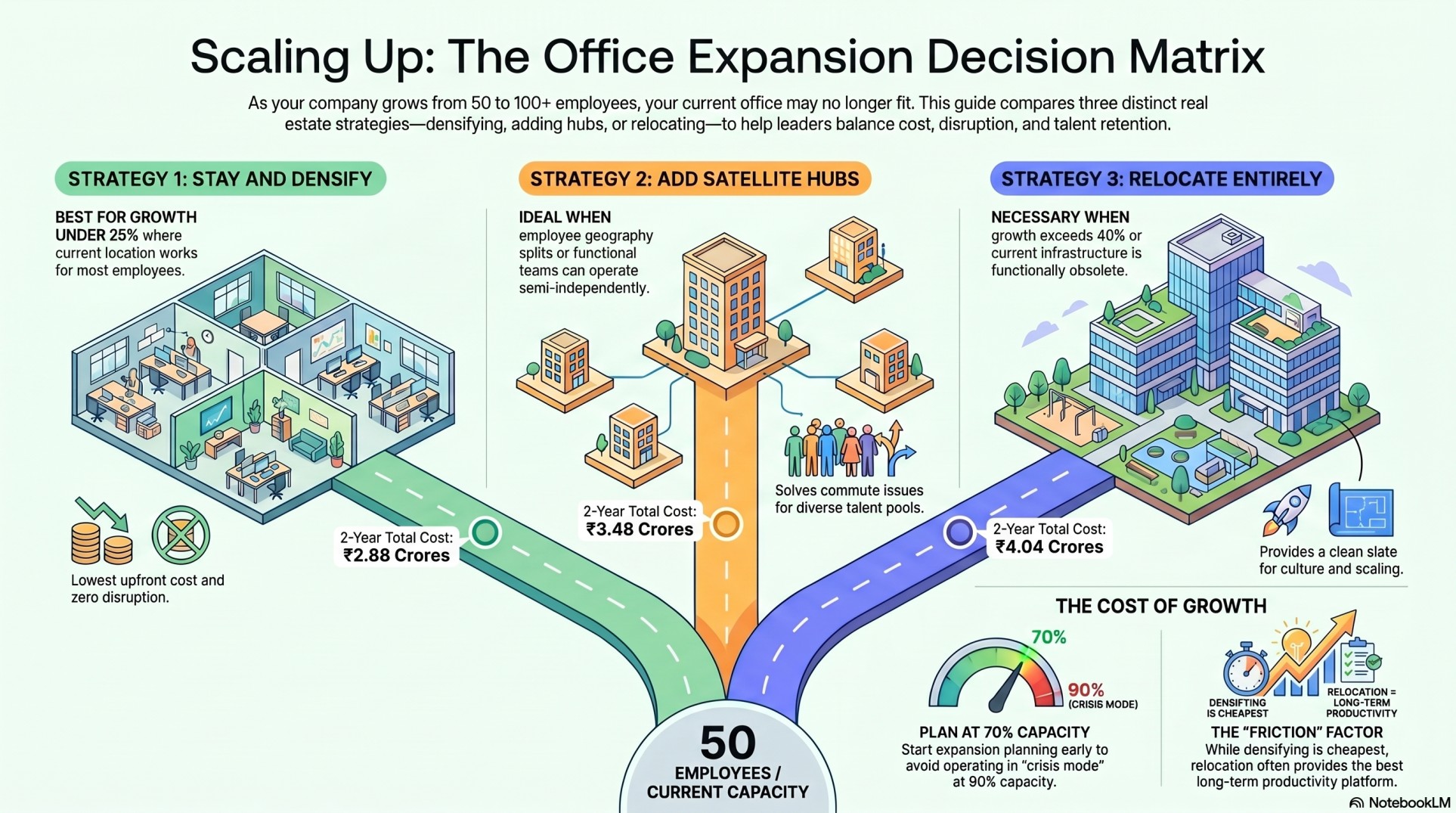
The Three Expansion Strategies
Strategy 1: Stay and densify
Maximize current space through layout optimization, reducing space per employee, converting underused areas, or negotiating adjacent space in same building.
Strategy 2: Add satellite hubs
Keep existing location as primary office, open second (or third) location in different micro-market or city to serve specific team segments or geographies.
Strategy 3: Relocate entirely
Move full operations to larger space that accommodates current team plus 18-24 month growth runway.
No strategy is universally better. The right choice depends on growth trajectory, employee distribution, current lease terms, and operational priorities.
Decision Matrix: Which Strategy Fits Your Situation?
Choose “Stay and Densify” When:
Growth is moderate (15-30% headcount increase):
Going from 50 → 65-70 employees doesn’t require new location. Most offices are designed with 10-20% spare capacity. Through layout optimization—converting unused conference room to hot-desks, reducing circulation space, tightening workstation density from 50 to 45 sq ft per person—you can absorb moderate growth.
Example: 2,500 sq ft office at 50 employees = 50 sq ft/person. Optimize to 45 sq ft/person, now supports 55 employees. Add adjacent 500 sq ft suite (if available), you’re at 3,000 sq ft supporting 66 employees. Growth accommodated without relocation.
Your current location still works for employee distribution:
If 80% of team lives within 30-40 minutes of current office, moving location disrupts majority commutes. Commute impact is often underestimated—employees tolerate sub-optimal office design more than they tolerate added commute time.
As long as new hires also fit existing geography (recruiting from similar neighborhoods), staying makes sense. Only when hiring patterns shift—suddenly recruiting heavily from South Delhi or Noida—does relocation become strategic.
You have lease flexibility:
If current landlord offers adjacent space or floor expansion within same building, staying is low-friction. You avoid moving costs, keep existing setup operational during transition, and leverage known building infrastructure.
Traditional leases make this harder (requires re-negotiation, fresh security deposits, extended lock-ins). Managed office providers with multiple floors in same building can offer seamless expansion—move 20 seats to adjacent suite, maintain single contract.
Disruption tolerance is low:
Staying means business continues uninterrupted. Relocating means 2-4 weeks of reduced productivity, IT downtime risk, employee confusion, and focus drain. For companies in critical delivery phases—major client implementations, product launches, fundraising processes—minimizing disruption overrides other considerations.
Choose “Add Satellite Hubs” When:
Employee geography becomes bimodal:
You started in Udyog Vihar recruiting from North-West Gurgaon and Delhi. Series B brings 40 new hires, half recruited from South Gurgaon and Noida. Suddenly your team splits: 60 people live within 30 minutes of Udyog Vihar, 40 people face 60-75 minute commutes.
Relocating to middle ground (Golf Course Road) optimizes for no one—everyone gets mediocre commute. Better solution: Keep Udyog Vihar for North-West cluster, open Sohna Road or Sector 32 hub for South cluster. Each team gets <30 minute commute.
You need regional presence:
Companies expanding beyond Gurgaon into Noida, Delhi, or Bangalore don’t need to relocate—they need additional hubs. Sales team in Bangalore, engineering in Gurgaon, ops in Noida.
Hub strategy makes sense when different functions serve different markets or when talent pools are geographically concentrated. One location can’t optimize for all.
Functional teams can operate semi-independently:
Hubs work when teams have low collaboration interdependence. Engineering and sales rarely need face-to-face sync. Engineering and product need frequent interaction—splitting them creates coordination overhead.
Good hub splits: Sales (one hub) + Engineering (another hub). Bad hub splits: Frontend engineers (one hub) + Backend engineers (another hub). The test is: how often do these groups need to be in same room for real work?
Your growth is experimental:
Series B includes tentative Bangalore expansion. Not sure it’ll work. Don’t want to commit to large Bangalore office yet. Hub strategy lets you test: open 10-15 seat space, see if team grows, expand if successful.
This is less risky than committing to 50-seat Bangalore office when headcount might plateau at 20. Managed providers with 60-day delivery timelines enable this experimentation—if Bangalore works, expand quickly. If not, exit without stranded CapEx.
Cost considerations with hubs:
Satellite hubs add operational overhead: two leases to manage, duplicated amenities (two pantries, two receptions), coordination costs. Only economical if you’re avoiding very large single-location lease or solving significant commute problem.
For 100-person company, better to have one 100-seat office than two 50-seat offices unless geography or function clearly requires separation. Hub strategy makes sense at 150+ employees where functional or geographic splits justify overhead.
Choose “Relocate Entirely” When:
Growth exceeds 40-50% within 18 months:
Going from 50 → 75+ employees requires fundamentally different space. Trying to cram 75 people into space designed for 50 creates operational problems—undersized meeting rooms, insufficient power capacity, overcrowded pantries, parking shortages.
Better to relocate to properly sized space (4,000-5,000 sq ft for 75-100 seats) than patch current location. The disruption of relocation is one-time pain. Living with inadequate space is daily friction for 2-3 years.
Your current space has unfixable problems:
Building infrastructure failures (power outages, HVAC inadequacy, parking shortages). Landlord relationship issues. Building becoming functionally obsolete. Surrounding area deteriorating (traffic worsening, retail closing, safety concerns).
Some problems don’t solve through densification or expansion. When building itself is constraint, relocation is strategic even without major headcount growth.
Lease renewal is approaching:
If you’re 12-18 months from lease end, expansion decision aligns with lease decision. Rather than renew + expand in inadequate location, time relocation to coincide with natural lease termination.
This eliminates dual-rent overlap (paying for both old and new space during transition). With flex office 60-day delivery, you can sign new lease 60 days before old lease ends, relocate during notice period, avoid rent duplication.
Employee distribution shifted significantly:
Company started with founder living in South Delhi, recruited from that network—entire team was South Delhi/Gurgaon. Three years later, hiring shifted to tech talent in Noida and East Delhi. Original Udyog Vihar location that worked perfectly now creates 60-90 minute commutes for 70% of team.
Relocating to Golf Course Extension or Sector 32 optimizes for current employee geography even if it disrupts the 30% who are close to current location. Majority matters more than minority in commute optimization.
You want fresh start:
Psychological benefit of relocation during major company milestones. Series B close, rebrand, new leadership—relocating signals change and growth. Old cramped office represented scrappy startup phase. New professional office represents scaling company phase.
This is softer benefit but real. Culture shifts often coincide with physical environment shifts. If company is transforming identity (startup → growth stage, services → product, B2C → B2B), new office reinforces transformation.

Hybrid Strategies: Combining Approaches
Smart companies don’t choose one strategy forever—they phase:
Phase 1 (Year 0-1): Stay and densify
– Current: 50 employees, 2,500 sq ft
– Optimize to 45 sq ft/person
– Negotiate adjacent 500 sq ft
– Capacity: 55-66 employees
Phase 2 (Year 1-2): Add satellite hub
– Primary office: 60 employees in Udyog Vihar
– Satellite hub: 25 employees in Sector 32 or Sohna Road
– Total: 85 employees across 2 locations
Phase 3 (Year 2-3): Relocate to consolidated HQ
– Move to 5,000-6,000 sq ft single location
– Accommodate 100-120 employees
– Close satellite hub (or convert to regional sales office)
This phased approach minimizes disruption, preserves capital early (avoiding large relocation upfront), tests hub model before committing, and aligns major moves with natural lease cycles.
Financial Comparison: 50 → 100 Employees Over 24 Months
Strategy 1: Stay and densify
Months 0-12: Optimize current 2,500 sq ft, add 500 sq ft adjacent
– Cost: ₹9 lakhs/month (existing) + ₹1.5 lakhs/month (500 sq ft at ₹18K/seat for ~8 seats)
– Total months 0-12: ₹1.26 crores
Months 13-24: Add another 1,000 sq ft as available
– Cost: ₹10.5 lakhs/month + ₹3 lakhs/month (1,000 sq ft)
– Total months 13-24: ₹1.62 crores
2-year total: ₹2.88 crores
Strategy 2: Add satellite hub
Months 0-12: Keep current location, add 1,500 sq ft hub (25-30 seats)
– Primary: ₹9 lakhs/month
– Hub: ₹4.5 lakhs/month (₹18K/seat × 25 seats)
– Total months 0-12: ₹1.62 crores
Months 13-24: Expand both locations
– Primary: ₹10 lakhs/month (some densification)
– Hub: ₹5.5 lakhs/month (expanded to 30 seats)
– Total months 13-24: ₹1.86 crores
2-year total: ₹3.48 crores
Strategy 3: Relocate entirely
Months 0-6: Plan relocation, negotiate new 5,000 sq ft space
– Current space: ₹9 lakhs/month × 6 = ₹54 lakhs
– New space prep (notice overlap): ₹1 month dual rent = ₹18 lakhs
– Moving costs: ₹8 lakhs
– Total months 0-6: ₹80 lakhs
Months 7-24: Operate from new location
– New space: ₹18 lakhs/month (5,000 sq ft, 100 seats, room for growth)
– Total months 7-24: ₹3.24 crores
2-year total: ₹4.04 crores
Analysis:
Stay and densify is cheapest but constrains growth and creates operational friction. Satellite hubs cost 20% more but solve geography and allow experimentation. Full relocation costs 40% more upfront but provides best long-term platform.
However, these costs ignore:
– Productivity loss from inadequate space (stay strategy)
– Coordination overhead between hubs (hub strategy)
– One-time disruption during move (relocate strategy)
When factoring total cost of occupation including productivity and friction costs, relocation often wins for high-growth companies despite higher nominal rent.
Common Expansion Mistakes
Mistake 1: Waiting too long to act
Companies recognize they need more space at 90% capacity. By the time they evaluate options, sign leases, and complete fit-out (4-6 months traditional), they’re at 110% capacity operating in crisis mode. Plan expansion at 70-75% capacity to execute before constraint bites.
Mistake 2: Optimizing for current team, ignoring future hiring patterns
Choose office location based on where current 50 employees live. But next 50 hires will come from different neighborhoods (talent density shifts, recruiting strategy changes). Optimize for where future team will be, not just current team.
Mistake 3: Underestimating [meeting room and collaboration space needs](https://aihp.in/calculate-meeting-room-requirements-office-gurgaon/)
Plan space for desks but forget meeting rooms scale faster than headcount in hybrid work. Going from 50 → 100 employees doesn’t double meeting room needs—it triples them. Budget space accordingly or face constant room booking conflicts.
Mistake 4: Ignoring lease timing
Make expansion decisions independent of lease cycles. End up with 18 months left on current lease when you want to relocate, paying dual rent or expensive termination penalties. Align expansion planning with lease milestones.
Mistake 5: Choosing permanent solution for temporary growth
Sign 9-year lease for 150-seat office when growth projections are speculative. 18 months later, headcount plateaus at 90. Now stuck with 60 empty seats for 7+ years. Better to use flexible shorter-term options during uncertain growth phases, commit to long-term space once trajectory stabilizes.
—
📥 RESOURCE: Download The Ultimate Guide to Gurgaon Office Space for expansion planning templates, location comparison worksheets, and cost modeling tools for evaluating stay vs hub vs relocate scenarios.

Conclusion: Match Strategy to Growth Stage
Office expansion strategy isn’t about finding universally “best” option—it’s about matching approach to company situation:
Stay and densify works for moderate growth (15-30%) with stable geography and low disruption tolerance. Cheapest option but constrains long-term scaling.
Add satellite hubs works for bimodal geography, regional expansion, or functional separation. More expensive but solves specific geography or market problems.
Relocate entirely works for major growth (40%+), fundamental location problems, or natural lease transitions. Highest upfront cost but best long-term platform.
Most successful companies use phased approach: densify initially, add experimental hub if needed, relocate when growth stabilizes and trajectory is clear.
The key is planning 12-18 months ahead. Recognize expansion need at 70-75% capacity, evaluate options while operating normally, execute before constraints create daily friction.
For companies evaluating expansion strategies in Gurgaon’s office market, understanding location options—from established corridors to emerging micro-markets—helps model different scenarios.
For guidance on expansion planning and evaluating stay vs hub vs relocate scenarios for your specific growth trajectory, get in touch with AIHP.