 Workspace
1 May 2026 · Sarthhak Kaluucha · 12 min read

Workspace
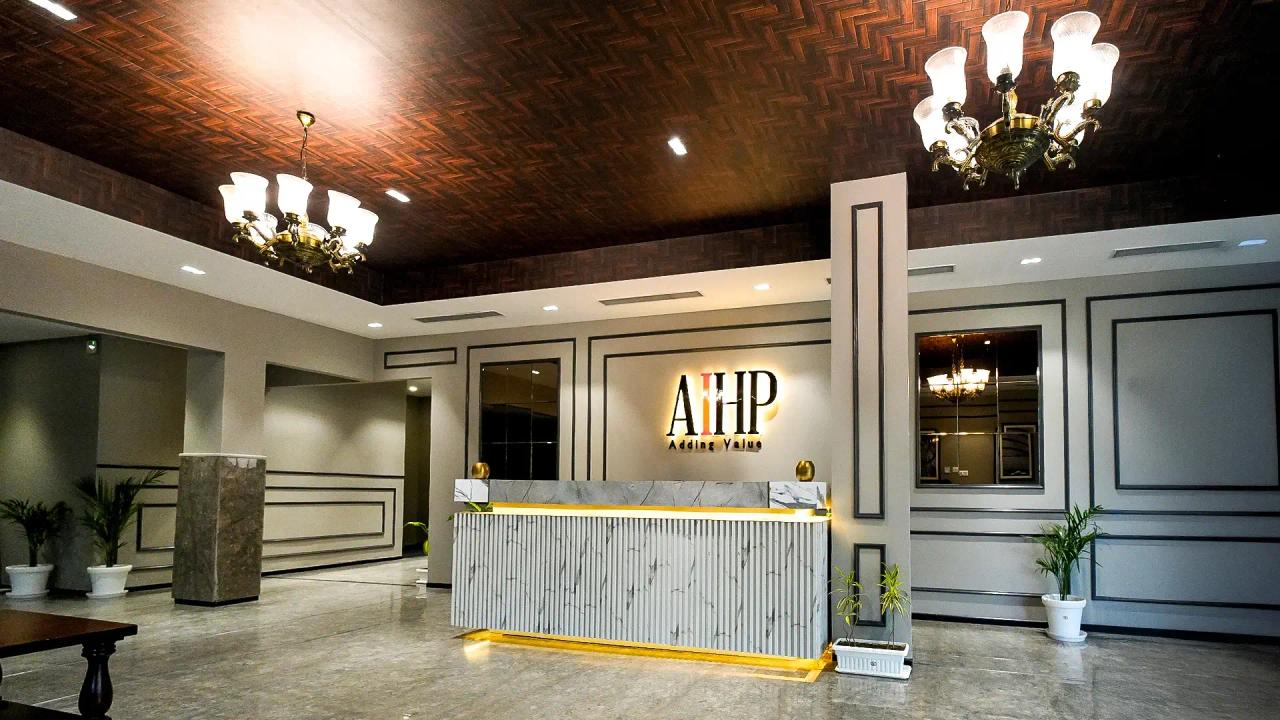
TL;DR
Managed office providers deliver fully operational 50-100 seat offices in 60 days versus 4-6 months for traditional build-to-suit. Speed comes from modular design systems, pre-negotiated vendor relationships, bulk material procurement, parallel execution, and elimination of client decision bottlenecks. Companies needing fast deployment—new GCC launches, contract wins, emergency relocations—gain 3-5 month time advantage. Listen to this article on
When companies compare flex versus traditional office leases, one factor often gets lost in cost analysis: timeline to occupancy. Traditional build-to-suit requires 4-6 months from lease signing to operational workspace. Managed providers like AIHP deliver fully functional offices in 60 days.
For companies with immediate deployment needs—launching GCC operations, onboarding teams after major contract wins, or relocating due to infrastructure failures—this 3-5 month time compression has real financial value. The question isn't just "can you deliver faster?" It's "how do you compress timeline without compromising quality?"
Here's how the 60-day delivery model actually works.
Standard build-to-suit timeline looks like this:
Weeks 1-4: Design and planning
- Site survey and measurements
- Requirements gathering and brief development
- Conceptual design iterations
- Vendor selection for interior contractor
- Material selections and approvals
- Detailed design development
- Budget finalization
Weeks 5-8: Approvals and procurement
- Fire NOC applications
- Building management approvals
- Electrical load approvals
- Material procurement begins
- Long-lead items ordered (custom furniture, imported finishes)
- Contractor mobilization
Weeks 9-16: Construction
- Electrical and HVAC rough-in
- Partition installation
- Flooring and ceiling work
- Paint and finishes
- Furniture installation
- Equipment setup
Weeks 17-20: Testing and handover
- HVAC balancing and testing
- Network infrastructure testing
- Fire system testing
- Punch list completion
- Final inspections
- Handover and move-in
Total: 16-20 weeks (4-5 months) if everything goes smoothly. Reality is 5-6 months with inevitable delays.
The bottlenecks aren't construction speed—they're decision points, approvals, procurement lead times, and sequential execution.
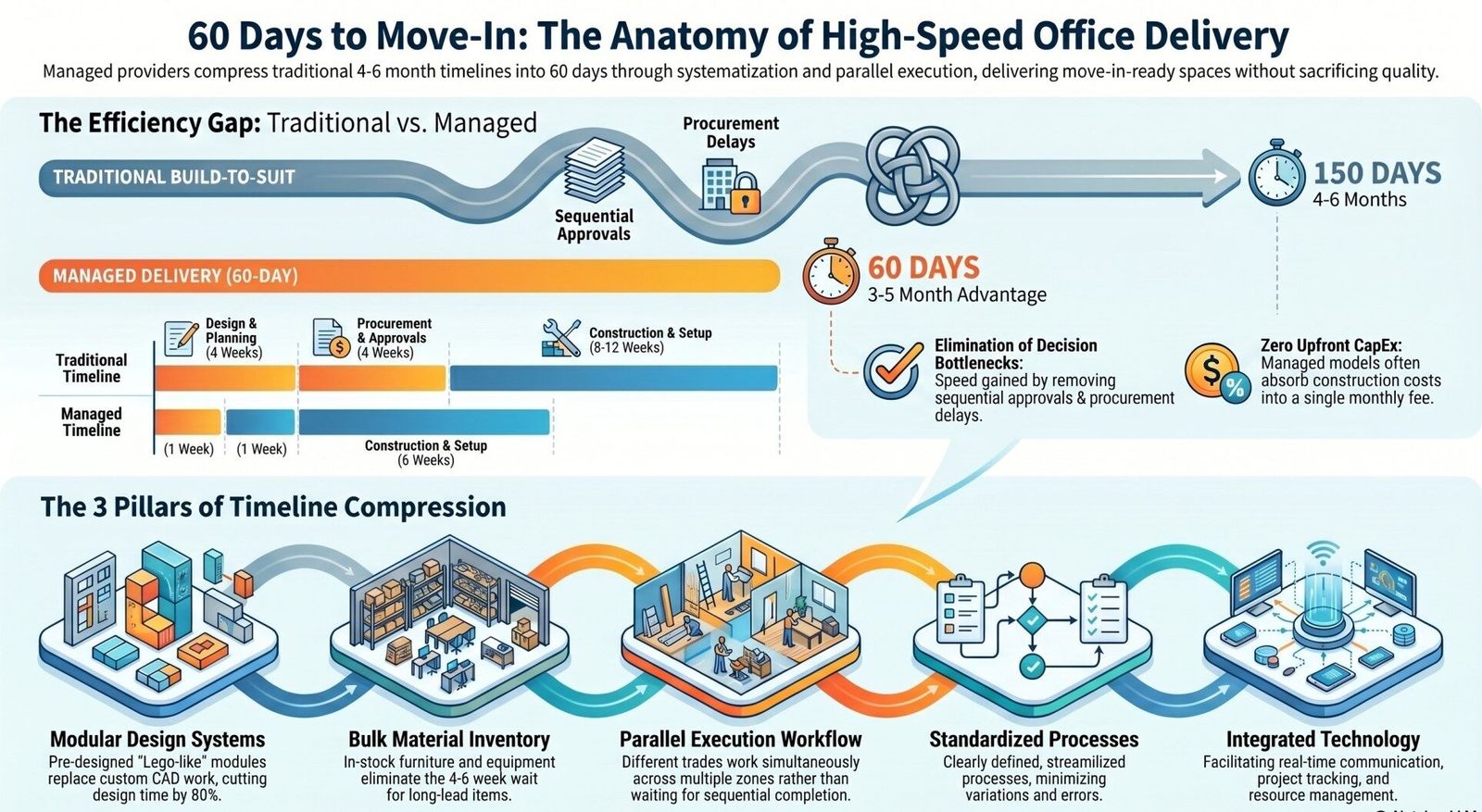
Managed office providers compress this 4-6 month timeline to 8-9 weeks through five operational strategies:
Instead of starting with blank CAD file, managed providers work from library of pre-designed modules that snap together like Lego.
AIHP maintains design templates for:
- Standard workstation layouts (open plan, team clusters, hybrid models)
- Meeting room configurations (small 4-person, medium 8-person, large 12-person, boardrooms)
- Collaboration zones and breakout areas
- Reception and waiting areas
- Pantry and amenity spaces
When client specifies 60 seats with 4 meeting rooms and team-based layout, designer isn't creating from scratch. They're assembling proven modules, adjusting for actual space dimensions, and customizing branding elements.
Design phase compresses from 3-4 weeks to 3-5 days. Client reviews layouts, selects finishes from curated palette, approves branding elements. No endless iteration loops.
Traditional build-to-suit means tendering every trade—electrical, HVAC, partitions, flooring, furniture, IT. Each tender takes 1-2 weeks. Managed providers maintain standing relationships with preferred vendors across all trades.
AIHP works with established network of:
- Electrical contractors (pre-approved rates, known quality)
- HVAC specialists (standardized equipment, fast deployment)
- Partition and ceiling contractors (modular systems, quick install)
- Furniture suppliers (bulk inventory, 2-week delivery)
- Flooring vendors (carpet tiles, engineered wood, vinyl—all in stock)
- Technology providers (network, AV, access control)
No vendor selection process. No negotiation. Rates are pre-fixed through annual contracts with volume commitments. Purchase orders go out same day as design approval.
Procurement phase compresses from 3-4 weeks to 2-3 days.
Traditional fit-out waits 4-6 weeks for custom furniture, imported finishes, or specialty equipment. Managed providers maintain inventory of high-turnover items.
AIHP keeps buffer stock of:
- Modular workstation systems (Herman Miller, Haworth, Godrej—multiple lines)
- Standard chairs (task chairs, executive chairs, visitor chairs)
- Meeting tables and conference furniture
- Partition systems (glass, drywall, fabric panels)
- Flooring materials (carpet tiles in 8-10 colors, vinyl planks)
- Standard lighting fixtures
- HVAC equipment (VRV units, FCUs, AHUs in common capacities)
Custom elements (branded graphics, specialty finishes, client logos) are the only long-lead items. Everything else ships from inventory within 1-2 weeks.
Material lead time compresses from 4-6 weeks to 1-2 weeks.
Traditional build-to-suit runs sequential: finish electrical before starting partitions, complete partitions before flooring, finish flooring before furniture. Each trade waits for previous to complete.
Managed providers run parallel execution wherever possible:
Week 1-2:
- Electrical rough-in starts in zones 1-2
- HVAC modifications begin simultaneously
- Partition materials arrive and stage
Week 2-3:
- Partitions install in zones 1-2 (where electrical is complete)
- Electrical rough-in continues in zones 3-4
- Flooring materials arrive
Week 3-4:
- Flooring installs in zones 1-2 (where partitions are complete)
- Partitions install in zones 3-4
- Furniture arrives and stages
Week 4-5:
- Furniture installs in zones 1-2 (where flooring is complete)
- Flooring installs in zones 3-4
- IT infrastructure runs throughout
Week 5-6:
- Final furniture placement all zones
- Equipment installation (printers, TVs, AV)
- Testing and punch list
This zonal, parallel approach means multiple trades work simultaneously without interfering. Overall construction compresses from 8-10 weeks to 5-6 weeks.
Building management approvals can take 2-4 weeks in traditional build-to-suit: fire NOC, electrical load approval, structural clearance for partition loading, wet area waterproofing approvals.
Managed providers in their own buildings or long-term leased buildings have pre-negotiated approval frameworks. AIHP has blanket approvals for:
- Standard partition systems (pre-approved loading, fire rating)
- Electrical modifications within defined capacity limits
- HVAC balancing for standard densities
- Standard wet area specifications
Only non-standard modifications require fresh approvals. Most 50-100 seat fitouts use standard configurations, getting same-day or 2-3 day approvals.
Approval phase compresses from 2-4 weeks to 2-5 days.
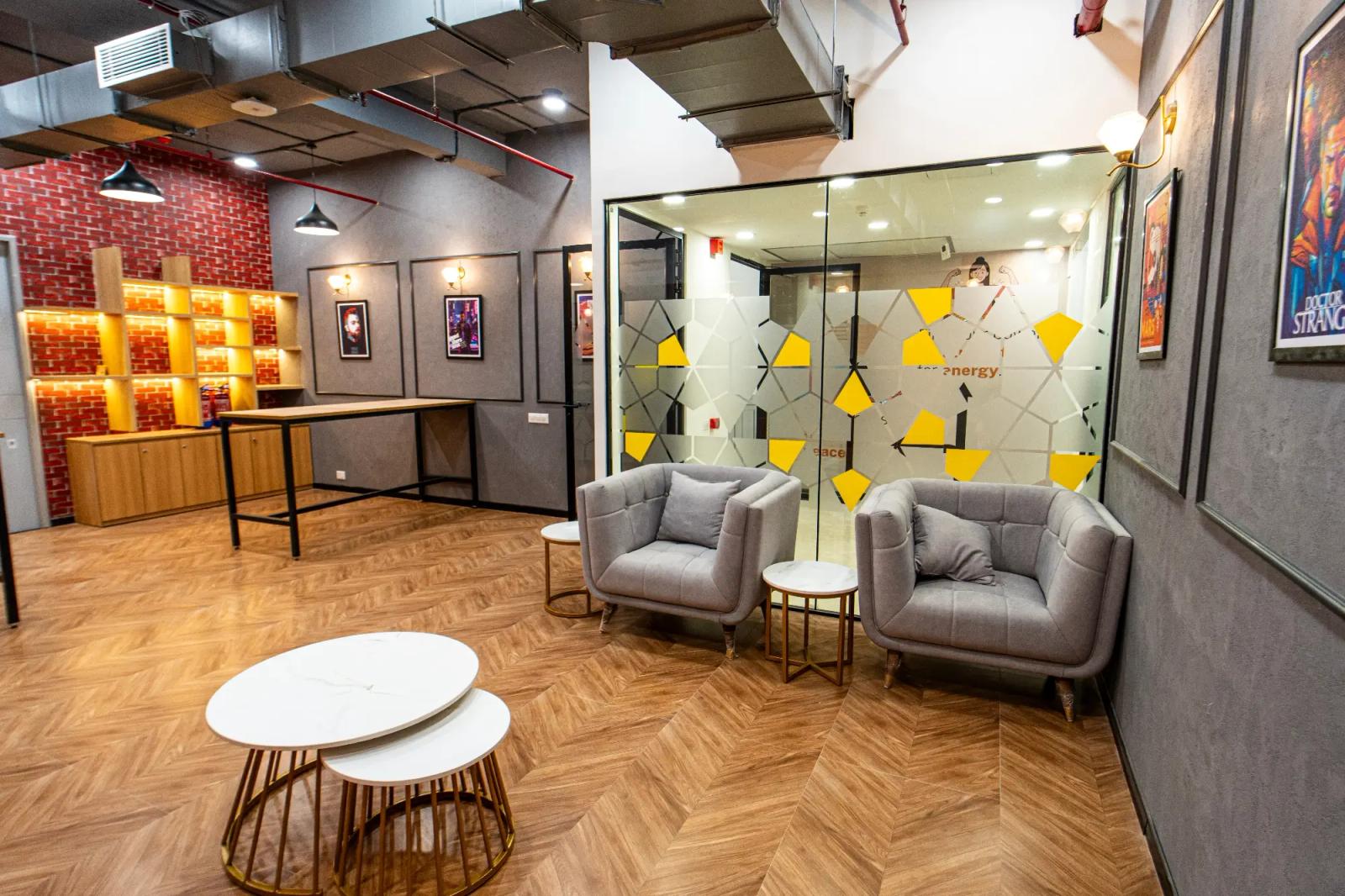
Bringing it all together, here's actual 60-day managed office delivery timeline:
Days 1-7: Design finalization
- Day 1: Site handover, client brief
- Days 2-3: Modular layout design using templates
- Days 4-5: Client review, finish selections
- Days 6-7: Final approvals, branding elements finalized
Days 8-14: Procurement and mobilization
- Day 8: Purchase orders to all vendors
- Days 9-12: Material procurement from inventory
- Days 13-14: Site mobilization, equipment staging
Days 15-42: Construction (4 weeks)
- Weeks 3-4: Zone 1-2 electrical, partitions
- Weeks 4-5: Zone 1-2 flooring, Zone 3-4 partitions
- Weeks 5-6: Zone 1-2 furniture, Zone 3-4 flooring, IT throughout
- Week 6: Final furniture all zones, equipment install
Days 43-56: Testing and commissioning
- Days 43-48: HVAC balancing, network testing, fire system check
- Days 49-52: Punch list completion
- Days 53-56: Final inspections, cleaning, staging
Days 57-60: Handover
- Day 57-58: Walk-through with client
- Day 59: Keys handover, access provisioning
- Day 60: Move-in ready
Total: 8-9 weeks (60 days) from design brief to operational workspace.
Common objection: "60-day delivery means I get generic cookie-cutter space, right?"
Not exactly. Managed providers compress timeline through systematization, not standardization. Here's what's customizable within 60-day model:
Layout configuration:
- Open plan vs team-based clusters vs hybrid
- Meeting room quantity and size distribution
- Collaboration zone locations and types
- Manager cabin vs open seating
- Workstation density (tight 40 sq ft/seat vs spacious 60 sq ft/seat)
Finish selections:
- Flooring type and color (8-10 options in stock)
- Partition fabric or paint colors (curated palette)
- Workstation panel colors and configurations
- Meeting room aesthetics
- Pantry finishes and equipment
Branding elements:
- Reception wall branding and graphics
- Way-finding signage
- Meeting room naming and graphics
- Brand colors throughout space
Technology specifications:
- Network backbone and WiFi density
- AV equipment in meeting rooms
- Access control sophistication
- Printers and equipment specs
What's not customizable within 60 days: imported materials, fully custom furniture, structural modifications requiring extensive approvals, non-standard HVAC or electrical beyond building capacity.
For companies needing extreme customization, managed providers can extend timeline to 90-120 days—still faster than traditional 4-6 months because core systems remain modular.
Fast deployment isn't just nice-to-have. It creates tangible financial value in specific situations:
New GCC or captive center launches:
Global companies opening Indian GCC operations face hard deadlines: leadership visits scheduled, initial teams hiring, onboarding timelines committed. Waiting 5-6 months for traditional fit-out delays revenue recognition, extends bench time for hired employees, and misses market windows.
60-day delivery means operational workspace ready before first employee batch starts, eliminating 3-4 months of unproductive rent payment.
Contract wins requiring immediate team ramp:
Company wins major outsourcing contract starting in 90 days. They need to onboard 75 people, train them, and be operational. Traditional 4-6 month fit-out timeline means they miss contract start date or scramble for temporary space.
60-day delivery lets them sign lease, complete fit-out, and onboard team within contract timeline—no interim arrangements, no lost revenue, no client disappointment.
Emergency relocations:
Building infrastructure failure, fire safety issues, or operational problems force immediate relocation. Company has 60-90 days to vacate current space. Traditional fit-out timeline is impossible.
60-day delivery provides escape hatch—they can relocate entire team without extended temporary arrangements or business disruption.
Market timing and competitive response:
Competitor opens office in target market. Company needs presence quickly to compete for talent and clients. Waiting 5-6 months means competitor establishes position unopposed.
60-day delivery allows fast market entry—claim talent, establish presence, respond to competitive moves.
In each case, time compression has direct financial value: earlier revenue recognition, avoided interim space costs, competitive positioning, contract compliance.
No model is optimal for all situations. The 60-day delivery model makes specific trade-offs:
What you gain:
- 3-5 month time advantage over traditional build-to-suit
- Reduced project risk (proven modular systems, known vendors)
- Preserved capital (no upfront CapEx vs traditional lease)
- Operational simplicity (single vendor vs coordinating multiple contractors)
What you trade:
- Some customization flexibility (work within modular system)
- Slightly higher monthly costs vs traditional lease (as covered in flex vs traditional analysis)
- Limited ability to specify exotic materials or finishes
- Dependence on provider's design aesthetic and systems
For companies where time is critical resource and requirements fit within managed provider's modular systems, the trade-off heavily favors 60-day model.
For companies with unlimited timeline, extreme customization needs, or strong preference for ownership of every specification decision, traditional build-to-suit remains appropriate despite longer timeline.
📥 RESOURCE: Access AIHP's Design Portfolio to see examples of spaces delivered through the 60-day model across different industries, team sizes, and aesthetic requirements. Portfolio includes layouts, specifications, and timeline documentation.
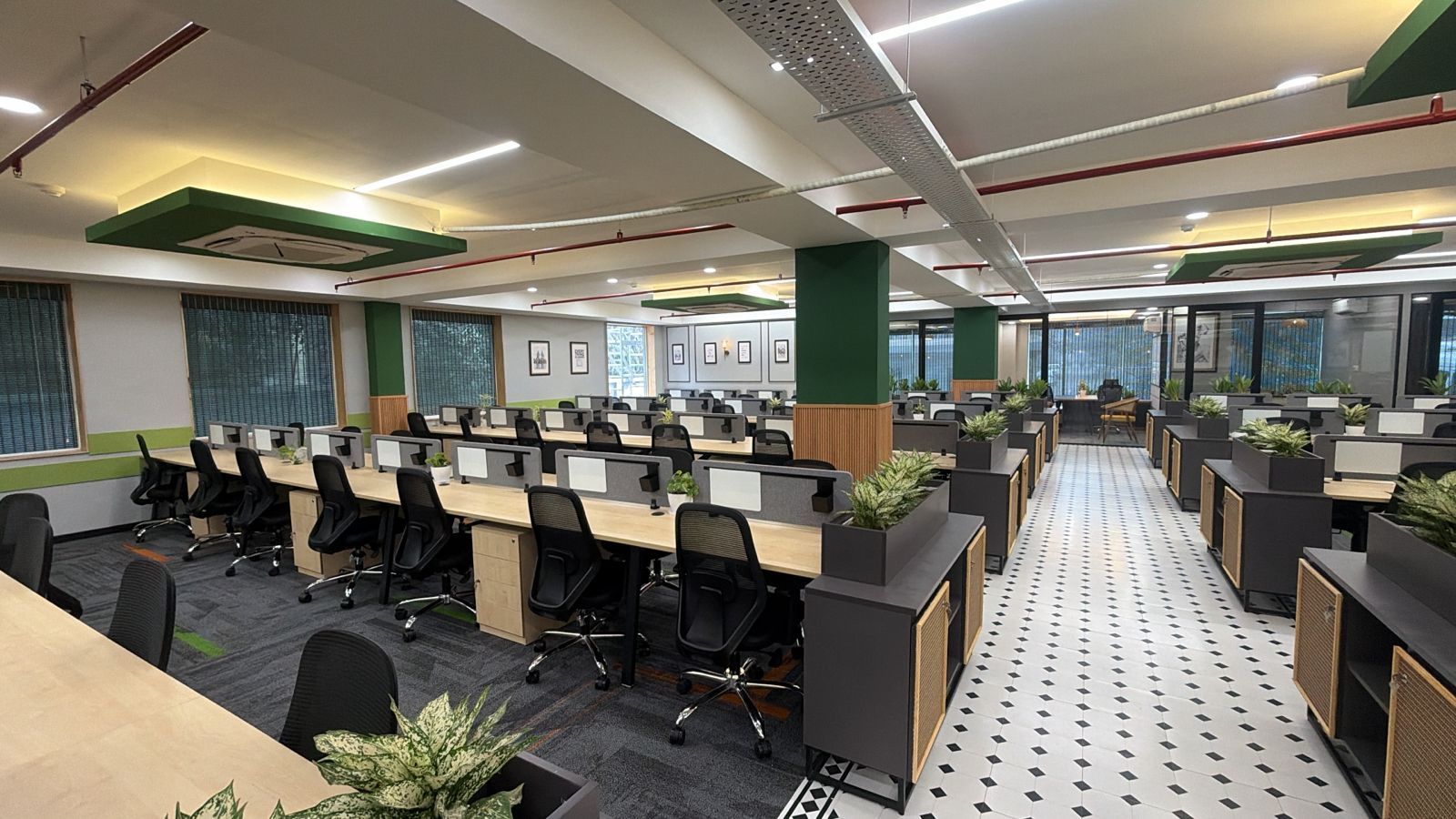
The 60-day office delivery model isn't magic—it's systematization. Managed providers compress traditional 4-6 month timelines through modular design systems, pre-negotiated vendor relationships, bulk procurement, parallel execution, and streamlined approvals.
This speed creates real competitive advantage for companies facing hard deadlines: GCC launches with committed start dates, contract wins requiring immediate ramps, emergency relocations, or market timing imperatives.
The model requires accepting some constraints on customization and slightly higher monthly costs compared to traditional lease. But for companies where time is critical resource—and that's increasingly common in fast-moving markets—the ability to go from lease signing to operational workspace in 60 days changes strategic options.
Companies evaluating Gurgaon office space should assess not just cost and location, but timeline to occupancy. In situations where 3-5 month time advantage translates to earlier revenue, avoided interim costs, or competitive positioning, the 60-day model isn't faster—it's strategically superior.
For information on 60-day delivery timelines and feasibility for your specific requirements, get in touch with AIHP.
Workspace1 May 2026 · Sarthhak Kaluucha · 12 min read
 Workspace
6 Mar 2026 · Sarthhak Kaluucha · 13 min read
 Workspace
3 Mar 2026 · Sarthhak Kaluucha · 12 min read
Ready to move your team?
Fully-managed private offices across Gurgaon's prime corridors — move-in ready, fully serviced, sized for your team.