 Workspace
3 Mar 2026 · Sarthhak Kaluucha · 12 min read

Workspace
TL;DR
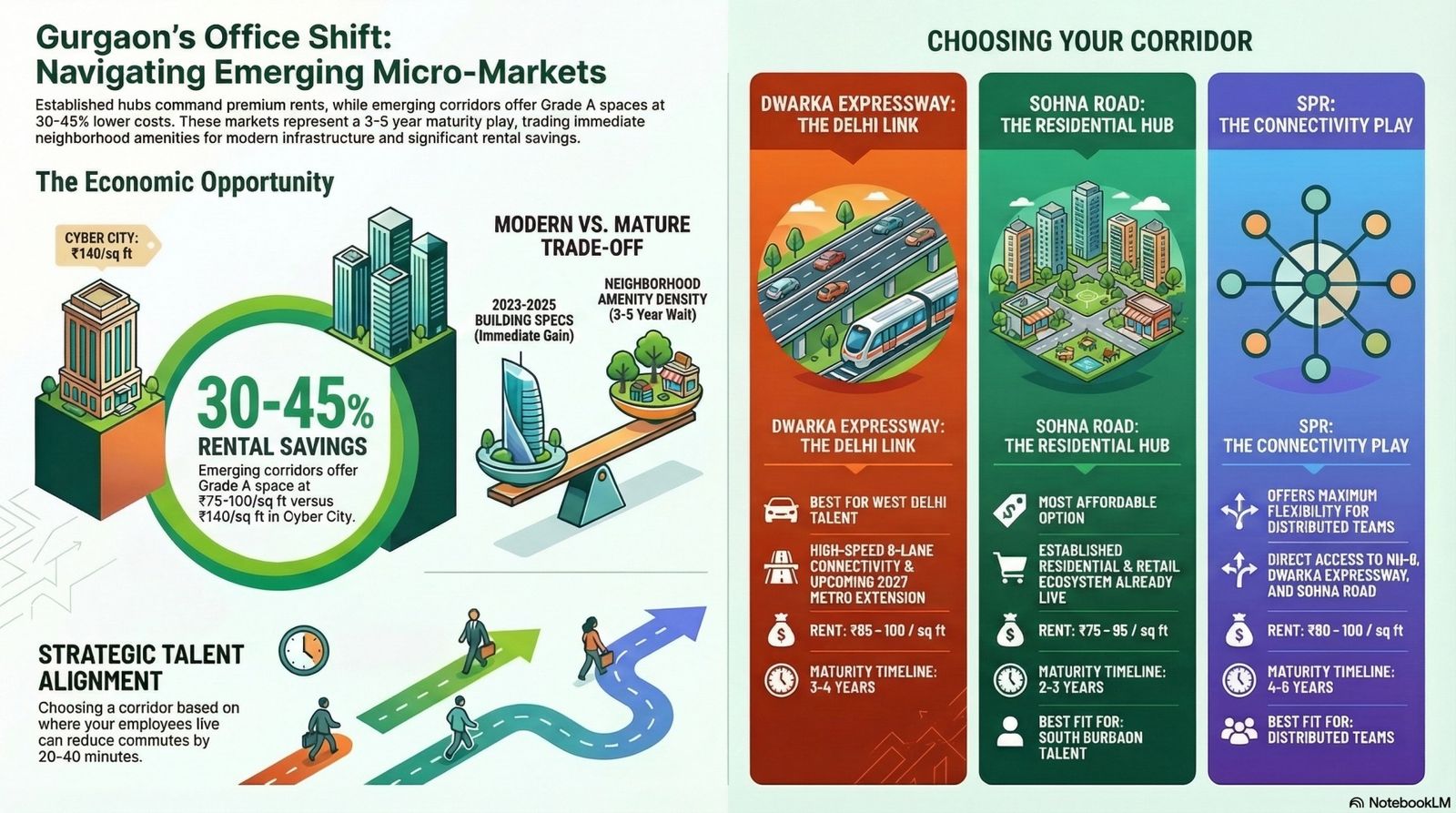
Dwarka Expressway, Sohna Road, and Southern Peripheral Road offer 30-45% lower rents than established micro-markets while delivering modern infrastructure. Companies accepting slightly longer commutes for some employees can secure Grade A space at ₹75-95/sq ft versus ₹110-140/sq ft in Cyber City or Golf Course Road. Maturity timeline: 3-5 years to match established corridor amenities. Listen to this article on
Companies evaluating Gurgaon office space face a familiar problem: prime micro-markets like Cyber City, Udyog Vihar, and Golf Course Road offer excellent infrastructure but command premium rents (₹110-140/sq ft). Emerging corridors promise lower costs but raise questions about infrastructure maturity, accessibility, and timeline to full development.
Three emerging micro-markets are changing this calculation: Dwarka Expressway, Sohna Road, and Southern Peripheral Road (SPR). They're not speculative anymore—Grade A buildings are operational, anchor tenants have moved in, and infrastructure is materializing faster than it did in established corridors.
Here's what companies need to know about each corridor and when they make strategic sense.
Dwarka Expressway (officially Northern Peripheral Road) connects Gurgaon to Delhi via Dwarka, running parallel to NH-8. The 29-km expressway opened in early 2024, immediately reducing congestion on NH-8 and creating a new growth corridor.
What's operational today:
Infrastructure status: Current supply is limited but growing. Developers who saw NH-8 saturation moved here early. You're finding modern buildings with proper power, HVAC, and parking—not compromise infrastructure.
The expressway itself is 8-lane divided, well-maintained, with proper lighting and signage. Not comparable to NH-8 in terms of
commercial density yet, but functionally operational for daily commute.
Rent economics: ₹85-100/sq ft for Grade A space versus ₹115-140/sq ft on Golf Course Extension Road or Cyber City. For 10,000 sq ft office, that's ₹8.5-10 lakhs monthly versus ₹11.5-14 lakhs—saving ₹1.5-4 lakhs monthly or ₹18-48 lakhs annually.
Commute trade-off: Employees living in West Delhi, Dwarka, Janakpuri save 20-40 minutes versus traveling to Udyog Vihar or Cyber City. Those living in South Gurgaon add 15-25 minutes. The corridor works if your talent distribution favors West Delhi or if you're willing to optimize location for cost.
Maturity timeline: 3-4 years to reach Udyog Vihar-level amenity density (restaurants, services, retail). Metro completion in 2027 will be the inflection point. Companies moving now are early but not speculative—the infrastructure exists, you're just not surrounded by developed ecosystem yet.
Best fit for:
Sohna Road extends south from Gurgaon toward Sohna town, becoming a major residential and commercial corridor. Unlike Dwarka Expressway's infrastructure-led growth, Sohna Road is driven by residential expansion creating demand for office space.
What's operational today:
Infrastructure status: More mature than Dwarka Expressway for residential amenities, less developed for Grade A office inventory. You'll find scattered office buildings rather than concentrated commercial zones like Udyog Vihar.
Road infrastructure is functional but congested during peak hours. The 8-lane Sohna Road handles traffic reasonably but lacks the premium expressway feel of Dwarka or Golf Course Extension.
Rent economics: ₹75-95/sq ft makes Sohna Road the most affordable option for Grade A equivalent space. For 10,000 sq ft, you're at ₹7.5-9.5 lakhs monthly versus ₹11.5-14 lakhs in premium corridors—saving ₹2-6.5 lakhs monthly.
This is where total cost of occupation math becomes critical. The rent savings are substantial, but verify utility costs, maintenance standards, and operational reliability match expectations.
Commute trade-off: Employees living in South Gurgaon residential sectors save significant commute versus traveling to Cyber City or Udyog Vihar. Those living in North Gurgaon or Delhi add 25-35 minutes. The corridor works best if you're hiring locally from Gurgaon's residential expansion.
Sohna Road's advantage is it's already a "live" neighborhood. You're not waiting for amenities to develop—restaurants, gyms, retail exist today. The office supply is catching up to residential demand.
Maturity timeline: 2-3 years to reach critical mass of Grade A office inventory. The corridor is mature residentially but emerging commercially. As more companies move here, commercial ecosystem will densify quickly.
Best fit for:
Southern Peripheral Road (SPR) runs east-west connecting Dwarka Expressway, Gurgaon, and Greater Noida, functioning as the southern bypass around Delhi. The section between Dwarka Expressway and Sohna Road is becoming a commercial corridor.
What's operational today:
Infrastructure status: SPR itself is well-maintained 6-8 lane highway with good lighting and signage. Office buildings are newer (2022-2024 construction) with modern specifications. Less commercial density than Udyog Vihar but newer physical infrastructure.
The corridor benefits from connectivity—you can reach NH-8, Dwarka Expressway, or Sohna Road within 10-15 minutes, making it flexible for teams distributed across Gurgaon.
Rent economics: ₹80-100/sq ft positions SPR between Dwarka Expressway and established corridors. For 10,000 sq ft, you're at ₹8-10 lakhs monthly versus ₹11.5-14 lakhs in premium zones.
Commute trade-off: SPR's advantage is flexibility. Employees can approach from multiple directions—west via Dwarka Expressway, north via NH-8, south via Sohna Road. This works if your team is geographically distributed rather than concentrated in one zone.
The tradeoff is SPR doesn't have concentrated residential density nearby yet. Most employees will commute from established Gurgaon sectors or Delhi, making absolute commute times similar to established corridors but with less traffic congestion.
Maturity timeline: 4-5 years to develop neighborhood character and amenity density. SPR is earliest-stage of the three emerging corridors. You're trading newness and connectivity for established ecosystem.
Best fit for:
Emerging micro-markets aren't universally better or worse than established corridors—they're different trade-offs that work for specific situations.
You have significant cost pressure. If rent is ₹110/sq ft in Cyber City and ₹85/sq ft on Dwarka Expressway, that 23% savings compounds across square footage and lease tenure. For growing companies, that capital deploys better in product or talent than premium rent.
Your talent distribution aligns with the corridor. If 60% of your team lives in West Delhi or South Gurgaon, locating on Dwarka Expressway or Sohna Road reduces commute burden for majority of employees. You're paying less rent while improving employee experience.
Your business doesn't require premium client-facing positioning. Back-office operations, engineering teams, support functions—these don't need Golf Course Road addresses. Save the money, invest in operational infrastructure instead.
You're planning 5+ year occupancy. Emerging corridors mature over 3-5 years. If you're signing a 5-9 year lease, you'll enjoy rent savings early while corridor matures around you. Short-term occupancy (1-2 years) doesn't benefit from long-term appreciation.
You value newer buildings over established amenities. Emerging corridors offer 2023-2025 construction with modern building systems. Established corridors have denser restaurants and services but often older buildings. Trade based on priorities.
Client perception matters significantly. If your sales process involves office tours or you entertain enterprise clients frequently, Golf Course Road or Cyber City address carries weight. Emerging corridors don't yet have that brand equity.
Your team is concentrated in North Gurgaon or Central Delhi. Dwarka Expressway, Sohna Road, and SPR are south-west corridors. If your team lives in DLF Phase 1-5 or Sushant Lok, they're adding commute time. Geography matters.
You need immediate ecosystem amenities. In Udyog Vihar or Cyber City, 50+ restaurants, banks, gyms, and services exist within 2km. Emerging corridors have 10-15. If your team values lunch variety and nearby amenities highly, established corridors deliver that today.
You're hiring executive talent from premium companies. Senior hires coming from Google, Microsoft, McKinsey expect certain office standards. Emerging corridor offices can meet building quality but lack neighborhood prestige. Consider this in talent competition.
Gurgaon's office market expanded from Udyog Vihar → Golf Course Road → Cyber City → Golf Course Extension over 20 years. Each corridor was "emerging" before becoming established.
Dwarka Expressway, Sohna Road, and SPR are following similar patterns:
Companies entering emerging markets today are making the same calculation early tenants in Golf Course Extension made 7-8 years ago: accept lower amenity density initially in exchange for cost savings and newer infrastructure. Those who timed it right saved ₹20-40/sq ft for 5+ years while corridor matured.
The difference in 2026 is emerging corridors are de-risked. Dwarka Expressway is operational. Sohna Road has residential ecosystem. SPR has newer buildings than most established corridors. You're not betting on infrastructure—you're timing amenity development.
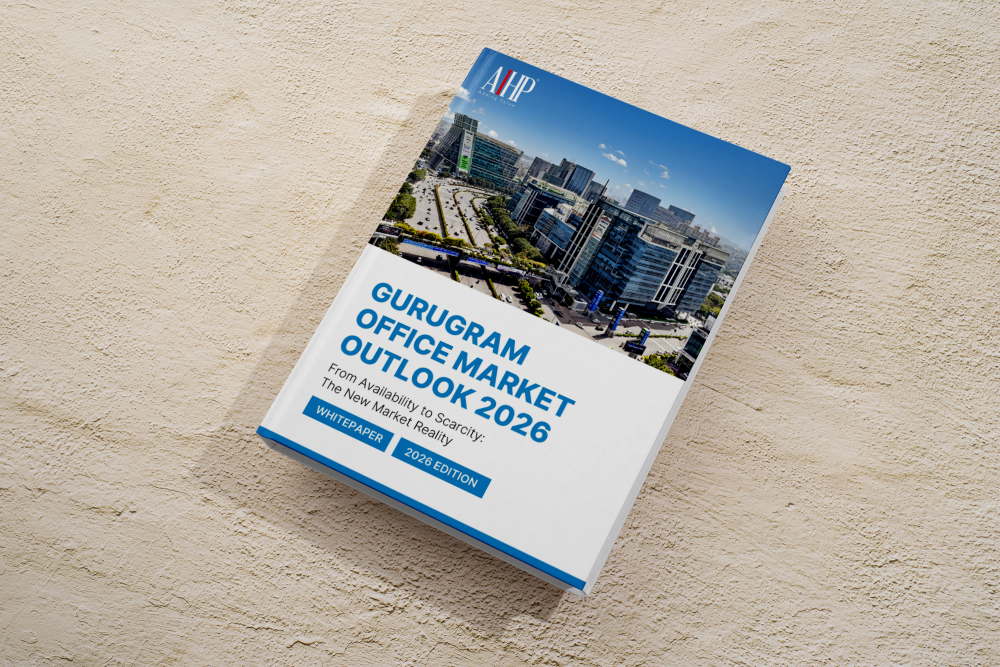
📥 RESOURCE: Download the Gurugram 2026 Office Market Outlook for detailed analysis of supply pipeline, rent trends, and maturity timelines across all Gurgaon micro-markets including emerging corridors.
Emerging micro-markets in Gurgaon offer legitimate cost savings (30-45% lower rent) and modern infrastructure. The trade-off isn't quality—it's ecosystem maturity.
Dwarka Expressway, Sohna Road, and SPR all have operational Grade A buildings, functional connectivity, and development momentum. They're 3-5 years from matching established corridor amenity density but already viable for operations that don't require immediate neighborhood maturity.
The decision comes down to cost tolerance versus amenity importance, talent geography versus brand perception, and willingness to enter early versus waiting for full development.
For companies with cost pressure, appropriate talent distribution, and 5+ year occupancy plans, emerging corridors deliver real savings without compromising building quality. You're choosing when to enter a growth corridor, not whether it will mature.
For guidance on evaluating emerging micro-markets and understanding which timing makes sense for your business, get in touch with AIHP.
Workspace3 Mar 2026 · Sarthhak Kaluucha · 12 min read
 Workspace
26 Feb 2026 · Sarthhak Kaluucha · 14 min read
 Workspace
24 Feb 2026 · Sarthhak Kaluucha · 19 min read
Ready to move your team?
Fully-managed private offices across Gurgaon's prime corridors — move-in ready, fully serviced, sized for your team.