 Workspace
10 Feb 2026 · Sarthhak Kaluucha · 18 min read

Workspace

TL;DR
Employees don't quit jobs because of office design. They quit because daily travel slowly erodes their energy. Gurgaon's commute patterns are forcing companies to rethink where offices belong. Smart firms now choose locations based on where teams live, not where leadership prefers. Hybrid scheduling and distributed micro-hubs are emerging as retention strategies. Listen to this article on
Employees don't quit jobs because of office design.
They quit because daily travel—forty-five minutes each way, five days a week—slowly erodes their energy and commitment. And Gurgaon's commute patterns are forcing companies to rethink where offices actually belong.
Here's what's changing: A few years ago, companies picked office locations based on prestige, cost, or where senior leadership lived. Employee commute was a secondary consideration at best.
That doesn't work anymore. The companies losing talent to competitors aren't offering worse compensation or weaker culture. They're just located in the wrong micro-market for where their teams actually live.
Commute tolerance has dropped. Hybrid policies made it worse—when showing up is optional, every minute of travel becomes a reason to stay home. And in a market where good talent has options, commute convenience is now a competitive advantage.
Walk into most Gurgaon offices and you'll find the same amenities: free food, game rooms, ergonomic furniture, collaboration zones. These things matter, but they don't determine whether someone stays or leaves.
Commute does.
Here's why: Office perks are episodic. You enjoy the free lunch, you use the gym occasionally, you appreciate the nice furniture. But commute is daily and unavoidable. It's the first experience of your workday and the last. It compounds.
Thirty minutes each way seems manageable. That's five hours weekly. Over a year, it's 260 hours—more than six full work weeks spent in transit. And that assumes traffic behaves, which in Gurgaon it often doesn't.
The real damage isn't just time lost. It's the psychological weight. Unpredictable traffic means you can't plan your morning. A trip that takes thirty-five minutes Tuesday takes sixty-five minutes Wednesday. That uncertainty creates stress that bleeds into work.
For parents, commute affects family logistics. Picking up kids, managing household responsibilities, having dinner together—all of this gets harder when you're spending two hours daily in traffic.
And hybrid work made the comparison visceral. Three days weekly, you avoid the commute entirely. The other two days, you're reminded exactly how much of your life goes to travel. That contrast makes long commutes harder to tolerate, not easier.
The math changes when retention is the priority. Losing a senior engineer costs 6-12 months of salary in replacement and ramp-up time. If commute convenience prevents even one resignation annually, it pays for the decision to choose a less prestigious but more accessible location.
Companies are starting to calculate this. Not just "what's the rent per square foot" but "what's the total cost including turnover from commute friction?"
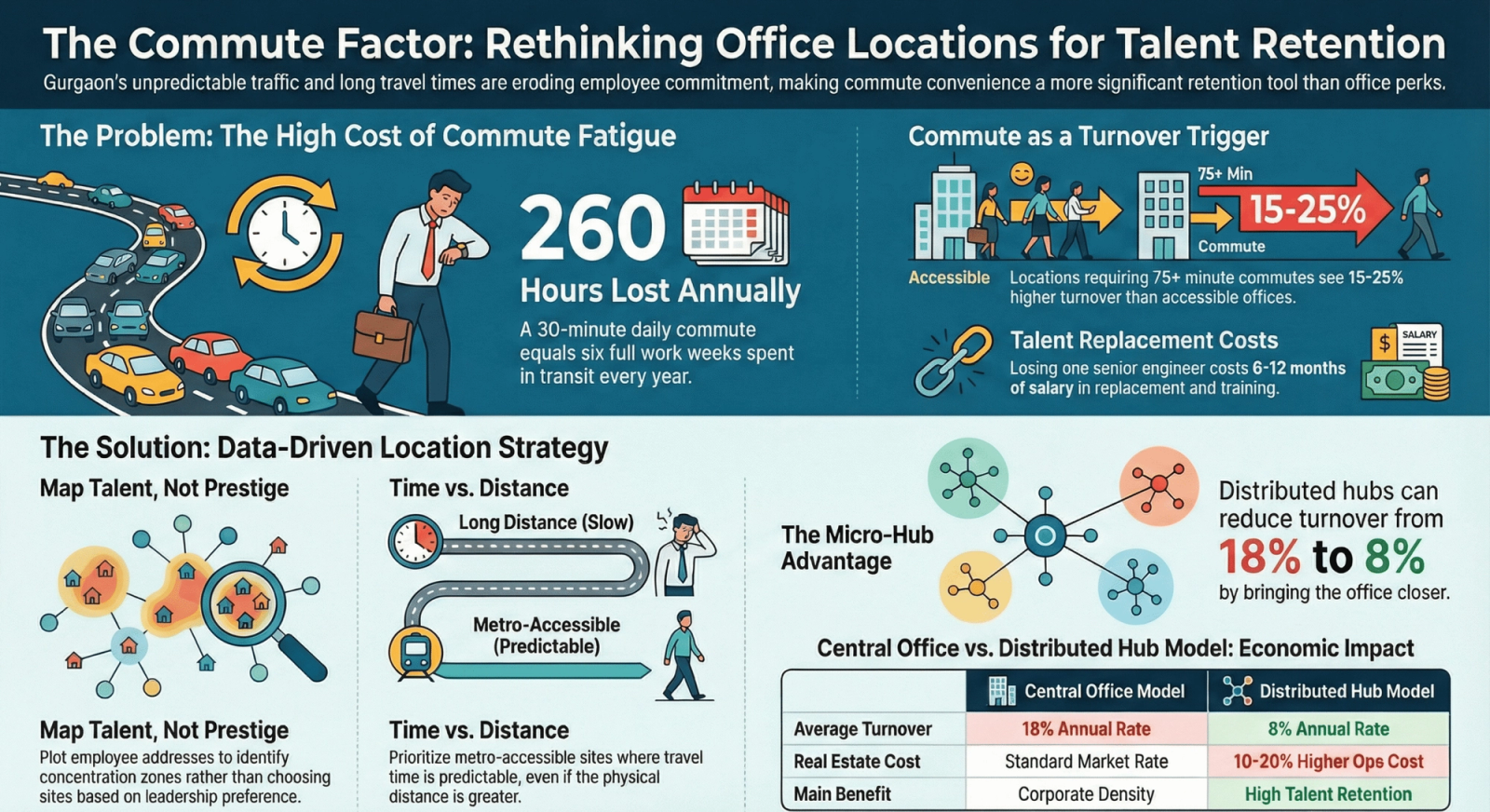
The old playbook went like this: Leadership toured buildings, compared amenities, negotiated lease terms. Maybe they surveyed employees about preferences. Then they picked based on cost and convenience—for leadership.
The new playbook starts with data.
Pull addresses from HR systems. Plot them on a map. You're looking for concentration zones—not just "most people live in Gurgaon" but specifically which areas.
Do they cluster in Golf Course Road residential complexes? Dwarka and West Delhi? New Gurgaon and Sohna Road? The pattern determines which office locations make sense.
Most companies find their teams aren't evenly distributed. You've got 60-70% of employees concentrated in 2-3 residential zones. Those zones should drive location decisions.
Distance doesn't matter in Gurgaon. Travel time does.
An office 8 kilometers away via Golf Course Road might take forty-five minutes during peak hours. An office 12 kilometers away via metro might take thirty-five minutes with zero variability.
Companies are running commute simulations: What's the average travel time from major residential clusters to each potential office location? Not at 11 AM on Sunday—at 9 AM on Tuesday.
The results surprise people. That prestigious Cyber City location everyone assumed was central? It's actually 65+ minutes for the 40% of your team living in Dwarka. Meanwhile, Udyog Vihar is thirty minutes via metro from the same residential areas.
Here's where most companies fail: They optimize for senior leadership commute and ignore everyone else.
The CEO lives in South Delhi. The CFO lives in Golf Course Road. They pick Cyber City because it's convenient for them. Meanwhile, 75% of the team lives in areas where Cyber City creates brutal commutes.
Smart companies flip this. They weight location decisions by headcount distribution. If 50% of your team lives in Dwarka-adjacent areas, metro accessibility becomes the priority—even if that means leadership has slightly longer commutes.
The logic is simple: Losing three mid-level employees to commute fatigue costs more than inconveniencing two executives.
Before signing a lease, run a trial. Tell the team you're considering Location X. How many say the commute would be manageable? How many say it would push them to start looking elsewhere?
You'll get honest answers, especially from employees with young kids or long-tenure people who've optimized their life around current commute patterns.
This isn't a survey about preferences. It's a retention risk assessment. If 15-20% of your team flags commute as a deal-breaker, that location will cost you people.
When you can't solve commute with location, you solve it with scheduling.
Some Gurgaon companies now stagger start times: 8 AM, 9 AM, and 10 AM cohorts. The logic is that peak traffic concentrates between 9-10 AM. Spreading arrivals reduces everyone's commute time.
Early starters get in before traffic builds. Late starters miss the peak. And you still get overlap hours for collaboration.
The 8 AM cohort sees commute times drop 20-30%. The 10 AM cohort avoids the worst congestion. Net result: Same office location, better employee experience.
The crude version of hybrid: "Everyone works 3 days in office."
The refined version: Teams coordinate which days they come in, based on commute patterns and collaboration needs.
Engineering teams that need deep focus time cluster office days Tuesday-Wednesday-Thursday. They commute those three days, work from home Monday and Friday. Sales teams that have client meetings come in Monday-Wednesday-Friday. Support teams that need overlap with global teams come in as needed.
This doesn't solve commute, but it makes it purposeful. You're commuting for specific collaboration value, not just showing up because policy says so.
And it reduces peak-day crowding. If everyone came in Monday-Wednesday-Thursday, you'd need space for 100% capacity. Staggered schedules let you design for 60-70% peak, which means smaller office space requirements and potentially more location flexibility.
A few companies—mostly in tech and creative services—now offer four-day in-office weeks with longer daily hours.
The trade-off: Slightly longer days (9 hours instead of 8), but only four commutes weekly instead of five. For employees with 45+ minute commutes, this math works. They get back five hours weekly that would have gone to the fifth commute.
This doesn't work for all businesses. Client-facing teams that need availability five days can't compress schedules. But for operational teams, product development, and internal functions, it's increasingly common.
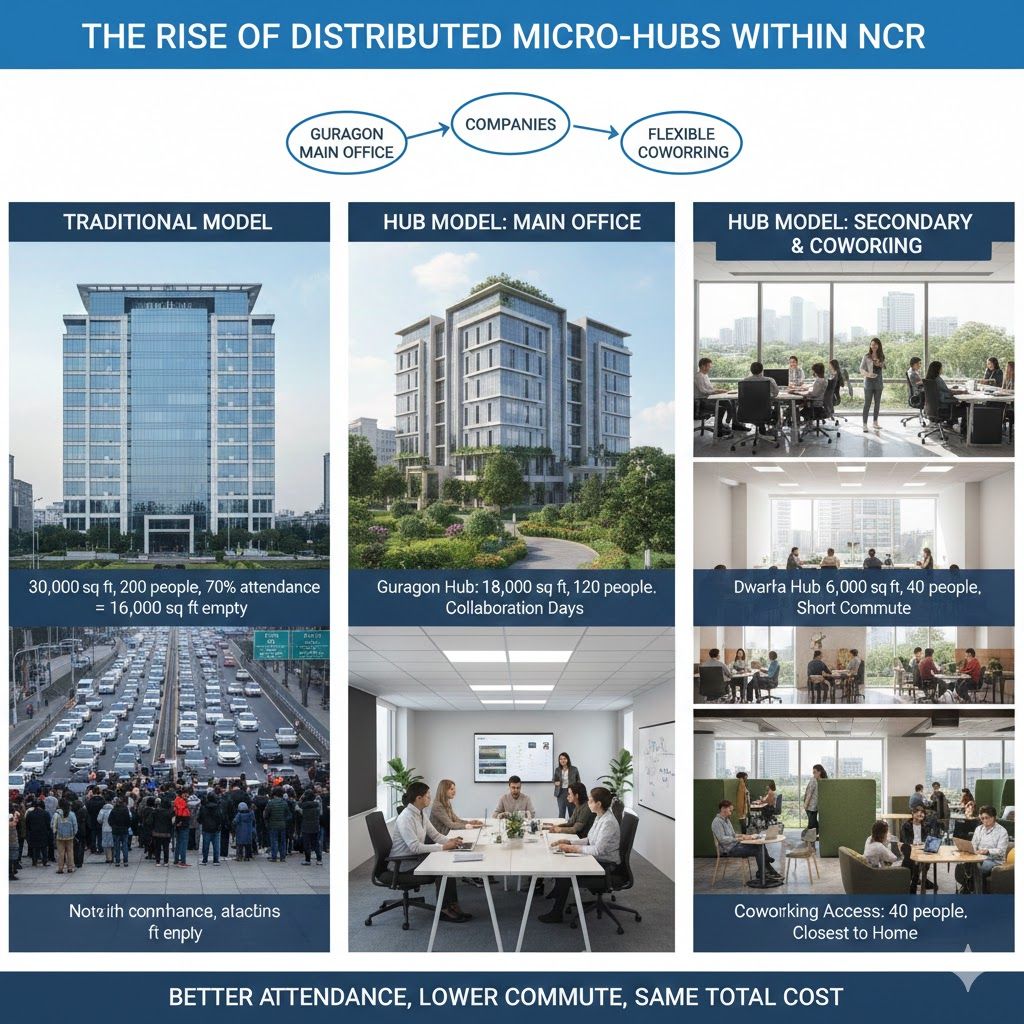
Here's the emerging pattern: Instead of one central office, companies are opening smaller hubs in different NCR zones.
Each employee works from whichever location is closest to home. You show up for important collaboration days at the main office. Otherwise, you use the closer hub.
Why this works: Instead of everyone commuting to one location, you distribute commute load. The Dwarka-based employees who would have faced 90-minute commutes to Cyber City now have 20-minute commutes to a Dwarka hub.
The economics are trickier. You're paying for multiple locations instead of one. But the math changes when you factor in retention and real estate efficiency.
Traditional model: Lease 30,000 sq ft, design for 200 people, assume 70% daily attendance = 14,000 sq ft actively used, 16,000 sq ft sitting empty.
Hub model: Main office 18,000 sq ft for 120 people, secondary hub 6,000 sq ft for 40 people, coworking credits for scattered 40 people = roughly same total cost but better attendance and lower commute burden.
Ten years ago, distributed offices meant collaboration problems. Video calls were clunky. File sharing was painful. Remote work tools weren't mature.
Now, distributed teams operate as smoothly as co-located teams. Slack, Zoom, cloud storage—these tools work the same whether you're in Gurgaon or Noida. The constraint was technology. Technology isn't the constraint anymore.
What holds companies back is mindset, not capability. Leadership worries about culture fragmentation or reduced oversight. But the companies actually running hub models report neither issue. What they report is better retention and higher office utilization.
Micro-hubs solve commute problems, but they create new complexity.
There's value in having everyone in one place. Spontaneous hallway conversations. Cross-team collaboration. The energy of a full office.
When you split across hubs, you lose some of this. The Noida team doesn't randomly run into the Gurgaon team at lunch. Cross-functional collaboration requires more intention.
Some companies handle this by designating "all-hands days"—one day monthly when everyone comes to the main office regardless of which hub they normally use. It creates the density you'd otherwise lose.
Managing one office is simpler than managing three. Facilities, IT, security, vendor management—everything scales complexity.
You need local office managers at each hub. You need duplicated infrastructure. Coffee machines, printers, meeting room booking systems—all of this gets multiplied.
The companies that make hubs work treat it like distributed operations, not just multiple offices. They standardize systems, automate where possible, and accept slightly higher operational overhead as the cost of better retention.
Here's an upside: Smaller hubs are easier to scale than large central offices.
Your main office grows from 100 to 140 people? You might be locked into your current space or face expensive expansion. Your Dwarka hub grows from 20 to 35 people? You find another 2,000 sq ft nearby or shift to a larger coworking space.
Managed office space models work particularly well for hub strategies. You get infrastructure and flexibility without long-term commitments. As teams shift between locations or grow unevenly, you adjust space without renegotiating leases.
In single-office setups, culture happens somewhat organically. People share space daily. Norms develop naturally.
In hub models, culture requires active design. How do teams stay connected across locations? How do you onboard new employees who might work from a secondary hub? How do you maintain shared identity?
The companies that handle this well over-invest in communication, regular cross-hub interactions, and clear cultural documentation. Culture becomes explicit rather than implicit.
If you're evaluating office locations, here's what changes the outcome:

Your current team might cluster in one area. But if you're hiring aggressively, where will new employees come from?
If you're recruiting senior engineers, they increasingly live in Golf Course Road residential areas. If you're hiring entry-level talent, they'll rent apartments near metro lines. If you're building operations teams, they'll come from areas with lower housing costs.
Map your hiring plan, not just your current roster.
Every company says "3 days in office." Then you look at calendar data and realize Tuesday-Wednesday-Thursday are 80% attendance days while Monday-Friday are 40% days.
Design for observed behavior, not policy documents. If your team naturally clusters around mid-week collaboration, optimize commute for those days specifically.
Commute doesn't exist in isolation. If compensation is strong and work is engaging, employees tolerate longer commutes. If compensation is tight and work is frustrating, even moderate commutes become resignation triggers.
Think about commute as a stress multiplier. In high-stress periods (tight deadlines, organizational changes), long commutes become unbearable. In low-stress periods, people tolerate them.
If you're in a high-growth phase with lots of pressure, reducing commute friction matters more. If you're stable and humming along, you have more tolerance for imperfect locations.
Choosing the wrong location isn't like choosing the wrong furniture. You can replace furniture. Office locations lock you in for 3-5 years minimum, often longer.
If you pick a location that creates commute problems, you'll bleed talent slowly. Not dramatically—just steady attrition of people who find opportunities closer to home.
The cost shows up in recruiting difficulty (candidates declining offers due to location), higher turnover (especially among employees with young kids), and reduced office attendance (people working from home more to avoid commute).
That's not a facilities problem you can fix with better amenities. It's a structural problem that requires relocation—which means breaking leases, disrupting operations, and spending on fit-out all over again.
Better to invest time upfront mapping commute patterns and making data-driven location decisions than to fix it retroactively.
The companies winning talent wars in Gurgaon are starting to market commute convenience explicitly.
Job descriptions now mention: "Office located 5 minutes from Udyog Vihar metro station" or "Walking distance from Golf Course Road residential complexes."
Recruiting teams ask candidates where they live and calculate commute times during interviews. If the commute is brutal, they address it upfront—either by discussing flexible arrangements or being honest that this might not work.
And companies are using location as a retention tool. When high-performers get competing offers, commute convenience becomes a negotiating point. "Yes, they're offering 15% more, but your commute would go from 30 minutes to 75 minutes. Over a year, that's 200 hours of your life."
It sounds minor compared to compensation. But for people with families and limited personal time, it's often the deciding factor.
The market is shifting. Five years ago, employees accepted long commutes as the cost of good jobs. Hybrid work changed that psychology. Now employees ask: "Why should I commute at all if I can do this work from home?"
The companies that answer that question with "Because the office is close enough that showing up is easy" win. The companies that answer with "Because we have nice furniture and free snacks" lose.
For organizations evaluating office space in Gurgaon, commute patterns should drive location decisions as much as rent and building quality. Get in touch with AIHP to discuss how to map your team's commute patterns and choose locations that support retention. For comprehensive analysis of Gurgaon's evolving office market and location trends, download the Gurugram 2026 Office Market Outlook.
Workspace10 Feb 2026 · Sarthhak Kaluucha · 18 min read
 Workspace
6 Feb 2026 · Sarthhak Kaluucha · 19 min read
 Workspace
3 Feb 2026 · Sarthhak Kaluucha · 14 min read
Ready to move your team?
Fully-managed private offices across Gurgaon's prime corridors — move-in ready, fully serviced, sized for your team.