 Workspace
11 Jul 2026 · Sarthhak Kaluucha · 5 min read

Workspace
TL;DR
Start by separating operators (who run the space and answer for it) from brokers (who list it and earn a commission). Then put seven questions to every shortlisted provider: who controls the building, minimum team size, who funds the fit-out, how far customization goes, what the per-seat fee includes, what the SLAs are, and where the inventory actually sits. Get every answer in writing before comparing prices.
Gurgaon has no shortage of companies offering to hand you a ready office. The hard part is that they are not all offering the same thing: some operate the space they sell, some resell other people's space, and the per-seat fees they quote can include very different bundles. This guide is the set of questions that separates them — not a ranking, a method.
An operator controls the space it sells: it builds the fit-out, employs the site staff, signs your agreement and answers for the air conditioning at 3pm in June. A broker aggregates listings across many operators and landlords, earns a commission on the deal, and exits at signature. Both are legitimate — brokers are a fast way to survey the market — but only one is accountable after you move in.
The test is three questions: who signs my agreement, who employs the people in the building, and who do I call when something breaks? If the answers are three different companies, you are talking to an intermediary.
The market splits into national managed-office operators with Gurgaon centres — Smartworks, Table Space, Awfis, Incuspaze and WeWork India among them — city-focused operators such as AIHP, and broker platforms that list across all of the above. National scale and local depth are different strengths: the former offers multi-city consistency, the latter concentrated inventory and direct control in one market. Neither is automatically better; it depends on whether your roadmap is one city or five.
Some operators own their buildings, some hold long leases, and some manage a floor for a landlord. The further the operator is from control, the more your expansion, renewal and service quality depend on a third party you never meet. Ask which of the three applies to the specific building you are shown.
Minimums tell you who the product is built for. AIHP's is 20 seats; other operators set theirs lower or higher. Just as important is the ceiling: if you plan to be 200 people in two years, ask to see where those 200 would physically sit.
The core financial promise of a managed office is that fit-out becomes the operator's capital expenditure, not yours — you pay one fee and keep your balance sheet clean. Confirm that holds for customization too: if your layout changes are billed as your CapEx, part of the model's advantage quietly disappears.
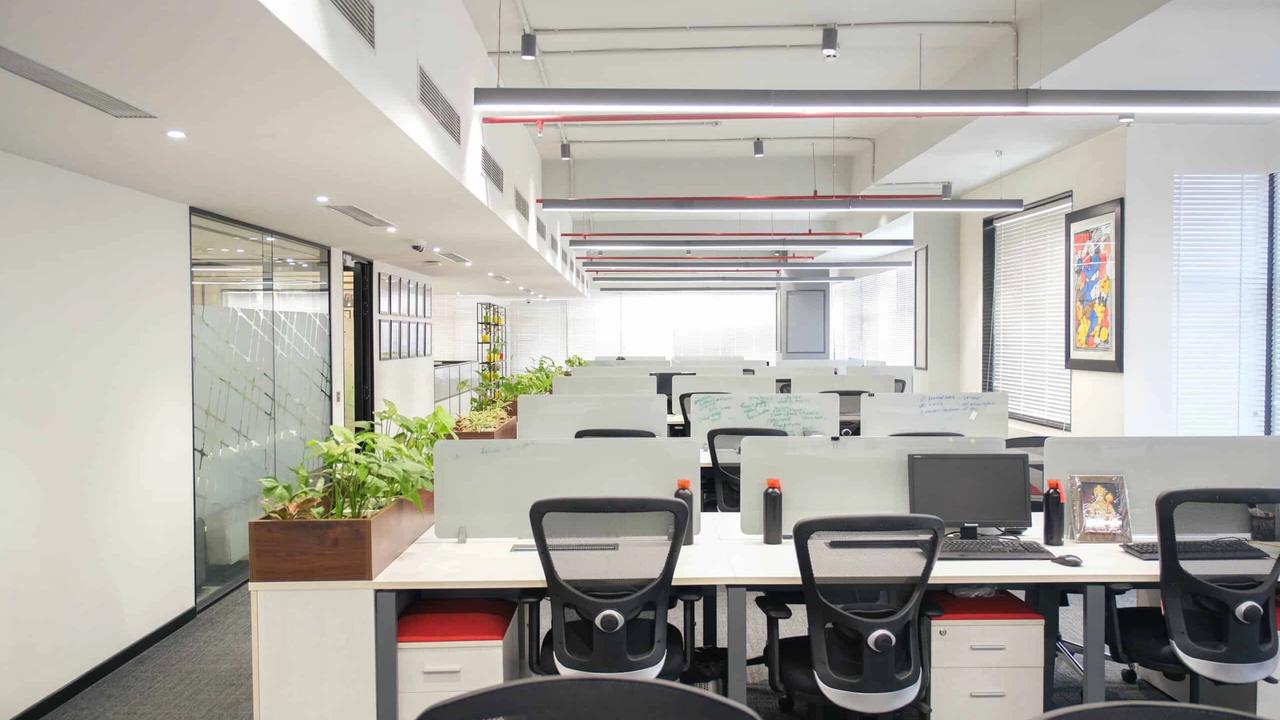
Providers range from fixed template floors to offices furnished as per your brand — your reception, cabin mix, layout and identity. If client visits matter to your business, see a floor the provider actually customized, not a render.
Two quotes at the same rate can be hundreds of rupees apart per seat once you account for what sits outside them. Get the inclusion list in writing: furniture, air conditioning, power backup, housekeeping, security, maintenance — and the exclusion list, which is where the differences usually hide. GST at 18% applies on top of any quote.
Uptime for power backup and internet, response time when something fails, and whether there are operations staff physically in your building — ask for each as a written commitment, not a brochure adjective. An operator that runs its own buildings can put its name to these; an intermediary cannot.
“Gurgaon” spans micromarkets with very different commutes and price points — Udyog Vihar on the Delhi border prices differently from Golf Course Extension Road. Evaluate the specific building and floor on offer, not the brand's city-level presence.
Live asking rates for managed private offices in Gurgaon run ₹6,500–₹15,000 per seat per month depending on micromarket and building. Location-wise tables and a worked 50-seat budget are in our guide to how much office space costs in Gurgaon — use it to sanity-check any quote before negotiating.
Choosing a managed office provider is mostly a matter of forcing precision: who controls the building, what the fee includes, what is committed in writing. Providers comfortable with those questions tend to be the ones who run their own spaces; the rest reveal themselves quickly.
AIHP is an operator, not a broker — it runs fully furnished private offices across Udyog Vihar, Sector 32, Golf Course Extension Road and Sector 50, furnished as per your brand, for teams of 20 seats and up. Put the seven questions to us: browse current availability under office for rent in Gurgaon.
Workspace11 Jul 2026 · Sarthhak Kaluucha · 5 min read
 Workspace
26 Jun 2026 · Sarthhak Kaluucha · 29 min read
 Workspace
12 Jun 2026 · Sarthhak Kaluucha · 13 min read
Ready to move your team?
Fully-managed private offices across Gurgaon's prime corridors — move-in ready, fully serviced, sized for your team.