 Workspace
15 Jul 2026 · Sarthhak Kaluucha · 4 min read

Workspace
TL;DR
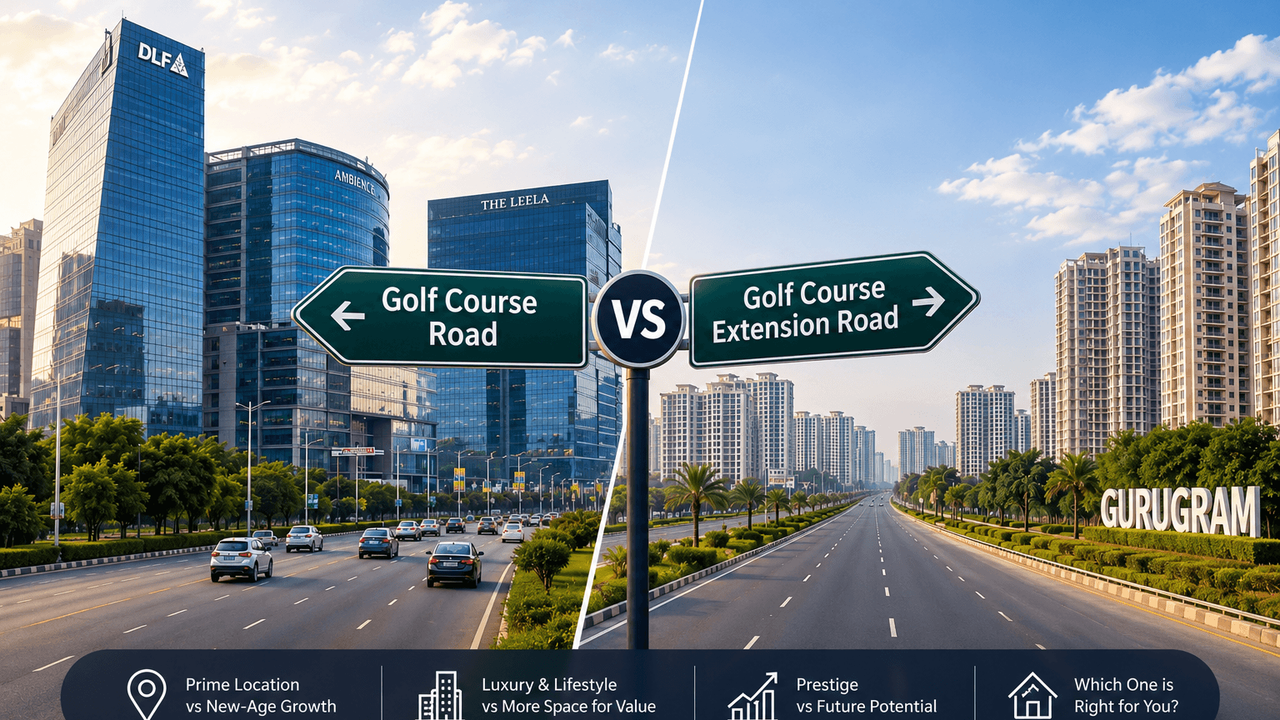
Golf Course Road (₹115-135/sq ft) has Rapid Metro direct access, established premium brand, and Gurgaon’s densest within-zone amenity ecosystem. Golf Course Extension Road (₹100-125/sq ft) is 10-15% cheaper with newer buildings, larger floor plates, and SPR road connectivity. One variable usually decides it: whether your team needs direct metro or can manage without.
The name confusion is where most of these decisions start going wrong. Golf Course Road. Golf Course Extension Road. Same Golf Course. Different roads. Different price points. Different connectivity profiles. Different tenant ecosystems. One has Rapid Metro stations serving it directly. The other's nearest station is a 12 to 15 minute cab ride away.
That gap is the comparison. Everything else — rent, building age, floor plates, brand — flows from it or supports it. If you’re evaluating both corridors for a Gurgaon office, this is the framework that keeps the comparison honest.
Both corridors sit in South Gurgaon’s premium segment. Both attract BFSI, consulting, and professional services tenants. Both sit above Sohna Road on price and positioning. According to CBRE India’s Gurgaon office market data, South Gurgaon’s premium corridors — GCR and GCER combined — account for a significant and growing share of Gurgaon’s Grade A absorption, driven by sustained BFSI and GCC demand. The question isn’t whether to be in South Gurgaon’s premium band. It’s which corridor within it.
Golf Course Road is served by the Rapid Metro's Golf Course Road line: Sikanderpur (the Yellow Line interchange), Phase 1, Sector 42-43, Sector 53-54, Sector 54 Chowk and Sector 55-56. These stations run directly along the corridor's commercial spine, so a building on Golf Course Road is typically a short walk from at least one of them.
Golf Course Extension Road has no metro station on the corridor itself as of 2026. The closest operational station is Sector 55-56 on the Rapid Metro, 5.5 to 6 km away (12 to 15 minutes by cab or auto). Millennium City Centre, formerly HUDA City Centre, on the Yellow Line is 6 to 7 km away (15 to 20 minutes by road via Subhash Chowk). The corridor is road-accessible via the Southern Peripheral Road and NH-248A, but employees relying on public transit face a last-mile leg every day.
The commute quality analysis is clear on what this means in practice: metro access drives employee satisfaction scores for office locations in Gurgaon more than any other single variable. It determines how wide a talent catchment you can realistically draw from. And it determines the attrition risk among junior employees who’ve never relied on a car.
Before you look at rent, building age, or floor plates, answer this: what proportion of your team relies on public transit to get to work? If the answer is significant — particularly in junior engineering, operations, or administrative roles — that single answer probably determines the corridor. Golf Course Road for metro-dependent teams. Golf Course Extension Road when driving-capable teams make up the majority.
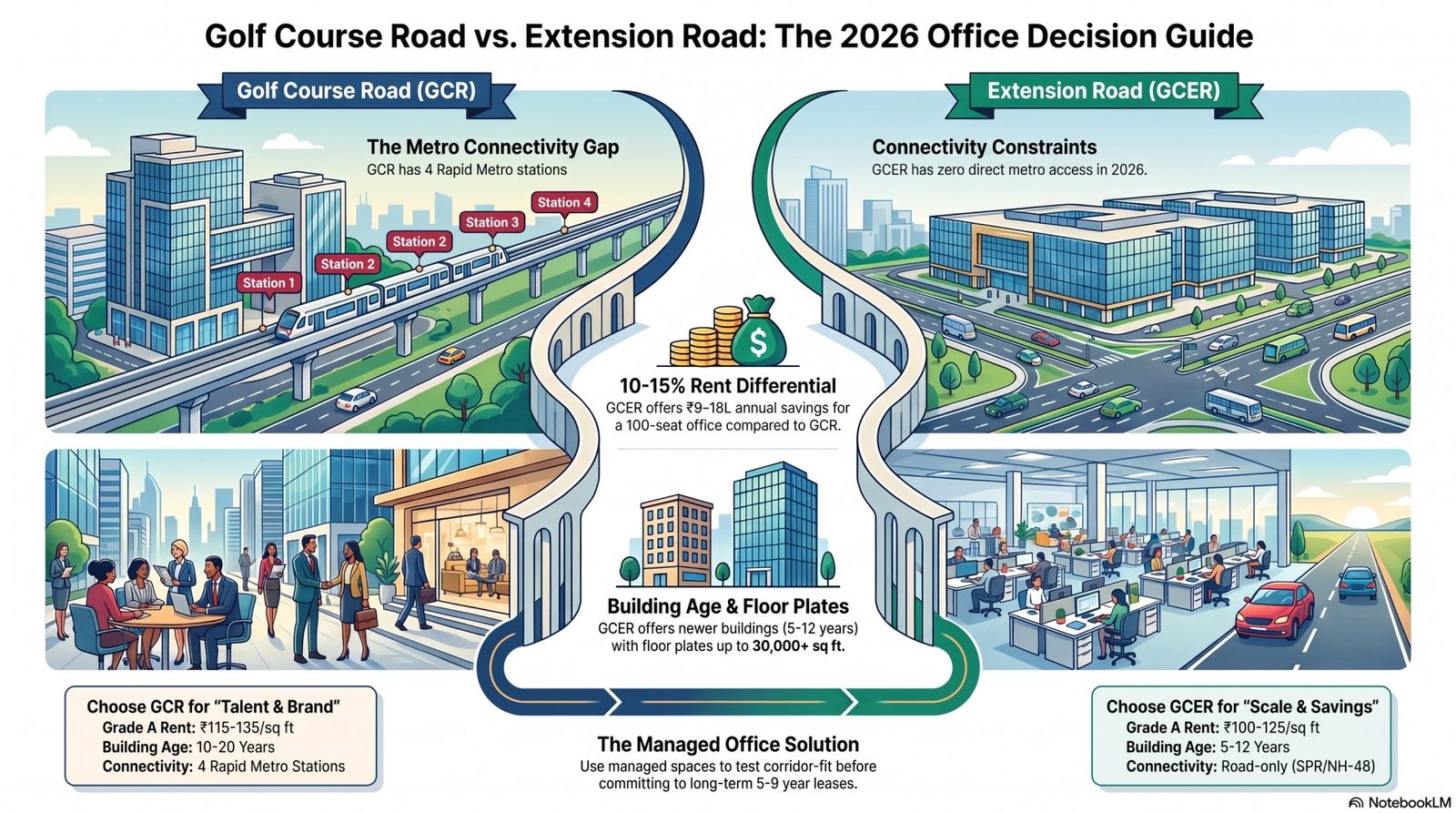
The rent gap is real. Not dramatic, but real at scale. For a detailed breakdown of how Gurgaon’s corridors price relative to each other, the Gurgaon office rent guide covers it comprehensively. Here’s the GCR vs GCER version.
| Factor | Golf Course Road | Golf Course Extension Road |
|---|---|---|
| Grade A rent | ₹115-135/sq ft | ₹100-125/sq ft |
| 100-seat office (5,000 sq ft) | ₹5.75-6.75L/month | ₹5-6.25L/month |
| Annual difference | — | ₹9-18L/year saving |
| Building age | 10-20 years | 5-12 years |
| Floor plates | 5-15K sq ft typical | 10-30K sq ft typical |
| Metro | Rapid Metro (stations on the road) | None on the corridor; Sector 55-56 Rapid Metro 12-15 min by cab |
| Airport | about 30 minutes (17-19 km) | about 45 minutes via NH-48 and SPR |
| Brand perception | Established premium | Emerging premium |
The rent saving at 100 seats is ₹9-18 lakhs annually. Over three years, ₹27-54 lakhs. That’s material, but not decisive on its own. What often makes it decisive is what the savings enable: additional hires, technology investment, marketing budget, extended runway. The real question is whether the rent saving outweighs what you give up by not having metro connectivity.
The answer depends entirely on your team’s geography. Run the numbers on total cost of occupation for each corridor: base rent plus utilities and facilities. GCER’s newer buildings often have lower CAM charges and more efficient power infrastructure than GCR’s older stock, which further narrows the effective cost gap. The headline rent differential doesn’t capture the full picture.
Golf Course Road’s commercial buildings were largely delivered between 2005 and 2016. They carry the infrastructure of that era: generally solid for enterprise operations, but older HVAC systems, smaller floor plates, and building management systems that predate modern IT security requirements.
Golf Course Extension Road’s Grade A stock was predominantly delivered between 2014 and 2024. Newer infrastructure across the board. Larger floor plates — often 10,000-30,000+ sq ft versus GCR’s typical 5,000-15,000 sq ft — which matters significantly for companies that need 200+ contiguous seats. Modern building management systems. Better parking ratios.
The GCER office guide covers specific developments in detail: M3M Urbana Business Park, BPTP Park Centra, Bestech Business Tower, and AIHP Central. The consistent theme is Grade A specification in newer buildings that can accommodate configurations GCR’s older stock cannot — particularly large open-plan engineering floors, purpose-built R&D labs, and dense data infrastructure.
Does newer building quality justify the metro trade-off? For large-format operations needing 200-500 contiguous seats, GCER’s larger floor plates might be the deciding factor — GCR simply doesn’t have buildings that can accommodate that at scale in a single tenancy. For standard 50-200 seat operations where GCR has adequate stock, the newer-building advantage on GCER is real but not decisive on its own.
Golf Course Road carries established premium brand equity. It is where India offices of Fortune 500 companies, global consulting majors, and international financial institutions have concentrated for 15+ years. The address signals “we’re here to stay and we’ve earned this location.” For client-facing businesses, for companies recruiting from premium MNC talent pools, for organisations where the office address appears in presentations to global leadership — that brand equity is a real operational input.
Cyber Hub — Gurgaon’s densest restaurant and entertainment complex — sits directly in the Golf Course Road commercial zone. This is the ecosystem that makes GCR more than an office address: it creates an environment where client lunches, after-work networking, and team events happen organically. JLL India’s annual office market research consistently identifies GCR’s within-zone amenity density as a significant retention factor for senior employees who expect professional surroundings throughout their workday.
Golf Course Extension Road is emerging premium. The address is credible and improving. The residential environment surrounding the corridor is excellent — the luxury residential developments that drove GCER’s commercial evolution create a neighbourhood that’s genuinely pleasant to work in. But the within-zone commercial ecosystem is thinner. Fewer restaurants within walking distance. Fewer networking events. Fewer moments of spontaneous professional interaction that make a dense commercial hub valuable.
The gap is closing. In 2030, the brand and ecosystem comparison will look different. In 2026, GCR still wins on both dimensions.
Golf Course Road connects to NH-48 (Delhi-Jaipur Expressway) via the IFFCO Chowk junction and to Sohna Road via internal Gurgaon roads. Traffic at IFFCO Chowk is a genuine operational issue during peak hours — morning and evening commutes, and particularly during monsoon, can add 20-30 minutes to car commutes from Delhi.
Golf Course Extension Road benefits from the Southern Peripheral Road directly. SPR provides high-speed east-west movement across South Gurgaon: Cyber City in about 25 minutes, NH-48 in 30-35 minutes. For employees driving from South Gurgaon residential sectors, the commute is often smoother than equivalent drives to GCR because it avoids IFFCO Chowk entirely.
Golf Course Road: IGI Terminal 3 in about 30 minutes via NH-48 (17 to 19 km). Golf Course Extension Road: IGI Terminal 3 in about 45 minutes via SPR and NH-48. The gap is about 15 minutes. Meaningful for companies with daily business travel. Less significant for those with occasional travel.
Both corridors draw from the same South Gurgaon residential zones — Sectors 56-67, Golf Course Extension residential areas, DLF Phases. Employees living in these zones face broadly similar commute times to either corridor by road. The differentiator is for employees living outside South Gurgaon: GCER’s metro gap excludes Delhi’s metro-dependent population more severely than GCR’s Rapid Metro connectivity.
• Metro access is non-negotiable: any significant proportion of your team uses Delhi Metro to commute
• Brand prestige is a genuine business requirement: client perception of office address affects relationships or deal outcomes
• Amenity density matters for team experience: your senior employees expect restaurant and hospitality infrastructure within walking distance
• Talent acquisition targets premium MNC professionals: GCR’s address resonates with candidates from Cyber City, Accenture, Deloitte, Goldman Sachs backgrounds
• Floor plate requirements are standard: 50-150 seats per floor, which GCR can accommodate comfortably
• Your team predominantly drives: South Gurgaon residential base, senior-heavy team profile, company transport provided
• Cost discipline is a priority: ₹9-18 lakhs annually saved at 100 seats goes into headcount, product, or runway
• You need large contiguous floor plates: 200-500 seat single-tenancy that GCR buildings cannot accommodate
• Modern building infrastructure is required: newer HVAC, power density, data infrastructure, building management systems
• Emerging premium is acceptable positioning: clients and candidates accept GCER as a credible premium address even without GCR’s established cachet
AIHP Central is AIHP’s owned building on Golf Course Extension Road — managed office space with zero upfront CapEx, 60-day delivery, and AIHP’s operational standards in GCER’s emerging premium environment. For companies that have evaluated the corridor and chosen it, AIHP Central provides a direct path without traditional lease complexity. View AIHP Central availability.
On Golf Course Road, AIHP operates through managed office space in the corridor’s Grade A buildings — leased floors managed to AIHP’s standards. The same model: per-seat fee, zero fit-out CapEx, 60-day delivery, facilities management included. View Golf Course Road availability.
The managed model resolves one of the practical challenges this comparison creates: you don’t need to commit to a 5-9 year lease before being certain which corridor suits your team’s commute patterns. A shorter-term managed arrangement lets you run the operation, gather data on how your team actually commutes, and make the longer-term location decision with real evidence rather than projections.
RESOURCE: Download The Ultimate Guide to Gurgaon Office Space for detailed micro-market comparisons, lease negotiation templates, and infrastructure verification checklists. Download the Ultimate Guide →
Golf Course Road and Golf Course Extension Road are not interchangeable corridors with a price gap between them. They are different operational propositions. GCR is the right answer when metro access matters, when established premium brand is a genuine business requirement, and when the within-zone ecosystem is worth paying for. GCER is the right answer when a driving-capable team reduces the metro dependency, when modern larger buildings solve a real space requirement, and when the 10-15% rent saving is deployed more productively elsewhere.
The comparison most companies underweight is not rent versus brand. It’s commute quality versus cost. Run the numbers on your team’s actual residential distribution before deciding. A 100-seat team where 30% of employees rely on metro faces a meaningfully different Gurgaon office market than a 100-seat team where 80% drive from South Gurgaon residential sectors. The corridors serve different commute profiles. Match the corridor to the profile, not to the aspirational positioning.
For guidance on which corridor aligns with team geography, operational requirements, and budget — and which specific buildings within each corridor are currently available — get in touch with AIHP. Or compare the two corridors directly against a third option in the premium band: MG Road, with Gurgaon’s strongest metro coverage at a similar rent to GCER.
Workspace15 Jul 2026 · Sarthhak Kaluucha · 4 min read
 Workspace
11 Jul 2026 · Sarthhak Kaluucha · 5 min read
Workspace11 Jul 2026 · Sarthhak Kaluucha · 5 min read
Ready to move your team?
Fully-managed private offices across Gurgaon's prime corridors — move-in ready, fully serviced, sized for your team.