 Workspace
29 Sept 2026 · Udit Chauhan · 9 min read

Workspace

TL;DR
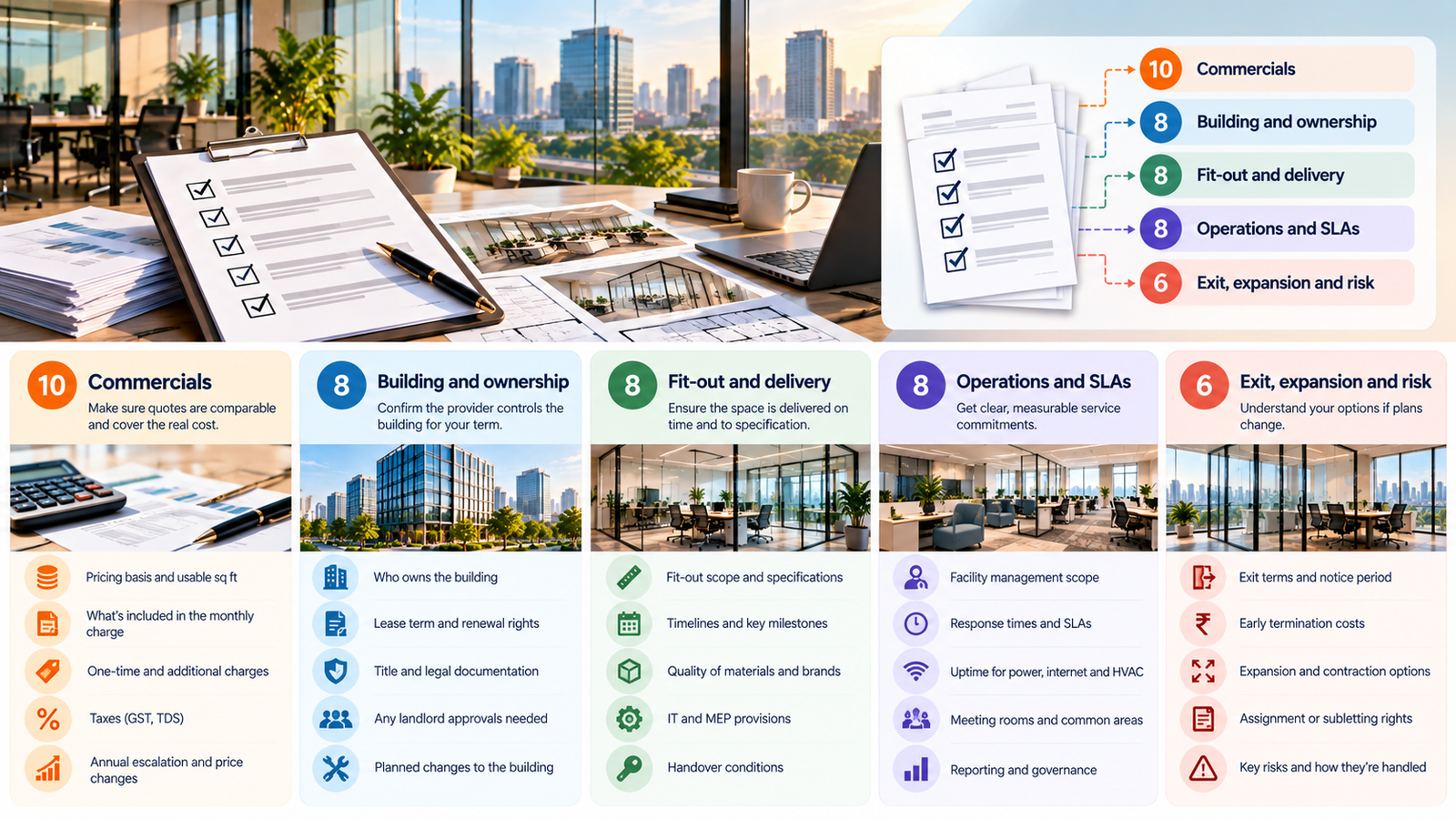
A managed office RFP makes every provider answer the same questions, so quotes can be compared line by line. The 40 below cover commercials, the building, fit-out, service levels and exit. Score the answers by theme, and count nothing a provider won't put in writing.
A managed office RFP (request for proposal) is a written brief you send to every shortlisted provider so their quotes can be compared line by line. This template gives you 40 questions across five areas (commercials, the building and who owns it, fit-out and delivery, day-to-day service, and exit terms), plus a way to score the replies.
Three quotes land in your inbox on the same afternoon. Each opens with a per-seat number, and none of those numbers means much until you know what sits behind it: what the price includes, when it rises, who owns the building, what leaving costs. An RFP makes every provider answer the same questions, in the same order, before anything is signed.
If you are still weighing up managed office space in Gurgaon against a conventional lease, start with how the four office models differ. If the model is settled and the provider isn't, how to choose a managed office provider in Gurgaon sets out the criteria, and this template is how you make each provider answer to them in writing.
| Theme | Questions | What it protects you from |
|---|---|---|
| Commercials | 10 | Quotes that look alike but cost differently once escalation, utilities and tax are counted |
| Building and ownership | 8 | Signing for a floor the provider may not control for your whole term |
| Fit-out and delivery | 8 | A late handover, or a "ready" floor that isn't |
| Operations and SLAs | 8 | Service promises you cannot enforce |
| Exit, expansion and risk | 6 | A change of plan that costs more than it should |
Run an RFP when you are comparing three or more providers and the deal will last years, or when finance, legal or procurement will want to see why you chose the one you chose. For a short project, a site visit and a quote will do. An RFP adds a round of work for you and for every provider.
The formal route fits because managed offices are now an enterprise product. Knight Frank's seat-level data for 2020 to 2025 puts large enterprises at 72% of flex seats across India and 83% in NCR. Buyers that size usually have a procurement process to satisfy.
The market gives you little slack. JLL reports a record 10.23 million sq ft leased by flex operators across the top seven cities in the first half of 2026, and Delhi NCR vacancy at its lowest in over fifteen years. With vacancy that tight, the better floors are unlikely to wait, so set a short deadline and name one person for questions.
The brief should carry your headcount now and in two years, the corridors you would accept, your move-in date, the requirements you will not trade away and how you will score. Ask every provider to answer by question number and to attach their draft agreement: an answer that isn't in the draft is a promise, not a term.
According to Knight Frank's flex research, operators pass on savings from scale but also charge a margin for their services, so a per-seat number only means something next to what it buys.
1.Is the price per seat, per workstation or per sq ft, and how many sq ft sit behind each seat?
A per-seat price on a tight layout and a per-sq-ft price on a generous one can't be compared until both are converted to cost per usable seat.
2.What does the monthly charge include, line by line?
Two quotes that both say "fully serviced" may treat electricity, printing, housekeeping and meeting-room hours differently.
3.What is billed on top of the monthly charge, and what are the one-time charges?
Onboarding fees, access cards, IT set-up and branding work often sit outside the headline price, and they are easiest to negotiate before you have picked a provider.
4.Are quoted prices before or after GST, and how are GST and TDS handled on the invoice?
Your finance team needs every quote on the same tax basis before anyone adds up totals.
5.What is the annual escalation, is it fixed or linked to an index, and can any other charge be revised during the term?
Escalation compounds, so a small difference in the yearly rate is a large one by year three. A clause letting the provider revise other charges mid-term undoes a fixed price.
6.How large is the security deposit, in what form, and when is it returned after exit?
The deposit sits on the provider's books, not yours, and the refund timeline is the term people forget to negotiate.
7.What are the lock-in period and the total term, and what does it cost to leave between the two?
The lock-in is the stretch you cannot leave. The term is how long the agreement runs if you stay. You need both numbers, and the cost of leaving in between.
8.When does billing start: at signing, at handover, or after a rent-free period?
Billing from signing means paying for a floor you can't use yet.
9.How are electricity, diesel generator (DG) power and water charged, and is there a usage cap?
Metering or a fair-use cap is how a fixed monthly price starts to move once you have settled in.
10.What are the payment terms: billing frequency, advance or arrears, and charges for late payment?
Payment terms shape your cash flow, and late-payment charges add up if invoices sit in approval.
When a provider leases the floor from someone else, that landlord's lease sits underneath yours. Why who owns the building changes your risk sets out the two structures.
11.Who owns the building, and what is your interest in it: freehold, long lease or sub-lease?
The party signing your agreement may not control the building for the whole of your term.
12.If you hold a master lease, when does it expire, and what happens to our agreement if it ends early?
Your term can outlive the operator's right to the floor. The expiry date tells you whether it will.
13.Will the building owner confirm in writing that our occupation continues if your own lease ends?
The operator can't promise what it doesn't control. The owner can.
14.Does the building hold a valid occupancy certificate and fire safety approval, and can we see copies?
You can't run an office you aren't allowed to occupy, and a lapsed approval is easier to fix before you sign than after. Ask for the issue dates and the next renewal date.
15.What power capacity, backup and lift arrangements does the building have for our headcount?
Capacity that suits an early team may not cope with the full headcount. IT-heavy teams in particular should check DG capacity and redundant internet lines, as the IT/ITeS location guide sets out.
16.What are the access hours, the visitor process and the parking allocation for our team?
Late-shift teams and visiting clients feel gaps here first.
17.What insurance covers the building, the fit-out and our equipment, and who is liable for what?
If a pipe bursts above your server cabinet or a laptop goes missing, the insurance answer decides who absorbs the loss.
18.Who manages the common areas, and who else occupies the building?
Neighbouring tenants and building management decide how noisy the floor is and how long you wait for a lift, and neither shows up in a seat price.
19.What is the delivery date from signing, and what counts as delivered?
"Ready" means the keys are in your hand at one provider and a tested, commissioned floor at another. Put the trigger in writing.
20.What happens if delivery slips: a credit, free days, or a right to walk away?
If the date slips and the agreement is silent, all you can do is complain. A remedy gives the date some weight.
21.Who pays for the fit-out, and is any of it recovered through the rent?
In a zero-capex offer the provider funds the fit-out and recovers the cost through the rent, over a period you should have in writing. The fit-out cost per sq ft is the number being paid back.
22.Who owns the fit-out, furniture and cabling at the end of the term?
It decides whether you take the assets with you, leave them behind or pay to strip the floor.
23.How far can we customise the layout and branding, and who approves and pays for changes?
"Customisable" runs from choosing chair colours to redesigning the floor, and examples from other clients show where a provider sits on that range. Full build-to-suit work is the far end.
24.What are the specifications and warranties for furniture, air-conditioning and lighting?
The spec sheet is what lets you compare two offices that both sell themselves as fully furnished office space in Gurgaon.
25.How many internet providers serve the building, and can we bring our own provider and security stack?
With one carrier, a single outage stops the whole floor, and your security team may not accept a shared network.
26.What is the handover inspection process, and how long do we have to raise defects?
Defects raised at handover are harder for a provider to dispute than defects raised six months later.
Service-level agreements (SLAs) set the response times, uptime and remedies a provider commits to, and on paper every provider's version reads much the same.
27.Which services are included, and at what hours and frequency?
Housekeeping, pantry and maintenance lists read alike until you compare how often each happens and when.
28.What are your written response and resolution times for air-conditioning, power, internet and housekeeping faults?
Different faults need different clocks. A dead air-conditioner and a jammed pantry door shouldn't share one promise.
29.What uptime do you commit to for power and internet, and how quickly does backup power switch in?
Uptime is usually quoted as a percentage. That figure means little without the way it is measured and who does the measuring.
30.What credit or remedy applies when a service level is missed, and how is a miss recorded?
A service credit or, after repeated misses, a right to exit is what makes a service level enforceable. How each miss is logged decides the credit, so get that in writing too.
31.Who is our on-site contact, what are their hours, and how do issues escalate?
Without a named contact, every fault begins with working out who to tell.
32.How is access controlled and logged, and who holds keys or master access cards?
Master cards and spare keys decide how private the floor is.
33.How do you handle visitor logs, CCTV footage and biometric data, and who is responsible for it under India's data protection law?
Access systems collect personal data, and someone decides how long it is kept and who sees it. That may be you, the operator or both. For the law itself, see the ConsentOS Learn Hub.
34.What reports do you provide on service, incidents and utilisation, and how often?
Reports let you spot a slipping service before it becomes an escalation.
Exit, expansion and reduction terms are cheapest to agree before signing, while the provider still wants the deal.
35.What are the early-termination rights and charges, before and after the lock-in?
These clauses set what a change of plan will cost, and your leverage on lock-in and escalation terms is highest before you sign.
36.What notice do we give, and in what condition must the space be handed back?
A reinstatement clause can turn a clean exit into an invoice.
37.Can we add seats in this building or nearby, at what price, and how fast?
Growth is the likeliest reason you will outgrow the floor. Agree the price and the timing now, and ask whether a second hub nearby would suit better than more seats in one building.
38.Can we reduce seats during the term, and from when?
With hybrid attendance, seat needs move down as well as up.
39.What happens to our deposit and access if the provider is sold, restructured or fails?
Ask how the deposit is held and whether the agreement survives a change of control.
40.Which law and forum govern disputes, and what is the escalation path before formal proceedings?
Governing law, venue and the steps before formal proceedings are easiest to settle while nobody is in a dispute.
Put every reply in one sheet, in question order, and score each answer from 0 to 2. Zero is no answer or a dodge, one is vague or verbal only, and two is specific, written down and reflected in the draft agreement.
Fix the weights before you open the replies, so the scores can't drift toward whoever impressed you in the meeting. Treat the split below as a starting point. A global capability centre (GCC) with a fixed launch date may weigh delivery higher, and a finance-led buyer may put more on exit terms.
| Theme | Starting weight | Who should score it |
|---|---|---|
| Commercials | 30% | Finance |
| Building and ownership | 20% | Real estate or legal |
| Fit-out and delivery | 15% | Administration or facilities |
| Operations and SLAs | 20% | Administration and IT |
| Exit, expansion and risk | 15% | Legal and finance |
Put every price on one basis: the total you will pay over the lock-in, including escalation, utilities, tax and one-time charges, divided by the seats you will use and the months in the lock-in. That is cost per usable seat per month. The coworking vs managed office cost comparison works through one, with GST and overages included.
Use the sheet in the negotiation as well. Send your top two providers their lowest-scoring questions with a short deadline, and see how each one handles the gap. It is a reasonable preview of how they will handle a fault after you sign.
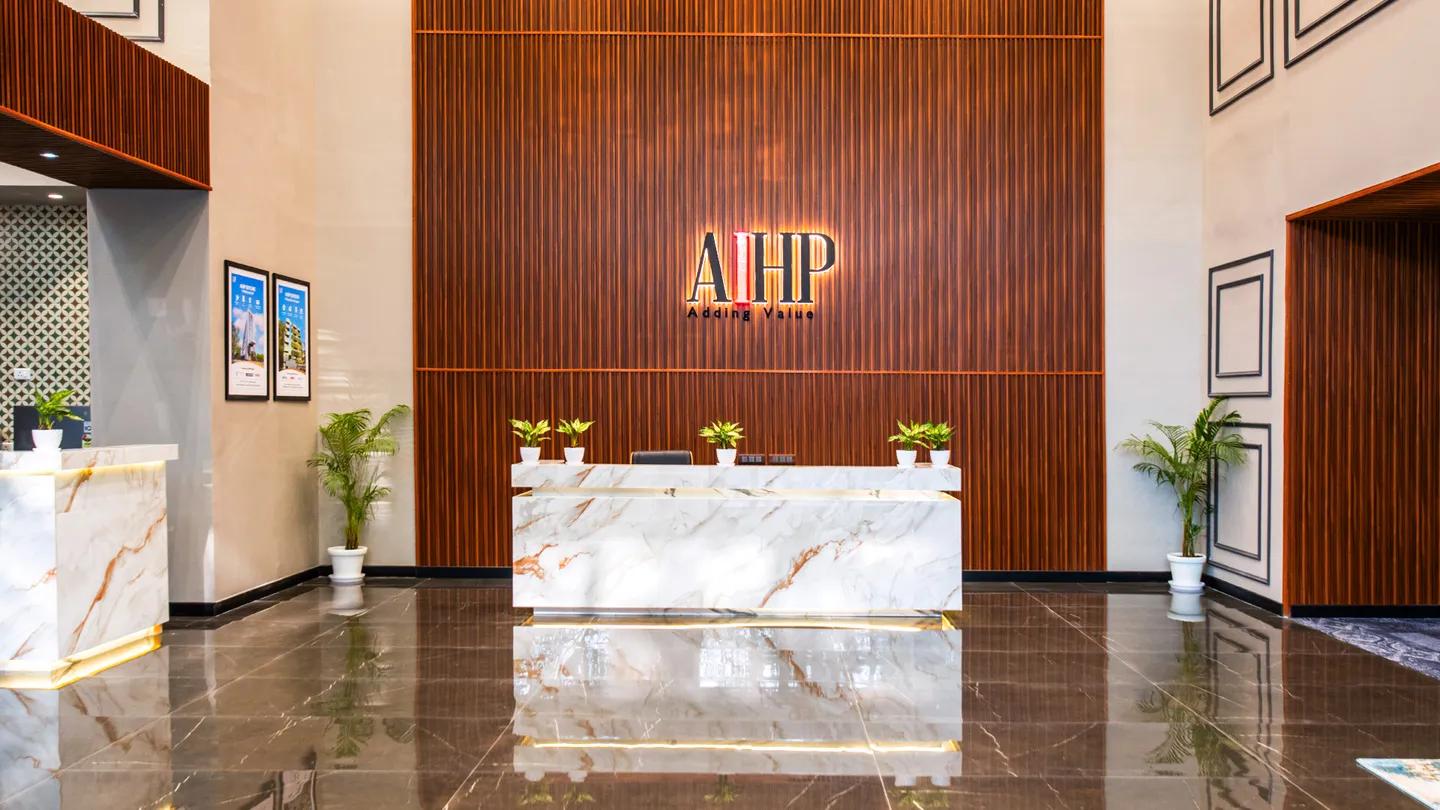
Nineteen of AIHP's buildings, in Udyog Vihar, Sector 32 and Golf Course Extension Road, are held freehold or on long leases, with no third-party landlord above AIHP. The rest of the portfolio, including Golf Course Road, MG Road, Sohna Road and Sector 50, is leased floors in third-party buildings, so the master-lease questions apply to AIHP there as much as to anyone. Ask about the specific building on your shortlist.
AIHP's terms are a six-month security deposit and a nine-year lease with a three-year lock-in. Delivery is quoted at 60 days, on a zero-capex model. The seat price covers furniture, pantry, housekeeping, a butler service, maintenance, electricity, internet, printers and TVs, plus a three-year warranty on air-conditioning and lighting. There is no receptionist in the package.
Teams start at 20 seats. Below that, AIHP isn't an option.
"I'd rather get the hard questions now, in writing, than find out in year two what we should have been asked."
Ankush Seth, CEO, AIHP
Workspace29 Sept 2026 · Udit Chauhan · 9 min read
 Workspace
21 Sept 2026 · Sarthhak Kaluucha · 10 min read
 Workspace
15 Sept 2026 · Sarthhak Kaluucha · 5 min read
Ready to move your team?
Fully-managed private offices across Gurgaon's prime corridors — move-in ready, fully serviced, sized for your team.