 Workspace
21 Sept 2026 · Sarthhak Kaluucha · 10 min read

Workspace

TL;DR
Managed office providers either own their buildings or lease floors from a third-party landlord and sublet to you. That single distinction shapes what happens at lease renewal, who absorbs cost escalation, and how much the operator can actually customise. Ask which structure applies to the specific building before you sign anything.
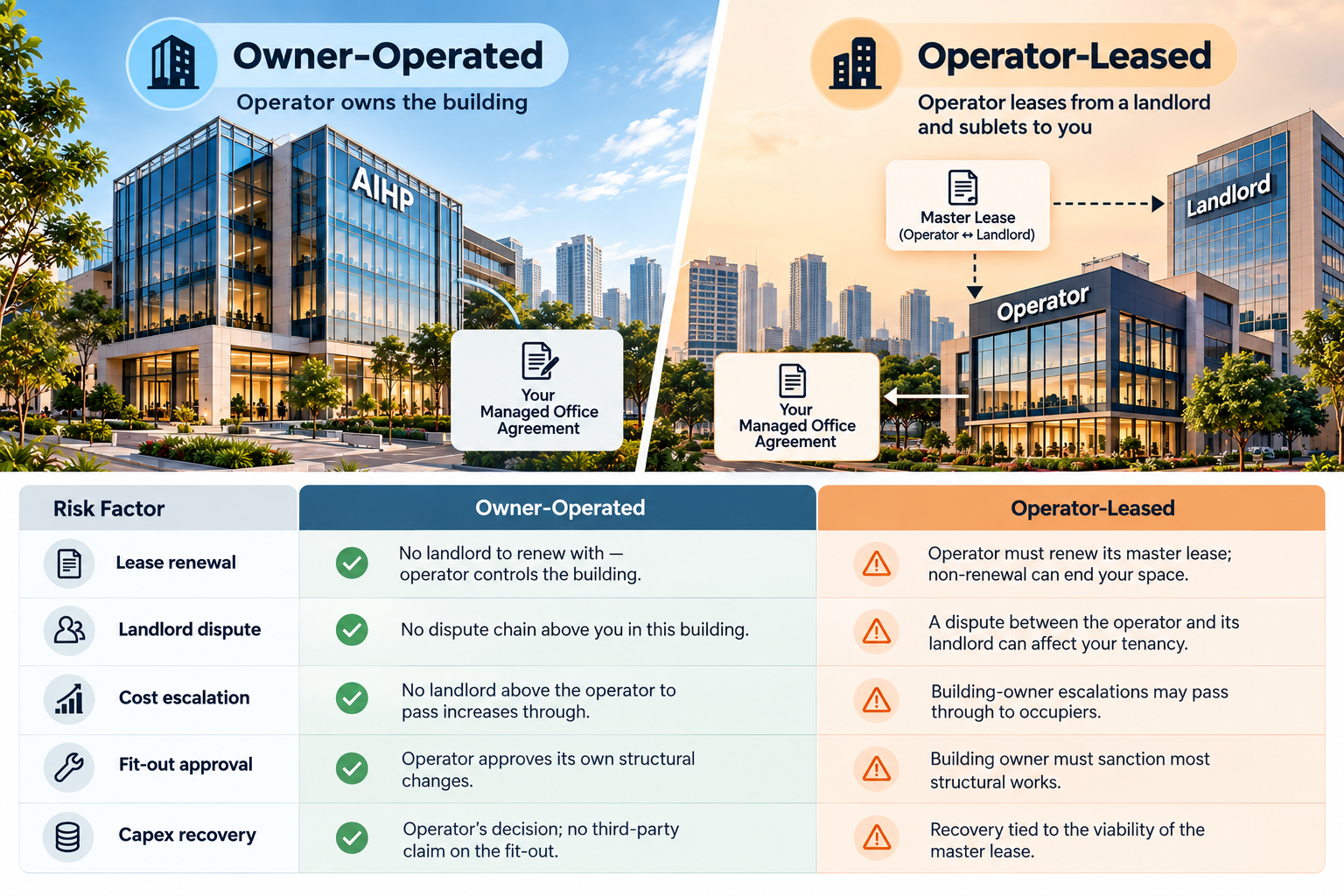
Most buyers never ask which structure they’re walking into. Managed office space in Gurgaon can be run in one of two ways: the operator owns the building outright, or it leases floors from a third-party landlord and sublets them to you. That distinction shapes what your renewal looks like, who absorbs cost increases, and how freely the operator can modify the building. None of it is obvious from a walk-through. This piece uses the prospectuses both operators filed with SEBI in 2025 to show what each model actually commits you to.
Owner-operators have their name on the title deeds. When you sign a managed-office agreement with them, you’re contracting with the building owner — there is no landlord above them in that building.
The master-lease operator works differently. It leases floors from a building owner — typically on a 9–15 year term — fits them out, and sublets to occupiers under shorter agreements. You sit one legal remove from the property owner. Your agreement is with the operator; above them sits a landlord they pay rent to, and that landlord’s lease is the risk you’re inheriting.
This isn’t a comment on quality. Master-lease operators run well-specified, well-maintained spaces. And owner-operators, including AIHP, also operate leased floors in buildings they don’t own — so the distinction is specific to the building you’re considering, not a verdict on any provider overall. For a broader comparison of all four office models — serviced, managed, coworking, conventional lease — see [LINK WHEN LIVE: Topic 5].
| Here’s how | Owner-operator | Master-lease operator |
|---|---|---|
| Lease renewal | No landlord to renew with — operator controls the building | Operator must renew its master lease; non-renewal can end your space |
| Landlord dispute | No dispute chain above you in this building | A dispute between the operator and its landlord can affect your tenancy |
| Cost escalation | No landlord above the operator to pass increases through | Building-owner escalations may pass through to occupiers |
| Fit-out approval | Operator approves its own structural changes | Building owner must sanction most structural works |
| Capex recovery | Operator's decision; no third-party claim on the fit-out | Recovery tied to the viability of the master lease |
India’s two largest listed flexible-office operators — WeWork India and Smartworks — both filed prospectuses with SEBI in 2025, and both name the master-lease structure as a risk in those filings. WeWork India’s RHP, reported by Business Standard, states that “any inability to meet lease payment obligations, refusal by landlords to renew leases, or physical damage to these centres could negatively affect the business and overall profitability.” As of June 2025, those agreements covered approximately 7.35 million sq ft across 60 of its 68 operational centres.
An ICRA credit assessment found that short-term leases — under two years — made up 50–55% of WeWork India’s total lease portfolio at the time of its IPO, with 47% of leases due for renewal in FY2027. The company’s top 10 landlords held approximately 34% of its total operational leasable area.
Smartworks’ RHP (SEBI filing, July 2025) carries similar language. CARE Ratings, analysing the prospectus, names “risk of non-renewal of lease after lock-in period” as a material concern. The prospectus also describes a second dependency: if Smartworks cannot fill its floors with clients, it may struggle to meet its own obligations to building owners — a two-sided exposure that doesn’t exist in an owned-building model.
In most cases, master-lease renewals go through without incident — operators manage these relationships actively, and high occupancy makes them good tenants. But when a renewal does fall through, the disruption lands on the occupier, who had no part in the negotiation that produced it.
When a building owner raises rent, a master-lease operator has one real choice: absorb the increase or pass it through. Most pass it through, in whole or in part. The economics of the master-lease model require it — the operator’s margin sits between what building owners charge and what occupiers pay. If one side of that equation rises, the other has to follow or the model stops working.
“When we look at how we price our spaces, there’s no landlord above us setting the input cost,” says AIHP CEO Ankush Seth. “Our building costs are ours to manage. That gives us a very different kind of pricing stability than what master-lease operators can offer — because they’re always working with a landlord’s cost as the floor.”
An owner-operator’s pricing doesn’t face this upstream pressure. Owned buildings often carry a quality premium — but any cost movement there comes from the operator’s own decisions, not a third-party landlord’s pricing round. When you’re reviewing a managed-office agreement: ask whether it contains an escalation clause, what it’s linked to (a fixed percentage, CPI, or the landlord’s prevailing rate), and whether there is a cap.
Master-lease operators need building-owner approval for structural modifications — anything that affects the base building: raised flooring, additional power capacity, server rooms, facade signage, rooftop plant. For most standard fit-outs, this rarely causes friction. GCCs, BFSI tenants, and anyone needing custom power infrastructure or secure server rooms will find themselves waiting on a building owner whose timeline and commercial interests are entirely separate from theirs.
Owner-operators make those decisions themselves. Across AIHP’s 19 owned buildings in Gurgaon, the company has custom-fitted spaces to client specifications without needing external approval: dedicated server rooms, branded lobbies, private floors with independent access, additional power feeds for compute-heavy teams. The scope of what’s possible is determined by AIHP’s own team, not by a conversation with a building owner who has no commercial stake in the outcome.
“Owning the buildings means every decision about a client’s space is ours to make,” says Ankush Seth. “We can commit to a floor for nine years because we’re not thinking about our own lease ending in seven.”
A master-lease operator’s willingness to commit to a long term is bounded by its own master lease. If that lease runs out in seven years, a nine-year occupier agreement is a commercial exposure the operator has to carry — and most won’t. Owner-operators face no such ceiling. For teams planning a multi-year Gurgaon presence, that difference shows up in how firmly the offer can actually be committed to.
Take these into your next site visit:
• Does your company own this building, or lease it from a third-party landlord?
• If leased: when does the master lease expire, and does it carry renewal options?
• What happens to my space and security deposit if the master lease is not renewed?
• Who approves structural modifications — your team, or a landlord above you?
• Is there a cost-escalation clause in my agreement? What is it linked to, and is there a cap?
• Can you share documentation confirming the ownership or lease structure of this building?
• Has your company ever had to relocate tenants due to a master-lease ending or a landlord dispute?
• What contractual rights do I have if you lose access to this building before my term ends?
Compare providers using the framework in how to choose a managed office provider alongside the answers you get here.
AIHP owns 19 buildings in Gurgaon. In each of them, there is no third-party landlord above AIHP — the freehold or long-leasehold sits with AIHP directly.
AIHP Milestone, AIHP Palms, AIHP Tower, AIHP Signature, AIHP Horizon, AIHP Cyber Greens, AIHP Cyber Greens 2, AIHP 507-508, AIHP 867, AIHP Millennium, AIHP 390-391.
AIHP Imperial, AIHP Spectra, AIHP Atrium, AIHP Broadway, AIHP Skyline, AIHP Executive Centre, AIHP SCO 27. Additional SCO buildings are being added to this list.
AIHP Central.
Editorial note: AIHP Central on Golf Course Extension Road is being renamed AIHP Central. The website update was in progress as of 19 Sep 2026. Verify the rename is live on the site before this article publishes.
AIHP also operates leased floors in third-party buildings in other Gurgaon corridors — Golf Course Road, MG Road, Sohna Road, Sector 50 — where the master-lease structure described in this article applies just as it does to any other provider. The 19 buildings listed above are the ones AIHP owns outright.
For the full portfolio, team, and leadership, see aihp.in/about.
The Ultimate Guide to Managed Office Spaces — Everything a CFO, admin head or GCC lead needs before committing to a managed office in Gurgaon: costs, models, questions to ask, and how to evaluate providers. Download free →
Talk to our leasing team to confirm the ownership structure of a specific AIHP building, compare corridors, or discuss what a long-term managed-office tenure looks like in a building AIHP owns.
Workspace21 Sept 2026 · Sarthhak Kaluucha · 10 min read
 Workspace
15 Sept 2026 · Sarthhak Kaluucha · 5 min read
 Workspace
7 Sept 2026 · Sarthhak Kaluucha · 6 min read
Ready to move your team?
Fully-managed private offices across Gurgaon's prime corridors — move-in ready, fully serviced, sized for your team.