 Workspace
19 Aug 2026 · Sarthhak Kaluucha · 8 min read

Workspace
TL;DR
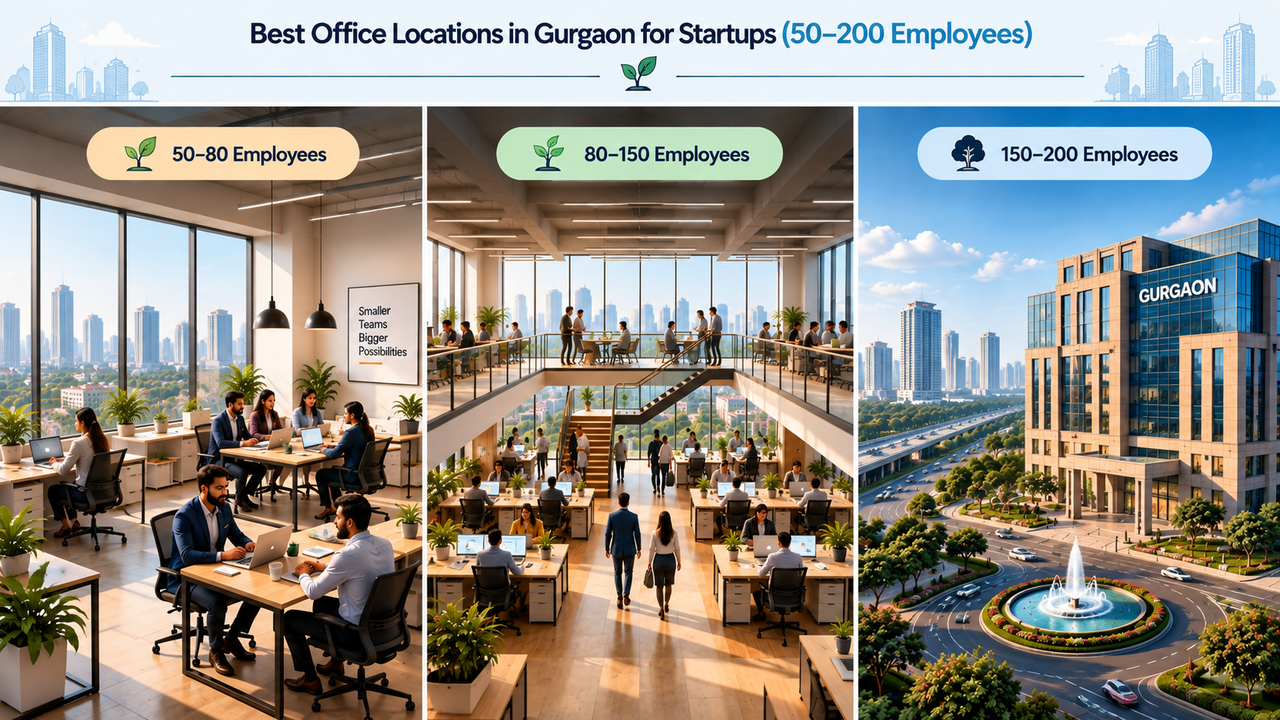
A 50-person startup and the same startup at 200 people need different things from an office. Udyog Vihar and Sector 32 fit capital-efficient early growth. Past 150 people, when the address starts doing real work in hiring and fundraising, AIHP has just opened something new on the NH-8 corridor worth knowing about.
Gurgaon has more than 100,000 startups in it, per NASSCOM's count — part of a startup ecosystem the same report puts at roughly $50 billion. A fair share of those companies will double headcount in the next eighteen months. Whatever office decision you make at 50 people, you're going to live with at 150, or you're going to move — and moving costs more than most founders budget for.
So the real question isn't “which office is best for a startup.” It's “which office survives the next funding round.” Those are different questions, and they point to different buildings depending on where you actually are.
Enterprises pick offices for stability. They know, roughly, what headcount looks like in three years. Startups don't get that luxury — a 50-person team that closes a Series B can be a 150-person team before the ink dries on next year's renewal, and a 200-person team having a bad quarter can be 120 people six months later. The office has to survive movement in both directions, which enterprise real estate advice mostly isn't built for.
That changes what actually matters. Capital efficiency counts for more early — every rupee not spent on real estate is a rupee of runway. Room to expand in the same building matters more than the address, because relocating mid-hypergrowth costs weeks nobody has to spare. And somewhere past 100–150 people, the office starts doing real work in hiring and fundraising — candidates and investors read it as a signal, whether that's fair or not.
Do the math on relocation once and you won't need to again. Moving a 100-person team mid-lease means new fit-out, a new address on every vendor contract and business card, and a week of lost productivity while everyone relearns where the pantry is — easily ₹15–25 lakh in direct and indirect cost before you've hired a single new person. That's the cost of picking a building without room to grow, not the cost of growing.
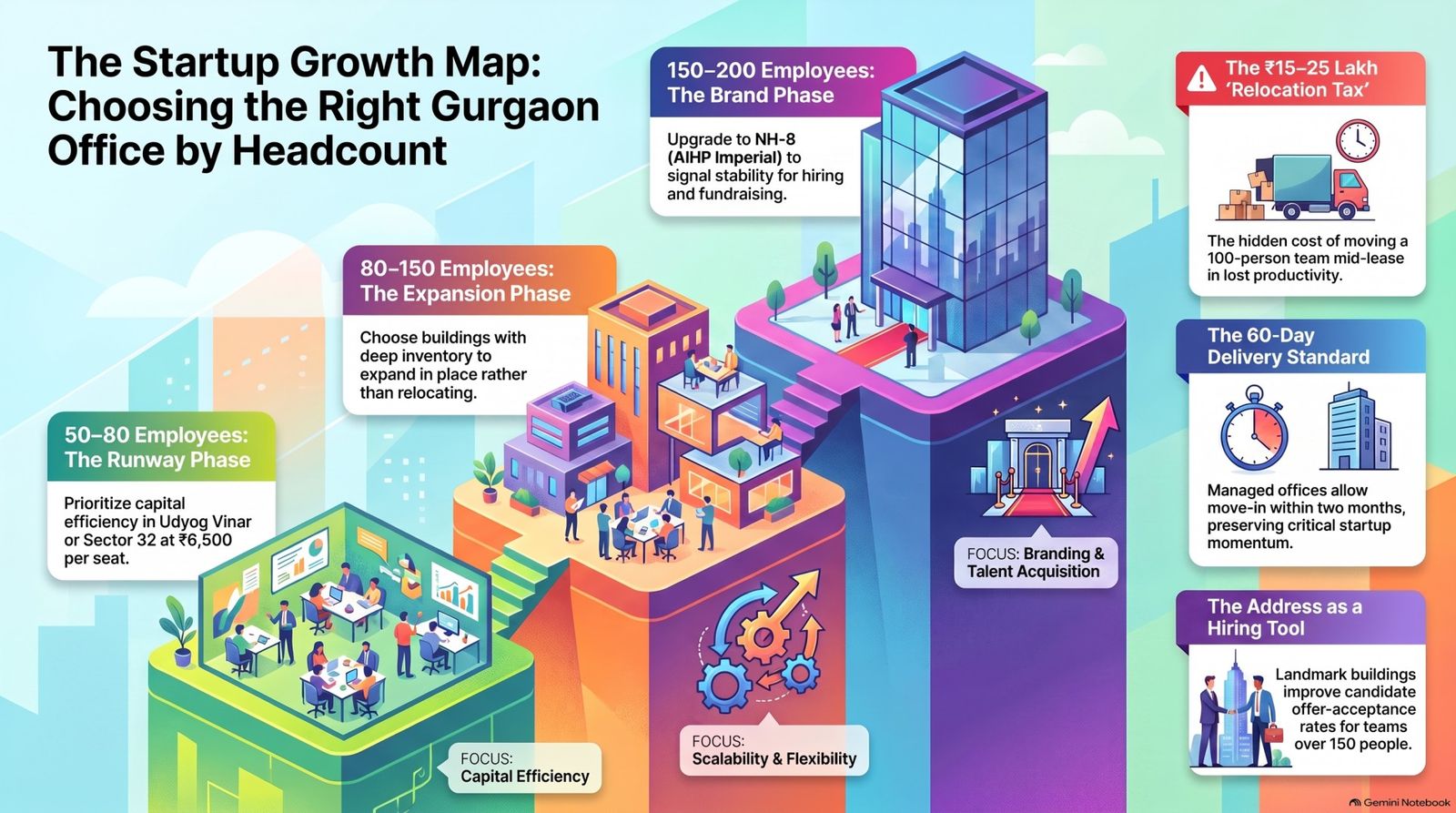
At this size, spend as little on real estate as the business will tolerate — every rupee here is a rupee not spent on hiring or product. Udyog Vihar's floor sits at ₹6,500 a seat, and Sector 32 runs the same band, both delivering the full managed-office standard — fit-out, furniture, butler, housekeeping, warranty-backed AC and electricity — without paying for visibility off NH-48 you don't need yet. Full breakdown: Udyog Vihar Office Market Guide 2026. View Udyog Vihar →
You've already seen what relocating costs. The fix isn't renting a bigger office than you need today — that just burns runway on empty seats. It's picking a corridor where the next floor is available when you need it, so growth means expanding in place, not starting a new lease negotiation from scratch.
Udyog Vihar carries 10+ AIHP-owned buildings across its footprint — that depth is worth more at 100 people than a marginally nicer lobby somewhere else. Sector 32 offers a similar profile next door if the two corridors' micro-market differences matter to your team. Udyog Vihar vs Sector 32: Which Gurgaon Corridor Fits Your Team? runs that comparison in detail.
Past 150 people, you're usually hiring against competitors with recognizable addresses, and fundraising in front of people who've walked through a lot of offices. This is the size where a landmark building stops being vanity and starts being a genuine hiring and closing tool — the difference between a candidate's offer-acceptance email saying “looking forward to it” and one that says nothing at all.
AIHP has just opened its newest campus on the NH-8 corridor: AIHP Imperial, over 300,000 square feet and 6,000-plus seats on three acres. It's built with a hospitality-grade finish most managed office space doesn't attempt — grand elevator lobbies, a dedicated dining lounge, a chandelier-lit entrance approached over a fountain roundabout, a European classical exterior. This isn't a shared floor with better carpet. It's a full campus, and a 150–200 person tenant occupies one part of it, not the whole thing.
For a startup at this size that's raised the kind of round where the office is part of the pitch to the next fifty hires, this is the option built for exactly that moment. And because the campus itself runs to 6,000-plus seats, outgrowing your floor isn't a near-term problem the way it can be in a smaller building — you're growing into more of the same address, not starting over somewhere else.
Pricing and current availability aren't public yet — get in touch for specifics.
• 50–80 employees — Udyog Vihar or Sector 32, ₹6,500/seat floor. Capital efficiency first. View Udyog Vihar →
• 80–150 employees — Udyog Vihar's 10+ building depth, room to expand without relocating. View Sector 32 →
• 150–200 employees — AIHP Imperial, NH-8. The address does real work at this size. View NH8 →
Three checks, regardless of which stage you're in right now.
• Room to grow in place beats a marginally better address. A building where you can take the next floor when you hit 80, then the one after that at 120, saves you the relocation cost outlined above entirely — that's worth more than a few thousand rupees a seat in most cases.
• All-in per-seat pricing beats a cheaper quote that hides fit-out and CAM as separate line items. A traditional lease that looks 20% cheaper on the headline rent often costs more once fit-out amortization and CAM are added back in — startups can least afford that kind of mid-lease surprise.
• Move-in speed matters here more than almost anywhere else. A runway-constrained team can't absorb a six-month build-out the way a funded enterprise can. AIHP's standard delivery window is 60 days from signing to move-in, regardless of corridor — more on how that timeline works in The 60-Day Office Delivery Model.
RESOURCE: Curious how a fast-scaling tech company actually used a managed office to support hypergrowth? The Daas Labs (SCIKIQ) case study walks through it.

Most startup office mistakes aren't about picking the wrong corridor. They're about picking the right corridor for today's headcount and forgetting to ask what happens at double that number. Pick a building with room to grow before you need it, not after.
Not sure which stage you're actually planning for? Get in touch and we'll help you size it against where the business is actually headed, not just where it is today.
Workspace19 Aug 2026 · Sarthhak Kaluucha · 8 min read
 Workspace
27 Jul 2026 · Sarthhak Kaluucha · 10 min read
 Workspace
22 Jul 2026 · Sarthhak Kaluucha · 13 min read
Ready to move your team?
Fully-managed private offices across Gurgaon's prime corridors — move-in ready, fully serviced, sized for your team.