 Workspace
22 Jul 2026 · Sarthhak Kaluucha · 13 min read

Workspace
TL;DR
Gurgaon Grade A office rent runs ₹75-140/sq ft in 2026 — an 85% spread across corridors sometimes 15 minutes apart. The right micro-market saves a 100-seat team ₹30-50 lakhs annually. The wrong one costs you that in attrition before you notice the problem.
Gurgaon Grade A office rent runs ₹75-140/sq ft in 2026 — an 85% spread across corridors sometimes 15 minutes apart. The right micro-market saves a 100-seat team ₹30-50 lakhs annually. The wrong one costs you that in attrition before you notice the problem.
Your CFO is looking at two quotes. Both say Grade A managed office, Gurgaon. Both include power backup, internet, facilities management. One is ₹12,000 per seat. The other is ₹6,500.
The CFO asks the obvious question: what is the ₹6,500 gap actually buying?
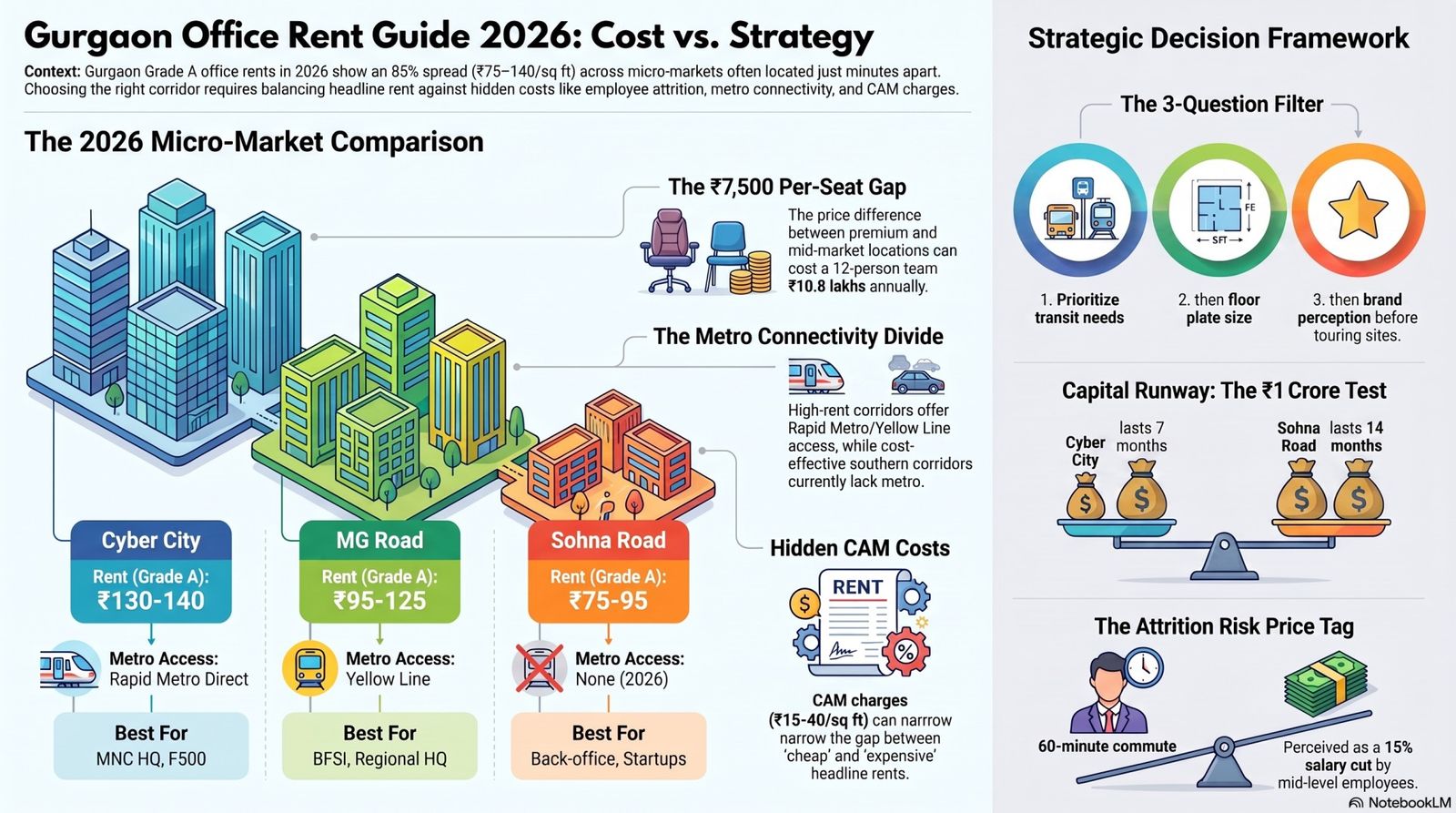
Sometimes it’s metro access and a client-facing address that closes deals. Sometimes it’s a postcode your team will never mention to a client and connectivity your engineers don’t need. The ₹6,500 per seat gap is ₹78,000 monthly for a 12-person team. ₹9.4 lakhs a year. Either the most wasteful line in your P&L, or the most defensible investment in talent and perception you’re making. Which one depends entirely on whether the premium matches what your business actually uses.
This article maps every Gurgaon micro-market against the same variables — rent, metro, airport, building age, tenant profile — so you can run the comparison in one place. The Gurugram 2026 Office Market Outlook has detailed supply and vacancy data by corridor; this is the decision layer on top of it.
Every corridor. Real numbers. One table.
| Corridor | Rent (Grade A) | Metro | Airport | Bldg Age | Best For |
|---|---|---|---|---|---|
| Cyber City | ₹130-140 | Rapid Metro direct | 20-30 min | 12-22 yrs | MNC HQ, F500, premium consulting |
| Golf Course Rd | ₹115-135 | Rapid Metro direct | 25-35 min | 10-20 yrs | Finance, consulting, established premium |
| MG Road | ₹95-125 | Yellow Line (2 stations) | 20-30 min | 8-18 yrs | BFSI, regional HQ, professional services |
| Golf Course Ext Rd | ₹100-125 | None (2026) | 35-45 min | 5-12 yrs | GCC HQ, BFSI, large floor plates |
| Sector 32 | ₹95-115 | HUDA City Ctr (~2 km) | 20-25 min | 8-18 yrs | Healthcare-adj, mid-market |
| Udyog Vihar | ₹85-115 | HUDA City Ctr (1-3 km) | 15-20 min | 8-25 yrs | IT, ITeS, GCC, BPO, startups |
| Sohna Road | ₹75-95 | None (2026) | 35-50 min | 8-15 yrs | Back-office, startups, cost-first IT |
The numbers are the starting point. Here’s what doesn’t fit in a cell.
A ₹140/sq ft Cyber City office can actually save money versus ₹115/sq ft Golf Course Road — if 40% of your team uses the Rapid Metro and stops quitting over their commute. Attrition has a cost that never appears on the rent line. The commute quality research puts a number on it: a 60-minute public transit commute with two interchanges generates attrition risk equivalent to a 15% salary cut in the eyes of mid-level employees. Some of Gurgaon’s cheapest corridors are the most expensive when that number gets added back.
Map your team’s residential distribution before you look at a single floor plate. The commute analysis changes the shortlist faster than the rent table does.
Cyber City and Golf Course Road buildings typically offer 5,000-15,000 sq ft per floor. Golf Course Extension Road and Sohna Road offer 10,000-30,000+. If you need 200 contiguous seats, the floor plate constraint writes your corridor shortlist before rent gets a vote. The building that fits you matters more than the building you’d prefer.
CAM charges range from ₹15-40/sq ft monthly across Gurgaon. That single variable closes 40% of the gap between a ₹95 corridor and a ₹130 one. Older buildings in premium corridors often carry higher CAM than newer buildings in mid-market corridors. Factor it in. The total cost of occupation framework runs the full comparison — and consistently shows the effective cost gap is narrower than the headline rent difference suggests.
The most common premium comparison. And the one where people most often optimise for the wrong thing.
Cyber City’s Rapid Metro has four stations directly serving the corridor. Dense. Convenient. But the Rapid Metro is a short standalone network. MG Road’s two Yellow Line stations connect the full 48-km Delhi spine — North Delhi, Central Delhi, South Delhi — on a single train with no interchange. The catchment is wider.
Rent gap: ₹5-25/sq ft depending on specific buildings. For 5,000 sq ft, that’s ₹25,000 to ₹1.25 lakhs monthly. ₹3-15 lakhs annually. Companies that choose Cyber City over MG Road without running the metro catchment maths are sometimes paying premium for a brand their team doesn’t need and their clients don’t distinguish. Companies that run the maths and still choose Cyber City usually have a clear reason: Fortune 500 address perception, Cyber Hub amenities, Rapid Metro density for a heavy South Delhi commuter base.
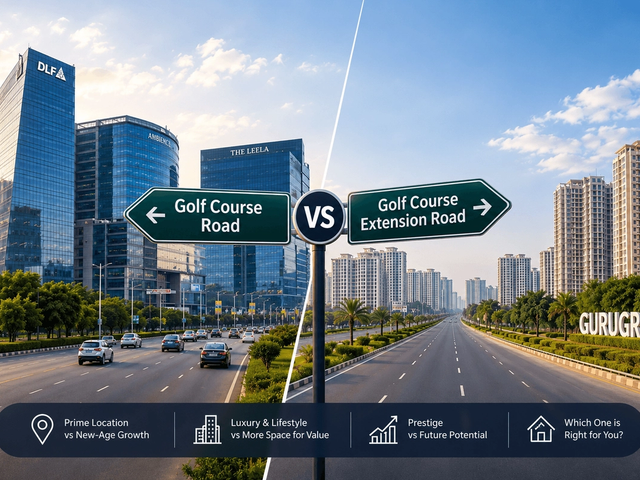
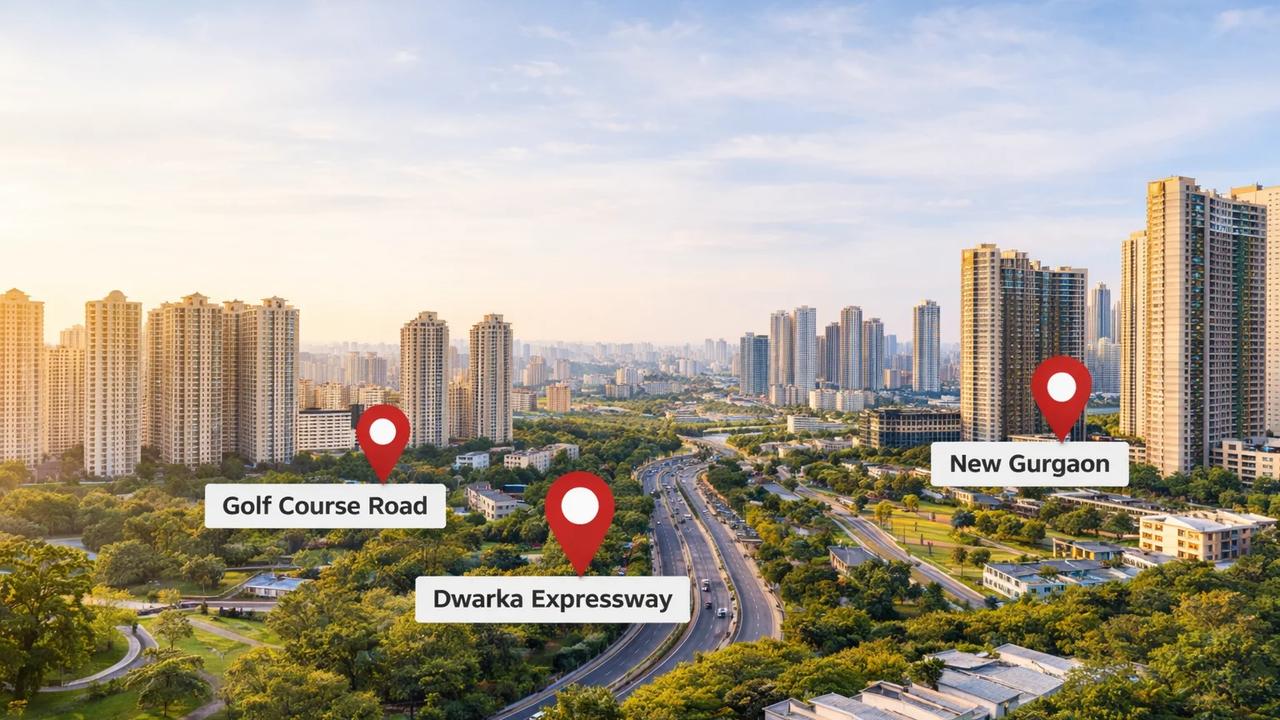
Same name. Different metro situations entirely. The full GCR vs GCER comparison covers this in detail. The short version: GCR has four Rapid Metro stations serving it directly. GCER has zero.
The rent saving on GCER is ₹9-18 lakhs annually for 100 seats. It disappears fast if 30% of your team uses metro and you’re subsidising company transport to cover the gap. Run that number before assuming GCER is cheaper.
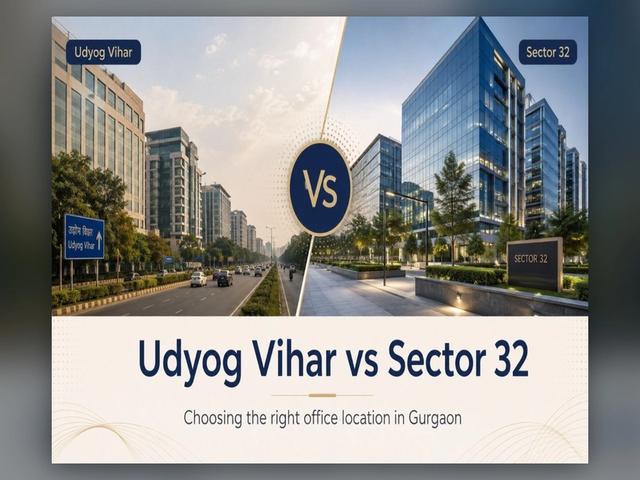
Neighbouring corridors. Similar metro proximity — both around 2 km from HUDA City Centre. The UV vs Sector 32 comparison has the detail. Entry pricing is now level: both Udyog Vihar and Sector 32 start at ₹6,500/seat, which is also the portfolio floor. Udyog Vihar stretches further at the top end, to ₹15,000/seat. The question is whether Sector 32’s healthcare adjacency and mid-market positioning fit your specific business better than Udyog Vihar’s wider choice.
Both South Gurgaon. Neither has metro. GCER is 20-25% more expensive and has newer buildings. Sohna Road has larger floor plates at lower entry cost.
The honest answer on this comparison: for most IT back-office and operations functions, GCER’s premium positioning doesn’t generate measurable return. The companies that choose GCER over Sohna Road usually need large floor plates in a newer building with better infrastructure — not just the address. If neither of those applies, Sohna Road’s ₹24 lakh annual saving at 100 seats is a straightforward decision.
Answer these in order. Most teams don’t need to get past question two.
First question: what proportion of your team relies on public transit? Over 25%: Sohna Road and GCER are off your list without a company transport budget. Under 25% — team predominantly drives from South Gurgaon residential sectors — the full map stays open. Move to question two.
Second: what’s your floor plate requirement? Under 150 contiguous seats, every corridor can accommodate you. Over 200 — particularly a single operation that can’t be split across floors — Golf Course Extension Road, Sohna Road, or Udyog Vihar Phase V are the realistic options. Premium corridors typically can’t.
Third: does the address carry weight where it counts? If you’re recruiting from Goldman Sachs or McKinsey alumni networks, or your clients visit and notice the postcode: Cyber City or Golf Course Road. If your clients evaluate your product and your engineers evaluate your commute: Udyog Vihar or GCER delivers comparable operational quality at 15-40% lower cost. Pick accordingly.
Same budget. Different runways.
A 50-seat team spending ₹1 crore annually on managed office space runs out in about seven months at Cyber City rates. Eight months at Golf Course Road. Nine to ten months at MG Road or Golf Course Extension Road. Eleven to twelve months — a full year — at Udyog Vihar or Sector 32. Thirteen to fourteen months on Sohna Road.
The team that chose Udyog Vihar over Cyber City has two to three additional months of operating capital before their next raise. That’s not nothing. That’s a product sprint, a key hire, or the margin between making a deadline and missing it.
This isn’t an argument that cheaper is always right. It’s an argument that the corridor decision carries the same weight as any other capital allocation decision — and deserves the same rigour, not a gut call based on which address sounds most impressive in a board deck.
RESOURCE: Download the Gurugram 2026 Office Market Outlook for supply pipeline data, vacancy rates by micro-market, and rent trajectory forecasts across every Gurgaon corridor. Download the Market Outlook →
Gurgaon’s rent spread is real. ₹75 to ₹140 per square foot across corridors that are sometimes a 20-minute drive apart. It exists because corridors genuinely differ on things that matter: metro catchment breadth, floor plate availability, building age and infrastructure quality, airport proximity, and the client perception that a well-known address carries.
Most teams either overpay for brand they don’t use, or underpay for metro access they do. The table above is the raw material. The three questions are the filter. Use them before you start booking site visits — it saves you from touring floors that were never going to make the shortlist.
For guidance on which micro-market fits your team’s commute profile, operational requirements, and budget — and which specific AIHP building within that corridor is available now — get in touch with AIHP or explore locations across Gurgaon’s corridors.
Workspace22 Jul 2026 · Sarthhak Kaluucha · 13 min read
 Workspace
15 Jul 2026 · Sarthhak Kaluucha · 4 min read
 Workspace
11 Jul 2026 · Sarthhak Kaluucha · 5 min read
Ready to move your team?
Fully-managed private offices across Gurgaon's prime corridors — move-in ready, fully serviced, sized for your team.