 Workspace
15 Oct 2026 · Sarthhak Kaluucha · 9 min read

Workspace
TL;DR
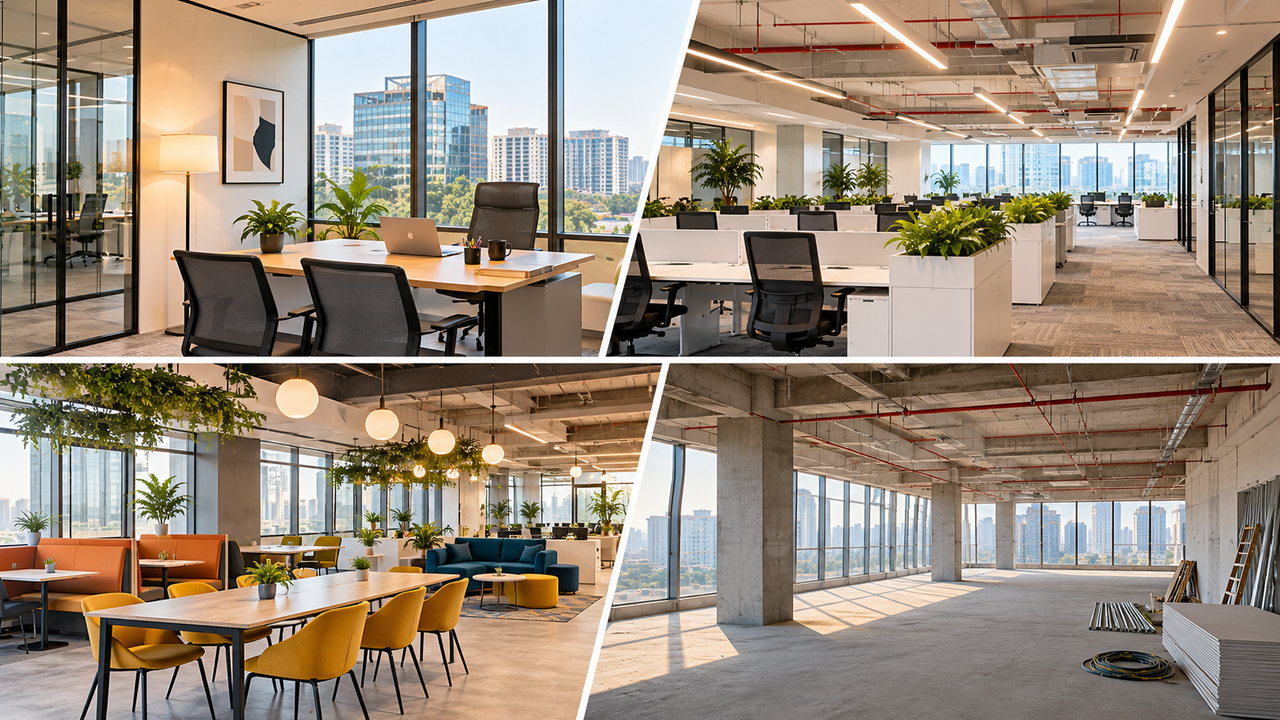
A serviced office is a furnished room on a short licence. A managed office is a floor built and run for one company on a multi-year agreement. Coworking rents shared seats. A conventional lease hands you an empty floor and the fit-out bill. Under 20 seats, take the first or third. From 20 up, decide on capex and how long you can commit.
Below 20 seats, take a serviced office or coworking. From 20 up, the choice is a managed office or a conventional lease, and it turns on two questions: who pays for the fit-out, and how long you can commit. A serviced office rents you a furnished room for months. A managed office builds you a floor and keeps you for years.
AIHP sells one of these, managed office space in Gurgaon from 20 seats, so weigh what follows with that in mind. The labels are used loosely in the market, and two providers can both say "managed" and mean different things. Knight Frank draws the line by customer: a managed office serves a single client or a very large anchor tenant, where coworking serves many.
Operators now lease a quarter of the market. Colliers puts them at 24% of gross office leasing across seven cities in the first half of 2026, while owners' direct leasing to corporates held at about 27 million sq ft. One of the four carries a longer commitment than its label suggests, and a short accounting test decides whether any of them lands on your balance sheet. Office for rent in Gurgaon shows what AIHP has available now.
Serviced office
A furnished private room or suite rented from an operator under a short licence, usually for a small team. Reception, utilities, cleaning and internet come in one monthly fee. You do not build the space or reshape it, and the licence is usually measured in months.
Managed office
A private floor taken by an operator to serve one client, built to that client's brief and run day to day by the operator. The operator funds the fit-out and bills a monthly fee, and the agreement runs for years. Knight Frank's 2024 survey counted this segment at 65% of India's flexible workspace market, ahead of coworking at 35%.
Coworking
Seats or desks in a shared space, rented by the day, month or year, with meeting rooms and common areas included. Operators lease whole buildings from landlords and sublease workstations or suites. You have no say over layout or branding.
Conventional lease
You lease the floor directly from the landlord, usually as a bare or warm shell, and pay for the fit-out, furniture and IT yourself. You control layout, branding and building rules, and you carry the capital cost and a lock-in. Bank of America's India arm signed one in Powai in January 2026. It runs ten years and nine months, with a three-year lock-in and a stepped escalation clause that adds 15% every three years.
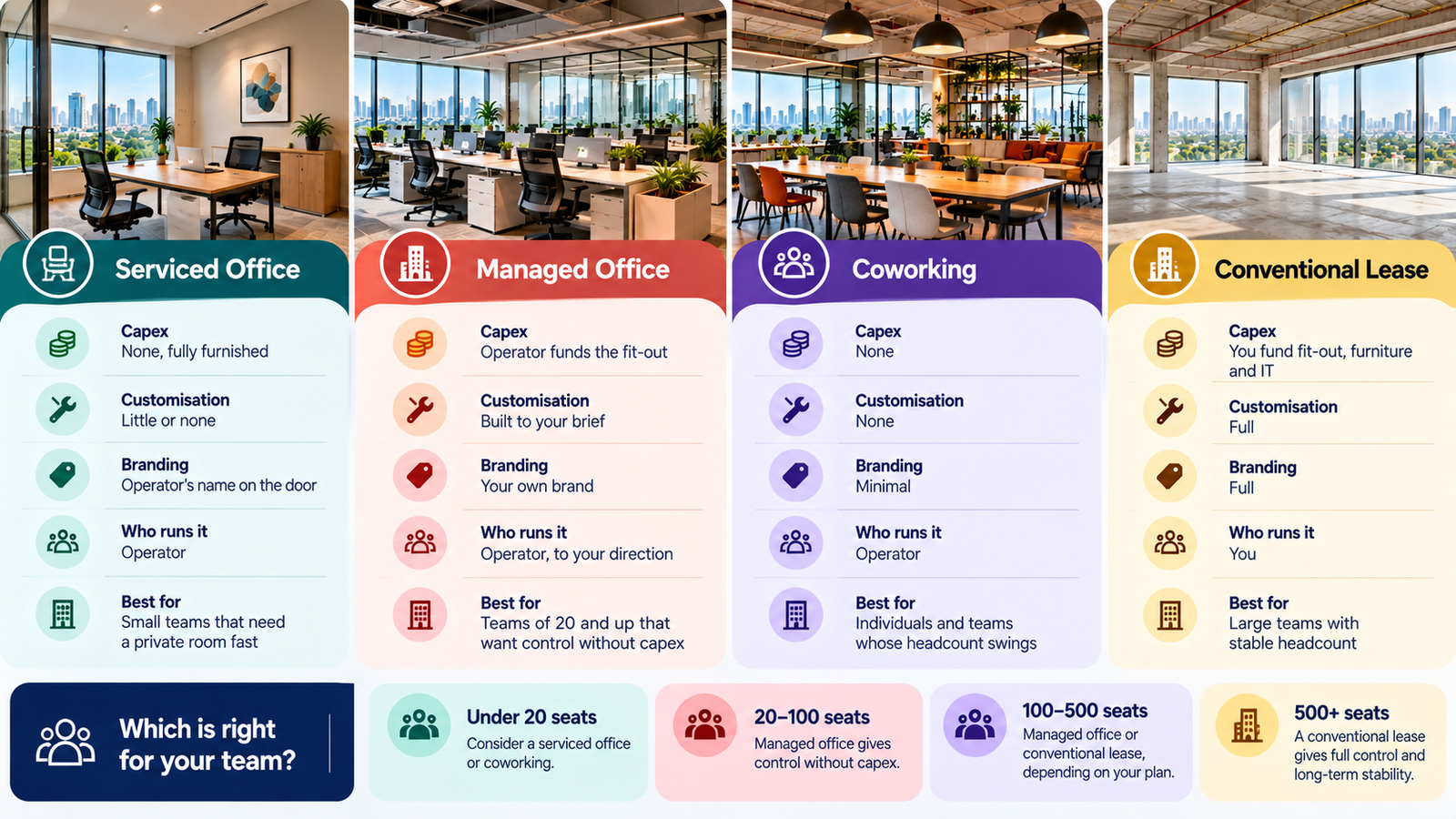
| Model | Capex | Customisation | Branding | Who runs it | Best for |
|---|---|---|---|---|---|
| Serviced office | None, furnished | Little or none | Operator's name on the door | Operator | Small teams that need a private room fast |
| Managed office | Operator funds the fit-out | Built to your brief | Your own brand | Operator, to your direction | Teams of 20 and up that want control without capex |
| Coworking | None | None | Minimal | Operator | Individuals and teams whose headcount swings |
| Conventional lease | You fund fit-out, furniture and IT | Full | Full | You | Large teams with stable headcount and capital to spend |
The managed-office row describes AIHP's model. Other providers differ on who funds the fit-out, so ask.
| Team size | Usual fit | What decides it |
|---|---|---|
| Under 20 seats | Serviced office or coworking | AIHP's minimum is 20 seats, so a managed office from AIHP is not an option |
| 20 to 50 seats | Managed office or serviced suite | Whether you can forecast three years of headcount, since AIHP's lock-in is three years |
| 50 to 100 seats | Managed office | Coworking's per-desk fees against an all-in managed price |
| 100 to 200 seats | Managed office or build-to-suit | Who funds the fit-out and how fast you need to move in |
| 200 seats and up | Conventional lease, build-to-suit or managed office | Whether headcount is stable and how much control you want |
At 20 to 50 seats the lock-in decides. A managed floor suits a team that can forecast three years of headcount, and a serviced suite suits one that cannot. Coworking vs managed office in Gurgaon compares the two on all-in cost.
From 100 seats the fit-out becomes the main line. A managed floor spares you the upfront build cost and moves you in within 60 days. A lease means funding the build and waiting for it, and in return you own the result for the term. Build-to-suit offices covers the middle option, where a landlord builds to your design. Large teams are a core market for managed space: Knight Frank finds large enterprises took 72% of flex seat absorption across India's eight major cities.
Serviced offices and coworking are pure operating cost: a fee per desk or per room, with nothing to build. PTI's report on the Colliers data says operators generally charge between ₹5,000 and ₹50,000 per workstation per month. That is a tenfold spread, so check what each price includes. Managed offices carry the fit-out inside the monthly fee. AIHP's published rates run ₹6,500 to ₹15,000 per seat per month across its Udyog Vihar buildings, with zero upfront capex. A conventional lease splits the cost three ways: rent and maintenance charges, a security deposit, and the fit-out, which the fit-out cost guide prices per sq ft.
Operators also add a margin. Knight Frank's survey says so plainly, while noting that they save on bulk rent and procurement. The right choice depends on the size of the space, the lease duration, the facilities and your capacity to spend capital upfront. Compare all-in cost per seat over the whole term, not the headline rate.
Serviced and coworking agreements are usually short. A managed-office agreement is closer to a lease in length: AIHP's run nine years with a three-year lock-in. "Managed" describes who runs the floor, and the length is a separate clause. The flexibility on offer is capex and speed, not an easy exit. Read the lock-in and hand-back clauses before the price. The managed office RFP template has four questions on early termination, hand-back and changing seat counts. The expensive mistake is a lock-in longer than your headcount forecast, whatever the rate.
Accounting works differently. Under Ind AS 116 a company records most leases on its balance sheet, as a right-of-use asset and a lease liability. The exceptions are short-term leases and low-value assets, according to KPMG's Ind AS guide. Short-term means 12 months or less with no renewal option held by you. ICAI's Ind AS Transition Facilitation Group has said a lease renewed each year by mutual consent can still qualify.
A contract is a lease only if it gives you control of an identified asset. A seat or room the operator can swap for another may therefore be a service cost, not a lease. A nine-year conventional lease will usually be on the balance sheet. A managed-office agreement could go either way, depending on its wording. We are not your auditor, and the answer turns on clauses we have not seen, so show the agreement to yours before you sign. Companies that do not follow Ind AS apply a different standard, and your CA will know which one you are under.
VANSUN Media Tech spent more than six years in coworking before moving 150 seats into a custom managed office in Sector 32, delivered in 60 days with no upfront capex. Its case study has the detail.
Knight Frank describes global firms using flex space as a transitional platform, a way to enter India and scale before they settle their long-term real estate. Others mix, and its name for that is core-plus-flex: a stable core of long-term space with flexible space around it.
VANSUN's founder also spoke to companies already renting from AIHP before he signed, which is worth doing with any provider.
Read the Ultimate Guide to Managed Office Spaces How managed offices work, what they include and how to compare them, as an e-book. Get the guide
Send your headcount, your growth forecast for the next three years and the date you need to move in through the contact page or to leasing@aihp.in. AIHP starts at 20 seats. Under that, one of the first two models fits better.
Workspace15 Oct 2026 · Sarthhak Kaluucha · 9 min read
 Workspace
12 Oct 2026 · Sarthhak Kaluucha · 9 min read
 Workspace
5 Oct 2026 · Sarthhak Kaluucha · 14 min read
Ready to move your team?
Fully-managed private offices across Gurgaon's prime corridors — move-in ready, fully serviced, sized for your team.