 Workspace
10 Nov 2026 · Sarthhak Kaluucha · 9 min read

Workspace

TL;DR
Haryana, Uttar Pradesh, Karnataka, Maharashtra and Gujarat have published GCC policies. Tamil Nadu offers a payroll scheme, and we found no notified policy in Telangana. The table sets out dates, rent and payroll support and eligibility as of 20 November 2026, with a link to each source.
As of 20 November 2026, five states have published policies written for GCCs: Haryana, Uttar Pradesh, Karnataka, Maharashtra and Gujarat. Tamil Nadu offers a payroll subsidy under a 2024 scheme, and Telangana has no notified policy that we could find. The five count rent in different ways, so the headline percentage tells you less than the clause behind it.
Picture a finance lead who has just been told the GCC is going to Gurgaon. The board wants one number, what the state gives back, so she opens the policy PDFs for the shortlist. Each one has a rent line. After a few, she's stopped trusting the word.
This page lines the policies up and shows what each rent line actually pays on. Tamil Nadu and Telangana are in too, because they belong in any real comparison even without a full GCC policy. Each row comes from the state's own document, a named firm's summary of it or, for Telangana, press reports, and the Source column says which. This is planning material, not legal or tax advice, so confirm each clause with the nodal agency before you rely on it.
GCCs bring headcount, and headcount brings office leases, so the states have noticed. CBRE South Asia's report, The Policy Advantage, says states with GCC policies are aiming for nearly 1.18 million jobs and roughly 1,380 new centres by 2031. The same coverage says GCCs leased more than 123 million sq ft across the top nine cities between 2022 and the first half of 2026, and that their share of office leasing climbed from about 29% to about 43%. Our guide to GCC companies in Gurgaon covers what they need from a floor.
The menus look alike on the surface. Each one offers some rent support and some payroll support, with a ceiling on both. The differences sit in what the rent line pays on, and that's where a business case can go wrong.
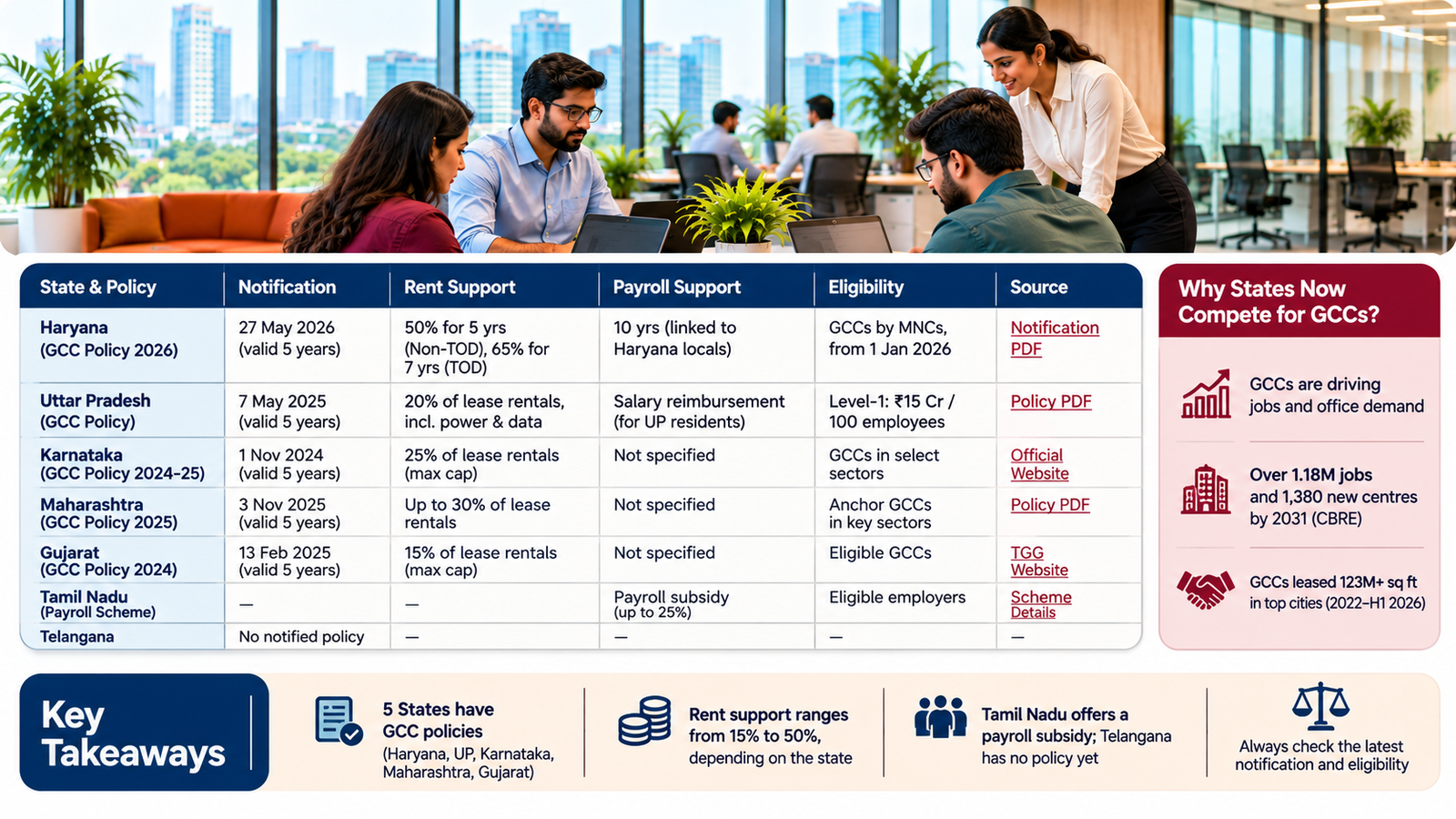
The table is dated 20 November 2026. Rent and payroll support are the two columns that move a business case, so they get the most room. Amounts are in rupees, and TOD means transit-oriented development.
| State and policy | Notified | Rent support | Payroll support | Eligibility | Source Haryana |
|---|---|---|---|---|---|
| GCC Policy, 2026 | 27 May 2026. Valid five years, or until replaced or amended. | Operating-cost support of 50% for 5 years (Gurugram non-TOD), 65% for 7 years (Gurugram TOD zone) or 65% for 9 years (other districts). Lease rentals count at up to 75% of actual rent, within valuation limits. | Employment subsidy for 10 years from start of operations, linked to the share of Haryana-local staff. Additional benefits for women, SC, Divyang and ex-servicemen. Amounts are in our Haryana guide. | GCCs set up by multinationals that start commercial operations on or after 1 Jan 2026. Our guide gives a floor of 100 employees within three years. | Notification PDF Grant Thornton alert |
| Uttar Pradesh GCC Policy | 7 May 2025. In force five years. | 20% of lease rentals, bandwidth, data centre and cloud costs, and power for 5 years from start of operations. Rent counts up to ₹50 per sq ft a month of carpet area, and the clause names plug-and-play and co-working space. Ceiling ₹40 crore a year (Level-1) or ₹80 crore (Advanced). | Salary reimbursement for on-roll staff with a year's service, domiciled in UP or in listed categories. 3 years in Gautam Buddha Nagar and Ghaziabad, 4 years elsewhere. Starts at 35% or 50% and tapers, with per-employee caps. | Level-1: ₹15 crore invested or 100 employees. Advanced: ₹50 crore or 300 employees. Higher floors in Gautam Buddha Nagar and Ghaziabad. | Policy PDF Invest UP notice Khaitan & Co note |
| Karnataka GCC Policy 2024-29 | Launched 19 Nov 2024. Policy period 2024-29. | Beyond Bengaluru only. Reimbursement based on headcount, capped at 50% of rent up to ₹2 crore. | No general payroll subsidy listed. EPF reimbursement up to ₹3,000 per new employee a month, beyond Bengaluru only. | New GCCs with 100 or more employees outside Bengaluru. | Official PDF Deloitte alert BDO alert |
| Maharashtra GCC Policy 2025 | Government Resolution of 3 Nov 2025. Valid five years. Guidelines issued 19 Aug 2026. | 10% (Zone I) or 20% (Zone II) of rent for up to 5 years, on the lower of rent paid or the ready reckoner rate. Yearly caps run from ₹1 crore (Small) to ₹4 crore (Mega and Ultra Mega). New units only, and not alongside the capital subsidy. | 40% (Zone I) or 50% (Zone II) of salary for 3 years, for Indian on-roll staff earning over ₹1 lakh a month. Caps of ₹5 crore a unit a year and ₹50,000 per employee. A 10% top-up where at least half the hires are women or persons with disabilities. | Either ₹50 crore fixed capital investment or 100 employees for the Small class. Classes rise to Ultra Mega, above ₹750 crore or 1,000 employees. | Policy PDF Operational guidelines |
| Gujarat GCC Policy (2025-30) | 11 Feb 2025. Valid to 31 Mar 2030. | 15% of eligible operating spend, which includes lease rental, for 5 years. Ceiling ₹20 crore a year (Category I) or ₹40 crore (Category II). RSM reports rent is counted up to ₹50 per sq ft a month or actual rent, if lower. | One-time support for each new local employee, up to ₹50,000 for men and ₹60,000 for women, after a year's retention. | Category I: fixed capital investment under ₹250 crore. Category II: ₹250 crore or more. | DST policy page RSM newsflash |
| Telangana No GCC policy yet | None found as of 20 Nov 2026. Reports from Sept 2026 say one is being prepared. | None specific to GCCs found. | None specific to GCCs found. | Reports say the draft would favour frontier tech such as space, semiconductors and AI, and Tier-2 towns. | Siasat report |
| Tamil Nadu Special Scheme to Promote GCCs (G.O. Ms. No. 34) | 12 Mar 2024. Runs 1 Apr 2024 to 31 Mar 2027. | None in the scheme as summarised by Cyril Amarchand Mangaldas. | 30%, 20% and 10% of payroll cost in years 1, 2 and 3, for roles costing ₹1 lakh or more a month and employees domiciled in Tamil Nadu. | Forbes Global 2000 or Fortune 1000 companies with at least 200 direct employees and no earlier structured state assistance. Capped at 50 GCCs. | G.O. listing Scheme page CAM article |
•Rent versus operating cost: Maharashtra and Karnataka pay a share of rent alone. Haryana, Uttar Pradesh and Gujarat pay a share of a wider bundle of operating costs that includes rent. Percentages from the two groups aren't like for like.
•Uttar Pradesh: the English policy PDF on Invest UP's site is marked Draft on every page, although Invest UP's own notice announced the notification on 6 May 2025 and Khaitan & Co and NASSCOM give 7 May. Ask Invest UP for the final text.
•Karnataka: rent, EPF and property-tax support are for new GCCs outside Bengaluru. Electricity-duty and internship support apply across the state.
•Maharashtra: the zone decides the rate, so check which zone a site falls in. The policy doesn't say whether the ₹50,000 cap is monthly or yearly.
•Gujarat: the ₹50 per sq ft ceiling is as RSM reports it. ICAI's salient-features deck lists lease rental as an eligible cost without a per-sq-ft figure, so check the policy PDF.
•Tamil Nadu: on 25 August 2026 the state announced a GCC corridor programme for three corridors in Chennai, with shared infrastructure and a higher floor space index. We haven't seen its rules.
CBRE's report also counts Rajasthan, Madhya Pradesh and Andhra Pradesh among the states with dedicated GCC policies, and it treats Kerala's as a draft. Delhi's cabinet approved a 10-year industrial policy in October 2026 that includes GCC incentives, according to press reports, but we haven't seen a notified text. We've left all five out until we can read the documents.
Gurgaon sits in Haryana, so this is the row most readers will use. The policy was notified on 27 May 2026 and runs for five years or until a new policy or an amendment replaces it, whichever comes first. It covers GCC units that start commercial operations on or after 1 January 2026. Grant Thornton's summary names no minimum headcount, but our Haryana guide gives one: 100 employees within three years of start.
Location sets the rate. Operating-cost support runs like this:
•Gurugram, non-TOD area: 50% for five years.
•Gurugram, TOD zone: 65% for seven years.
•Other districts: 65% for nine years.
Lease rentals sit inside that bucket. They count at up to 75% of actual rent and within prescribed valuation limits. The summary doesn't spell the limits out, and the guide puts them at 6% of the property's valuation.
The employment subsidy runs for ten years from the start of commercial operations. It's linked to the share of Haryana-local staff, with additional benefits for women, SC, Divyang and ex-servicemen. The guide sets out the amounts and the local-hire threshold.
Total incentives, together with other state and central incentives for the same project, are capped at 100% of fixed capital investment. Support for mega and ultra-mega projects is subject to approval by the Haryana Enterprise Promotion Board after a cost-benefit analysis.
For eligibility, the application route and what Gurgaon's tier means in practice, read the full Haryana GCC policy guide.
The rent support on this page pays on rent. A managed office doesn't send you a rent invoice. It sends one per-seat fee that covers the space and a lot besides. At AIHP that's fit-out, furniture, an on-site butler, daily housekeeping, AC and lighting under warranty, electricity, internet and facilities management. AIHP rents managed offices, so weigh this section with that in mind.
The texts we could check say little about that structure. Uttar Pradesh is the exception. Its lease-rental clause says plug-and-play and co-working space count, up to ₹50 per sq ft a month of carpet area. Maharashtra pays against a registered rental agreement or lease deed, and the English text of its operational guidelines doesn't mention managed, co-working or plug-and-play space. Grant Thornton's summary of Haryana's policy doesn't mention them either, and for Karnataka and Gujarat we found no statement either way.
A managed floor isn't co-working and it isn't a plain serviced office, and a clause that names one doesn't automatically cover another. Our comparison of serviced, managed and co-working space sets out the differences.
So read the rules narrowly, even though that's the less flattering reading for a provider. Don't assume the whole seat fee counts as rent. Before you sign, ask the nodal agency in writing what it will accept for an agreement like yours, what paperwork it wants, and whether the rent element has to be shown separately.
Capital subsidies raise a second question. They pay a share of the investment you make, and under a zero-capex model the provider pays for the fit-out. Ask the agency how much of it, if any, counts as yours. Our guides to zero-capex offices and total cost of occupation show where each cost sits.
If you're weighing a managed floor at AIHP, write to leasing@aihp.in with the state, the clause you plan to claim under and your start date, and ask what the agreement and invoices would show.
Free guide
Comparing a managed floor with a conventional lease? Read the Ultimate Guide to Managed Office Spaces first.

Each state has its own door. Start with the agency below and ask for its document list early.
•Haryana: file through the state's single-window system. Our GCC set-up guide says to file straight after the lease is signed, and the Haryana guide says the application must go in before commercial operations begin.
•Uttar Pradesh: Invest UP is the nodal agency, with a single-window Policy Implementation Unit (clauses 4.1.14 and 6.2). Advanced cases go to a high-level committee chaired by the Chief Secretary.
•Karnataka: Deloitte's summary describes a dedicated GCC support unit and a single point of contact for each GCC. Start there.
•Maharashtra: the Commissionerate of Services runs the policy. Claims are due within 11 months of the end of the financial year. A claim filed up to six months late loses 10%, and up to a year late loses 20%. After that it lapses. A rent claim needs proof of payment, a registered rental agreement or lease deed, a ready reckoner document and a CA certificate.
•Gujarat: applications, claims and payments run on one digital portal, reached from the GCC page. Eligible investment must fall within two years of starting commercial operations, or within two years of the expansion application for an existing GCC.
•Tamil Nadu: apply through Guidance Tamil Nadu. An inter-departmental committee reviews the case, and the Commissioner of Investment Promotion and Facilitation sanctions it.
Whichever state you pick, put the question in writing and keep the reply. Does the agency treat your kind of agreement as rent, what proof does it want, and by what date must the application be in?
Pick the two or three states that fit where your talent and clients are, then read the clause behind each headline rate. Put your questions to each agency in writing.
If Gurgaon is on your shortlist, model the Haryana column first and settle the managed-office question before you sign. Tell AIHP your headcount, your start date and the state policy you plan to claim under, using the contact page. If you'd rather see the buildings first, start with AIHP's GCC office space in Gurgaon.
•20 November 2026: First version. Seven states compared. We found no notified GCC policy in Telangana and haven't seen the rules for Tamil Nadu's corridor programme.
•Every change to a row will be logged here with its date.
Workspace10 Nov 2026 · Sarthhak Kaluucha · 9 min read
 Workspace
29 Oct 2026 · Sarthhak Kaluucha · 9 min read
 Workspace
26 Oct 2026 · Roshan Gond · 8 min read
Ready to move your team?
Managed private offices across Gurgaon, fully serviced and sized for your team.