 Workspace
22 Mar 2023 · Roshan Gond · 9 min read

Workspace

TL;DR
A satellite office is a smaller site a company runs away from its headquarters, for a local team, market or client base. How it is leased is a separate choice: managed office, coworking seats or a conventional lease. It rarely saves money against one office. Its case is against moving, over-leasing at the hub, or losing people to the commute.
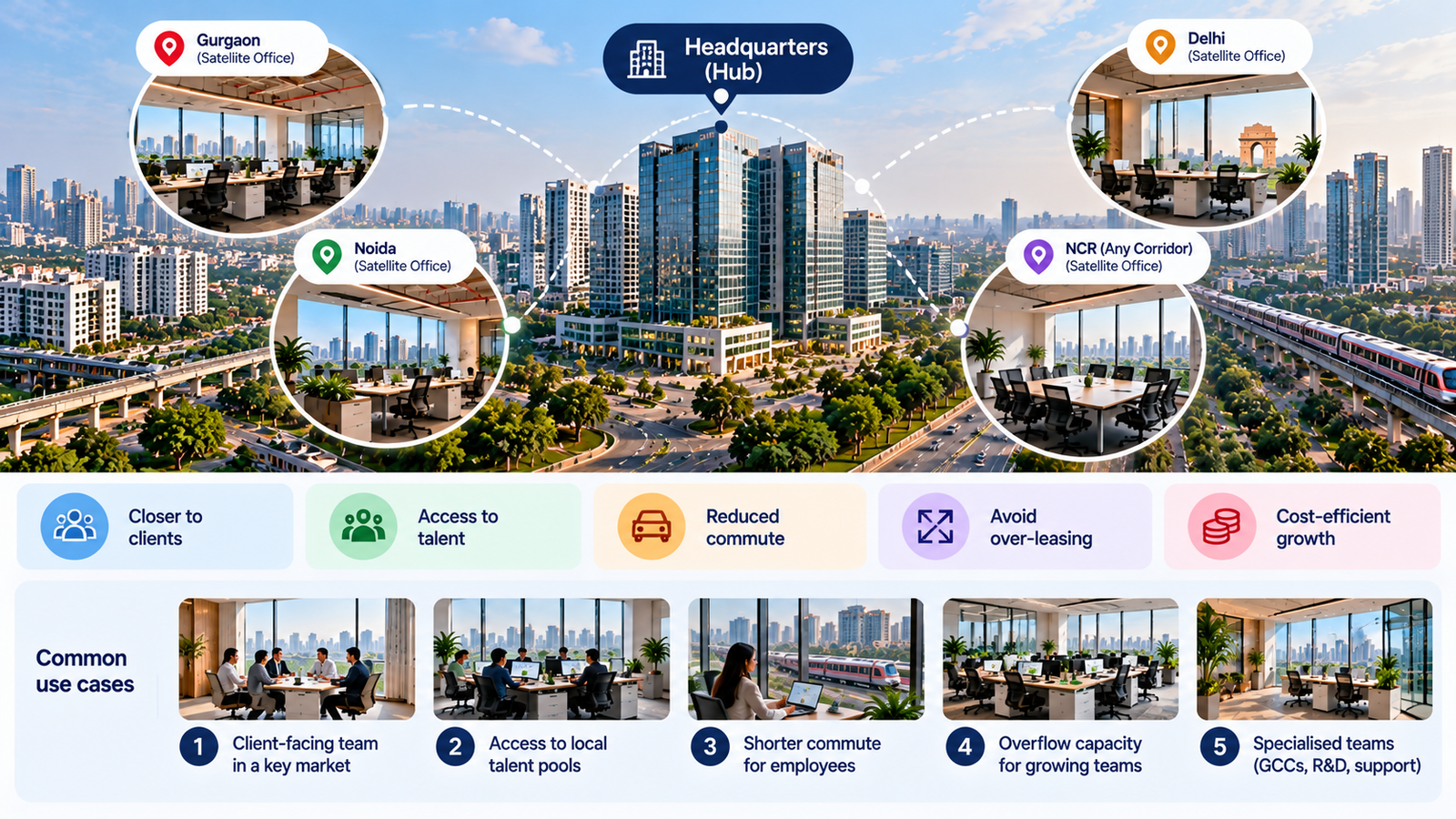
A satellite office is a smaller office a company runs away from its headquarters, staffed by a local team that reports into the main site. It exists to be somewhere the headquarters isn't: close to clients, close to talent, or closer to where staff live. How it is leased is a separate choice.
CBRE says Delhi-NCR recorded its highest-ever quarterly flex space take-up in Q2 2026. Leasing across the region splits three ways, between Gurugram, Noida and Delhi. For a satellite plan, that means deciding which of the three holds the hub.
AIHP's managed office space in Gurgaon starts at 20 seats, which suits a small satellite team. Where to put one is the first question, and best office locations in Gurgaon compares the corridors. Whether a satellite is the right move at all is another, and when to stay, add a hub or relocate covers it.
| Term | What it usually means | How it differs from a satellite office |
|---|---|---|
| Branch office | A site of the same company that carries a fuller local operation, often for a territory | The two overlap in everyday use. Where a line is drawn, a branch is a fuller operation and a satellite is smaller and supports the hub |
| Coworking space | Shared space run by an operator and rented by many companies, usually by the seat | A satellite can be built from coworking seats. The term describes the purpose, coworking describes the supply |
| Managed office | A private, fully serviced office run by an operator for one client on a fixed-term agreement | Another way to supply a satellite, with a private floor instead of shared seats |
| Remote worker at home | One person working from their own space | Falls outside the definition: there is no shared site and no local team |
| Virtual office | A business address with mail or phone handling and no working space | Falls outside the definition too, because nobody works from it |
These terms overlap, and no standard definition settles it. What the site is for decides where it sits and how you lease it, so settle that before the word.
The simplest satellite puts a small team near clients. A company headquartered elsewhere opens in Gurgaon so NCR clients deal with someone local. A close cousin holds people the hub could not hire otherwise: specialists who will not relocate and work from a small site near home, with the hub still setting the work.
The commute is a reason in its own right in Gurgaon. Commute patterns are changing where companies sit, and a company with its main office in one corridor can open a second in another so that people on that side of the city travel less. Then there is overflow: a headquarters that has run out of room adds a floor nearby instead of moving.
One AIHP client, ProcDNA, has the same two-corridor setup: an office at AIHP Cyber Greens in Udyog Vihar and another at AIHP Skyline in Sector 32.
Global capability centres (GCCs) have a version of their own. CBRE describes expansion into tier-II cities such as Chandigarh, Lucknow and Jaipur as a cost-effective hub-and-spoke model for GCCs.
In a hub-and-spoke model the hub is the main office, where leadership and most functions sit. Each spoke is a satellite closer to a talent pool, a client base or a part of the city where people live.
In Cushman & Wakefield's Q3 2026 data, Gurugram took 63% of the region's leasing, Noida 27% and Delhi 10%. Noida Expressway was the busiest submarket at 20% of the total, ahead of Gurgaon CBD at 18% and Sohna Road at 14%. CBRE's GCC research lists NH-8, Extended Golf Course Road and main Noida as the micro-markets driving GCC demand in the region.
A hub in a tight prime corridor does not tie the spoke to it. In the same report, Cyber City's Grade A vacancy was 1.3% in Q3 2026, while the grouping Cushman & Wakefield calls Gurugram Others, which includes Udyog Vihar, Sohna Road and Golf Course Extension Road, stood at 26.8%. That leaves more choice for a small team outside the tightest corridors. If your hub is in Cyber City, our guide to Cyber City alternatives covers where else to sit, and the Cyber City vs Udyog Vihar vs Golf Course Road comparison lines the three up.
To pick a spoke, ask where its people live and how often the hub needs them in the room.
Keep in the hub whatever needs the whole team together: leadership, shared services, anything that changes weekly. Put in the spoke the work that gains from being local, such as client-facing roles, a team whose hiring pool lives nearby, or people whose commute would otherwise decide whether they stay. Decide that split before you size the space.
A satellite adds a second set of overheads: a front desk, a pantry, IT, housekeeping and another lease to manage. So it rarely saves money against a single office. Its case is against the alternatives: moving the whole company, leasing a bigger floor at the hub than you need today, or losing people who will not make the commute. Price each one. The satellite wins only when one of them costs more than a second site, and we would be wary of any satellite pitch, ours included, that claims savings without saying against what.
The lease route changes the numbers. Flex vs traditional lease: the financial math works through it. With a conventional lease, ask who pays for the fit-out and the furniture. With a managed office, ask how the fit-out cost is carried in the agreement. AIHP's case studies report zero upfront capex for the fit-out.
The softer cost is coordination. Someone at the spoke has to own it, and the hub has to decide which meetings happen in person and where. A named local lead helps.
A satellite is the wrong answer when the team needs the hub in the room every day, or when the spoke would be too small to justify its own lead and lease. It is also the wrong answer when the real problem is a hub that has become too small, because a floor nearby or a move can then cost less than a second site.
•Decide what the site is for and how many people will sit there on a normal day. The per-employee space guide helps with the arithmetic.
•Choose the supply route. Coworking vs managed office compares the two on all-in cost.
•Pick the corridor with the best office locations guide and the Cyber City vs Udyog Vihar vs Golf Course Road comparison.
•Ask the exit and expansion questions before you sign. Questions 35 to 38 of the RFP template cover early termination, hand-back, adding seats and giving them back.
•Check registrations with your CA. A place of business in a different state can need its own GST registration.
•Set two measures before you open: how many days a week people use the site, and whether it is doing the job you opened it for, such as closing a commute gap or winning local clients. Review both before the lock-in ends.
•AIHP quotes 60 days to deliver a custom workspace. The 20-seat and 50-seat pages show what those sizes look like.
Read the Ultimate Guide to Managed Office Spaces
How managed offices work, what they include and how to compare them, as an e-book. Get the guide
Send your headcount, the corridor you are considering and the date you need the space through the contact page or to leasing@aihp.in.
Workspace22 Mar 2023 · Roshan Gond · 9 min read
 Workspace
30 Jan 2023 · Roshan Gond · 6 min read
 Workspace
20 Dec 2022 · Roshan Gond · 6 min read
Ready to move your team?
Fully-managed private offices across Gurgaon's prime corridors — move-in ready, fully serviced, sized for your team.